Scraping#Web scraping#Social media automation
catbus: Unified CLI and standardized JSON for 10 content platforms
catbus is a pure Node.js CLI that standardizes commands and JSON output across 10 platforms including TikTok, Bilibili, and X for human users and AI agents.
Project facts
GitHub Ecosystem- License
- MIT
- Language
- TypeScript
- Stars
- 268
- Data checked
- 2026-10-10
Snapshot figures reflect the check date and may change over time.
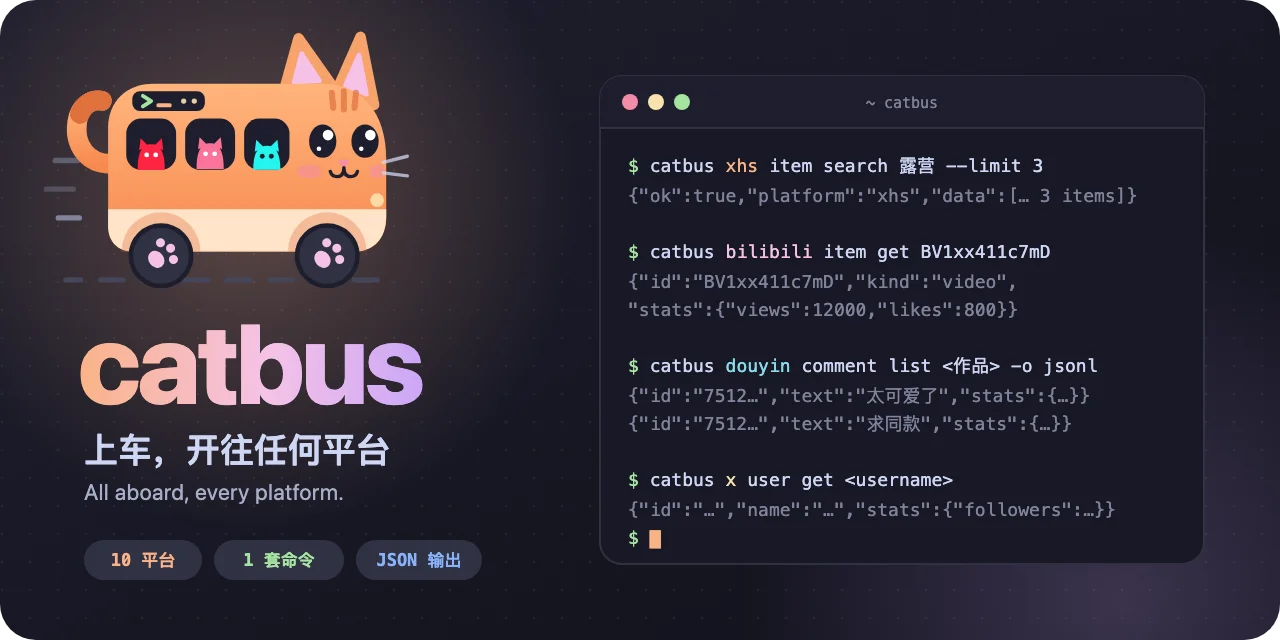
Scraping and automating content across multiple social media platforms often forces engineers to maintain separate, fragile scrapers: Xiaohongshu, Douyin, TikTok, Bilibili, Kuaishou, Weibo, Xianyu, Taobao, JD, and X all impose distinct signing algorithms, request structures, and authentication formats. catbus, an open source project created by the cv-cat team (MIT licensed, written in TypeScript, with 268 GitHub stars as of October 10, 2026), eliminates this fragmentation. Built entirely on Node.js without native build dependencies, catbus unifies interactions across 10 major content platforms under a single command-line syntax and normalized JSON envelopes, providing a consistent interface for developers and AI agents alike.
Core features
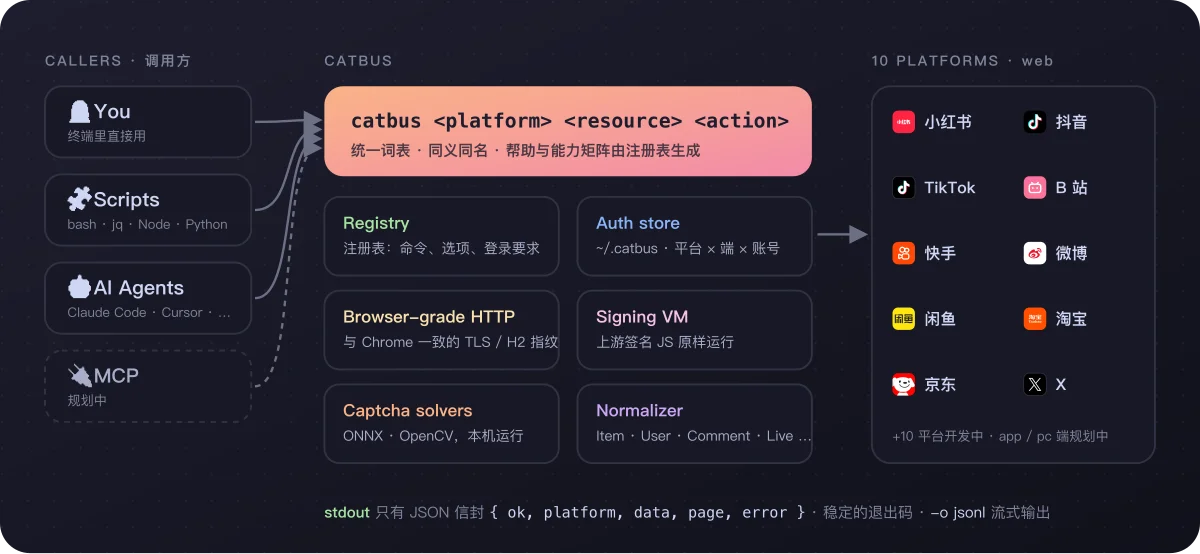
- Unified high-level vocabulary: The CLI maps identical actions to the same resource names and verbs across every supported network. Searching on Xiaohongshu, Douyin, TikTok, Bilibili, or X uses the same
item search <query>command, while posts, videos, articles, and author profiles are normalized into structured items, eliminating custom per-platform parser glue across production environments. - Pure Node.js runtime without toolchain overhead: The tool runs without requiring Python runtimes, C++ build tools, or machine-specific compilers. Precompiled bundles cover Windows, macOS, and Linux across x64 and arm64 architectures across 8 target environments, enabling simple global installation via package managers or lightweight containers.
- Browser-grade network stack and local CAPTCHA recognition: Network requests replicate authentic Google Chrome TLS and HTTP/2 fingerprints to minimize automated detection. Upstream signature algorithms execute inside isolated JavaScript sandboxes, while visual puzzle sliders and point-and-click CAPTCHAs are resolved locally through bundled ONNX and OpenCV inference models without external paid solving services.
- Local credential isolation and safety guardrails: Authentication supports QR code pairing, SMS codes, and manual cookie imports, with credentials strictly scoped by platform, client, and profile inside the local
~/.catbus/directory under restrictive file permissions. The codebase contains no telemetry reporting or remote token logging. Dangerous write actions require interactive confirmation flags, and platform-level anti-bot triggers return explicitRISK_CONTROLerror codes rather than repeating blind retry loops. - Agent-first JSON envelope architecture: All standard output streams emit pure JSON wrapped in predictable
{ ok, data, page, error }envelopes where error objects suggest the immediate next command. Commands likecatbus platforms <platform>reflect live capability matrices dynamically, and the repository includes Claude Code skill manifests and anllms.txtfile for direct integration vianpx skills add cv-cat/catbus.
Typical use cases
- Cross-platform market research and sentiment analysis: Teams building data pipelines alongside AnyCrawl can deploy lightweight scripts to track product mentions, customer feedback, and trending discussions across 10 platforms with a single normalized data structure.
- Multi-channel distribution and community operations: Content creators and social automation bots can use the CLI alongside agent interfaces like cli-anything to query comments, review performance metrics, and submit drafts without logging into multiple web dashboards manually.
- External tooling for autonomous AI agents: Autonomous coding and research agents can call the CLI as a standardized tool without needing bespoke reverse-engineering instructions for individual web endpoints.
Quick start
With Node.js 22, 24, or 26 installed on your workstation, install the CLI globally via npm and run the initial diagnostics:
# Install the catbus CLI globally
npm i -g catbus-cli

# Verify environment setup
catbus doctor

# Log in using QR code authentication
catbus bilibili auth login

# Search for content items and limit results to 20
catbus bilibili item search cat --limit 20
Switching platforms requires only replacing the platform identifier such as douyin, xhs, or x, while the remaining arguments and JSON responses retain identical shapes.
Summary
catbus is well suited for data engineers, social media developers, and agent creators seeking an automated bridge across major content networks without maintaining fragmented reverse-engineered scrapers. By verifying requests against upstream snapshots and handling anti-bot verification locally, it significantly reduces the maintenance burden of cross-platform scraping. Prospective users should remember that the project is under active development, with expanded write actions and live-streaming listeners still rolling out. Because each platform enforces its own terms and rate-limiting policies, developers should calibrate request volume responsibly to ensure compliance and prevent account restrictions.