Developer tools#MCP#Coding agent
universal-modder: let coding agents mod almost any PC game you own
universal-modder is an MIT-licensed skill pack that lets Claude Code, Codex and Cursor recon engines, read code, generate art with fal and test mods in-game.
Project facts
GitHub Ecosystem- License
- MIT
- Language
- Python
- Stars
- 5,222
- Data checked
- 2026-10-08
Snapshot figures reflect the check date and may change over time.
What keeps an AI from modding your games was never the coding — it’s that every game hides its own maze: which engine, where the assets live, which loader fits, whether anti-cheat is watching. universal-modder, an MIT-licensed toolkit by developer rehan-remade (created September 30, 2026, at 5,222 stars as of October 8), packs 11 Agent Skills, a fal MCP server and the um CLI into coding agents like Claude Code, Codex and Cursor, so they can mod almost any PC game you own: recon the engine, read the actual code, generate art and sound with fal, then verify the mod inside the running game. The part worth your stars is the knowledge base — every agent that lands a mod files a field note with the exact versions, the route it took and the traps it hit, so the next agent starts where the last one stopped instead of rediscovering them.
Core features
- One loop, twelve engine playbooks: the mod-any-game skill fixes modding into a ten-step loop — search the knowledge base, recon, set up a safe lab with saves backed up, read the real code, build one working slice, generate assets, verify in the game, record, package, write the field note — with playbooks for Unity, Unreal, Godot, Source, Bethesda, Minecraft, AoE2/Genie, RE Engine and RPG Maker among the twelve.
- A knowledge base AIs write for AIs: everything in knowledge/ is a real build log — the versions that worked, why that route, and gotchas written as symptom → cause → fix. Run
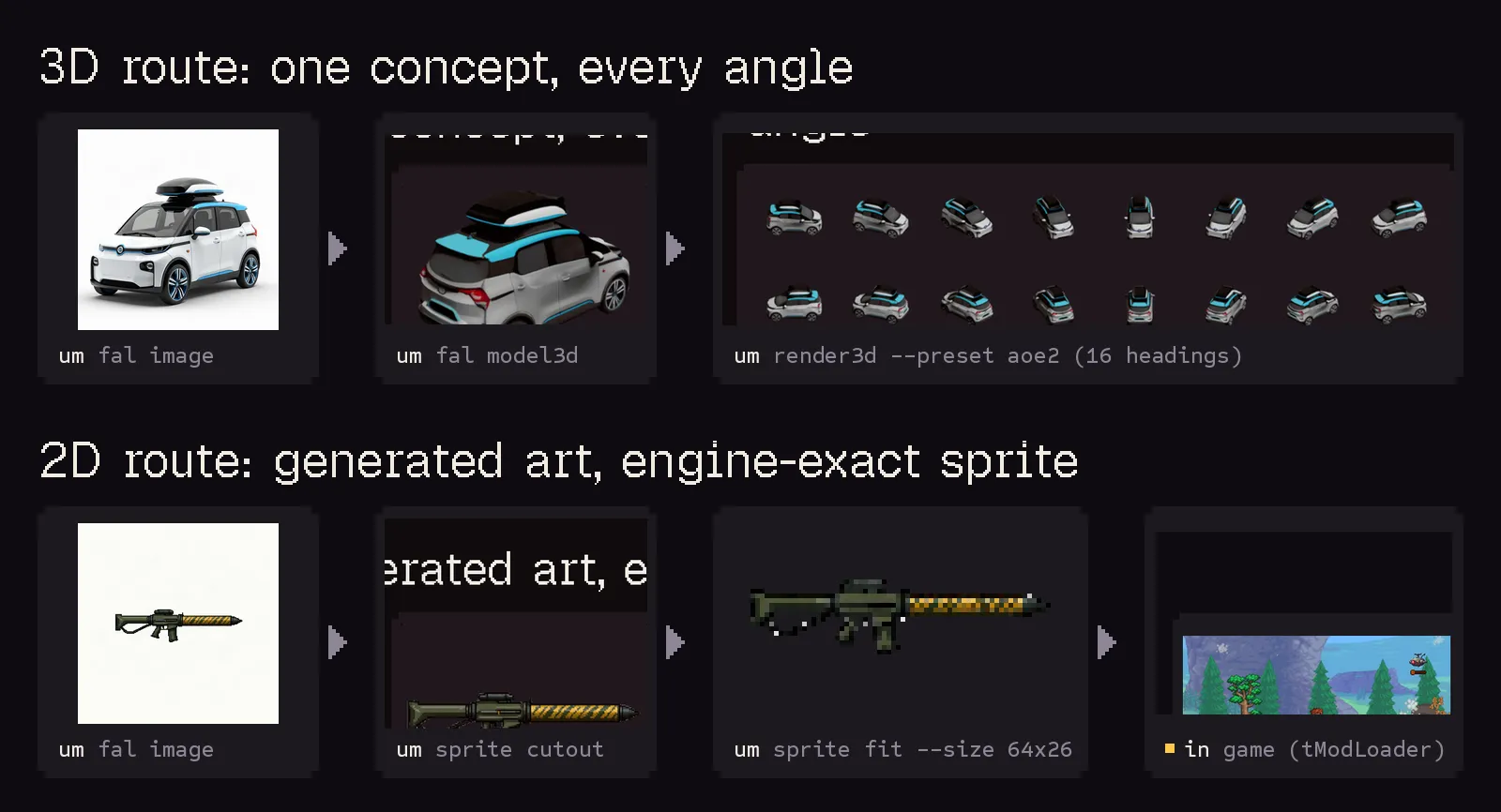
um kb searchfor prior art before you start, andum kb prafterwards to file your own note. - Full asset pipeline on fal: GPT Image 2, Nano Banana 2, FLUX, Trellis 2 and ElevenLabs produce transparent sprites, seamless textures, image-to-3D, auto-rigging, SFX and music; without a fal key,
um comfydrives a local ComfyUI for free.um render3drenders GLB models into 8- or 16-heading sprites from the game’s own camera angle with Blender. - The um CLI does the dirty work:

um scanfinds Steam/Epic/Xbox installs and fingerprints engine, version and anti-cheat;um backupsnapshots save folders;um wincaptures the game window with only the game’s audio;um publish checkblocks mods that would ship game files, decompiled code or leaked keys. - Three worked examples double as documentation: Fal Arsenal for Terraria (homing missiles, a tactical nuke, a two-phase drone mothership boss, every sprite from fal), a San Franciscans civilization for AoE2 DE (its Robotaxi unique unit rendered through image-to-3D), and real Minecraft running inside GTA V story mode — the two games trade camera and events over a local WebSocket, and Minecraft TNT blows up GTA cars.
Typical use cases
- Players who want new content in older games: you own Terraria, Stardew Valley or a Bethesda title, you can open a terminal, and you’d rather not learn another toolchain — ask for a homing missile launcher in Terraria and let the loop run.
- Mashup fans: porting content from one game into another (a Halo Warthog into Minecraft, Minecraft into GTA V) is what the mashup-mods skill exists for.
- Reverse-engineering learners: the reverse-engineering skill chains ILSpy, Ghidra, Frida and RenderDoc, and every knowledge-base entry is a worked lesson with its verification steps — sturdier material than dead forum threads.
Quick start
Two commands inside Claude Code, from the official README:
/plugin marketplace add rehan-remade/universal-modder
/plugin install universal-modder@universal-modder
You need Git, Python 3.10+ and ffmpeg, a fal key for generated assets, and Blender for 3D-to-sprite renders. Then ask “What engine is C:\Games\Foo, and has anyone modded it before?” for a recon pass, or just state the mod you want. Codex, Gemini CLI, Cursor and OpenCode each have their own install path, and any agent can take just the skills with npx skills add.
Summary
Built for players and indie developers who can drive a terminal and want their coding agent to chew through game toolchains for them; anyone hoping to cheat in online multiplayer should look elsewhere, because it refuses that outright. MIT licensed, written in Python. Know these before you start:
- It only touches games you own: the safety rules refuse to inject into online games with anti-cheat or write cheats against other players, and mods ship as code, your own assets and patches — never game files or decompiled dumps.
- Asset generation is metered: the fal models are closed commercial APIs and failed attempts cost money too; the free route is a local ComfyUI you host yourself.
- Windows first: the README says Windows games are driven natively or from WSL, so macOS and Linux users will live inside WSL.
- The repo is one week old: created September 30, 2026, already at 5,222 stars, so interfaces and folder layout will move; a mod hub for publishing and remixing other people’s mods is announced as the next step.
The pattern here — coding agents driving real software — shows up elsewhere on this site: cli-anything generates agent-ready CLIs for desktop tools like Blender, while universal-modder turns a whole game toolchain into skills. If you’d rather build worlds than mod existing games, image-blaster turns one photo into a walkable 3D scene.