Anthropic ditched git for in-house Scion as AI agents pushed merges past 30,000 a day
Anthropic replaced git with in-house Scion after AI agents pushed daily merges from 2,500 to over 30,000; seven engineers migrated the monorepo in five months.
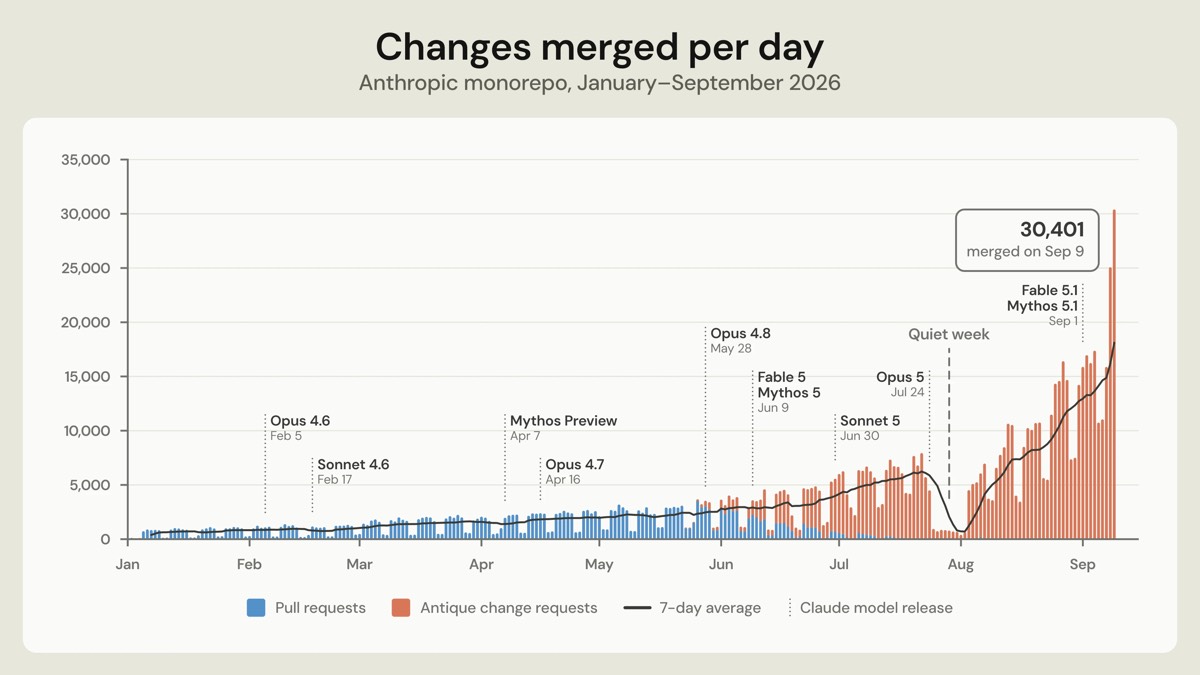
Anthropic has replaced git with Scion, a version control system it built in-house, the company confirmed in an engineering post on October 13, 2026. Seven engineers moved the entire monorepo off git in five months. The trigger was scale: daily merges grew from about 2,500 in May 2026 to more than 30,000 by September, while CI runs on the order of 25 million code checkouts every day — what the post calls the team’s biggest development bottleneck.
Key points
- A seven-person team at Anthropic built Scion and migrated the company’s monorepo off git in five months; the engineering post went up on October 13, 2026.
- Daily merges grew from roughly 2,500 in May 2026 to 30,000+ in September; fetched naively, the daily CI checkout load would mean over 600 PB of git traffic.
- Checkouts dropped from minutes to seconds, CI got about 25% of its CPU capacity back, and the infrastructure footprint shrank 200x — but Scion is not open source and not a general git replacement.
Background
The merge surge traces back to how Anthropic builds software now, not to any git regression. The post’s merges-per-day chart, reproduced by Simon Willison, marks every Claude model release on the timeline: Opus 4.6 in February, Mythos Preview in April, Fable 5.1 and Mythos 5.1 on September 1. The curve steps up after each one and peaks at 30,401 merges on September 9. Asked about the growth on Hacker News, post author Nick G. confirmed that the ability to delegate larger chunks of code to Claude took a noticeable step function up with Mythos Preview.
None of this is unique to Anthropic. We have covered the Indeed data showing US programming job postings up 15% since Claude Code launched, and Pi, the terminal coding-agent harness, clearing 111k GitHub stars. Agents writing most of the code is an industry reality now; Anthropic is simply the first to publish what that does to source control at its own scale — a main-branch history of nearly 100 GB, compressed working copies over 25 GB, and several hundred internal git mirrors at peak that still were not enough.
The facts
The checkable numbers around the Scion migration, all from Anthropic’s engineering post of October 13, 2026:
| Metric | Before (git) | Scion (official figures) |
|---|---|---|
| Merges per day | ~2,500 (May 2026) | 30,000+ (September 2026) |
| Checkout time | minutes | seconds (~two orders of magnitude) |
| CI CPU capacity | — | ~25% freed |
| Infrastructure footprint | hundreds of internal git mirrors | 200x smaller |
| Repository itself | main history ~100 GB, working copy 25 GB+ compressed | unchanged, same repo |
Scion’s write path lives entirely on the server. The unit of work is a changeset, recorded as a write-ahead-log entry — there is no push step at all. Only main and release branches keep refs, and a ref update is a compare-and-swap on a single Spanner row. The read path has three tiers: scion-daemon on each machine, a regional scion-cache, and the authoritative scion-server, all answering the same RPCs, with each tier reporting a cache hit rate above 99%. Working copies are sparse and virtualized, with files materialized on demand. Antique, the code review system built alongside, adds semantic approval constraints and a merge queue; the same five months also produced code search, per-directory IAM and automated bisect/revert pipelines — about half a dozen related systems in total.
The post is bylined Nick G. with the source control team — S.G., R.K., Dan C., Garrett H., Ben L., Colin M. and Joe P. — which it credits as a seven-person team behind both Scion and Antique. Scion was written from scratch, though the post credits Google’s Piper and Meta’s Sapling as prior art. One detail says a lot about how it was built: Claude Mythos Preview rewrote Scion’s ingestion pipeline, and the official numbers have it using 20x less memory and running 4x faster than the prototype the engineers had handwritten.
What others say
The Hacker News thread — 649 points and 617 comments as of October 14 — split along fairly predictable lines. Critics argued git was never the real problem: one called a 100 GB main-branch history “absurd” and suspected Anthropic of using git history as a message queue; a popular reply asked simply, “So… Anthropic reinvents SVN?”; others pointed out the design resembles the centralized version control that large game and 3D studios have always used.
nickg-anthropic — the post’s Nick G. — worked the thread: agents are not allowed to coordinate through source control, and “there really is tremendous growth in actual software and code being written that necessitated Scion.” He conceded that keeping agents from needlessly conflicting with each other leaves room to improve, and that Anthropic is exploring ideas there.
The sharpest independent read came from Simon Willison, for whom Scion “sounds… like a reinvention of centralized source control along the lines of Subversion.” He quotes Nick G. on why dropping offline support is an acceptable trade: “Since Claude is by far the heaviest user of Scion and is necessarily online, this just wasn’t important to do.” Willison also guesses the Fable/Mythos-class models are the key factor behind the coding-velocity surge.
Our take
Our read: Scion is not an option for you. The post says as much — “Scion is by no means a suitable replacement for git for general use” — and there is no open-source plan. Anthropic instead asks the community to improve git’s server side with server-side diff/merge RPCs, smarter negotiation, and better composition of sparse and shallow features, and offers to work with GitHub and GitLab on exactly that.
The real signal is the timeline: the team expects this class of problem to spread to more organizations over the next six to twelve months. If your CI checkout count is already in the tens of thousands a day, exhaust server-side scaling, sparse checkouts and mirror strategies before contemplating anything more radical — they are orders of magnitude cheaper. Keep a pinch of salt handy too, since every number here is Anthropic’s own account with no third party able to check it. Git is not dying; the episode reads better as infrastructure being renegotiated under agent-driven development — the same tension our Git 3.0 SHA-256 coverage flagged, with the ecosystem’s defaults up for renegotiation.