OceanBase launches OceanLake platform and open-sources OceanSeek engine
OceanBase launched its OceanLake lakehouse platform on November 24 and open-sourced the OceanSeek AI database engine under Apache 2.0.
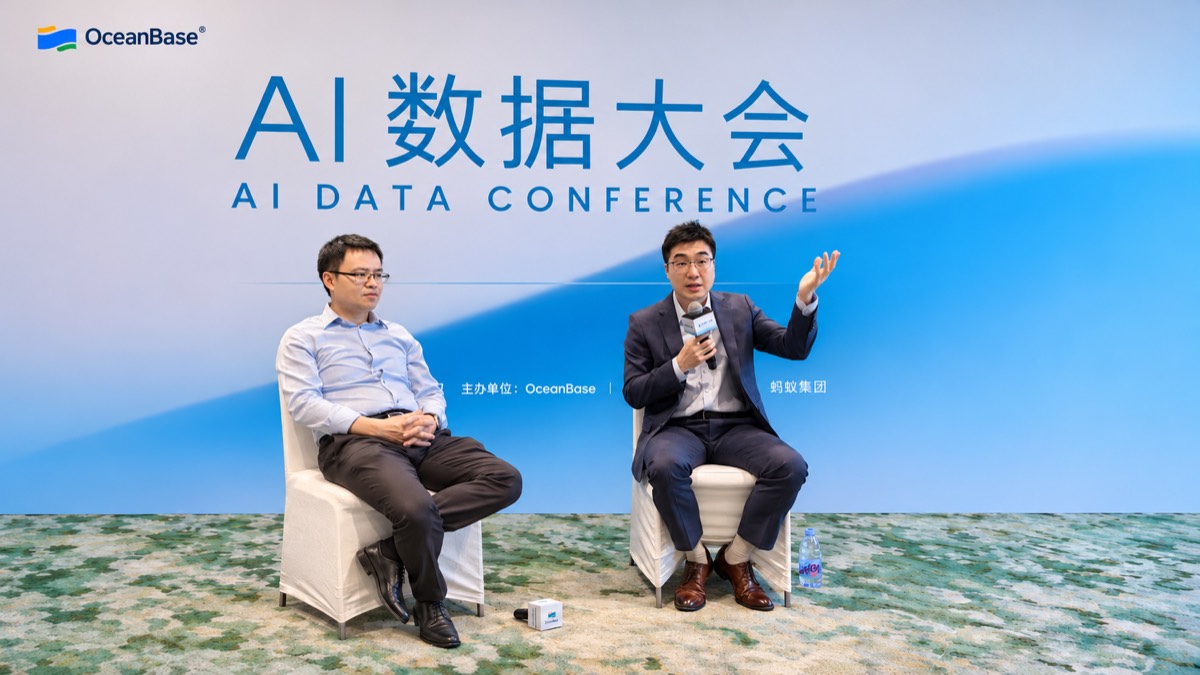
OceanBase unveiled OceanLake, a lakehouse-style AI data platform, at its AI Data Conference in Beijing on November 24, 2026, and open-sourced its core AI database engine as OceanSeek under Apache 2.0. OceanLake pairs the company’s AI database with object storage, the Iceberg and Paimon open table formats, and Spark, Flink and Ray compute engines. OceanSeek puts vector, full-text, JSON and scalar search behind one SQL layer. The official pitch has three parts: lakehouse integration, agent-friendly operation, and multimodal hybrid search.
Key points
- Hybrid search in a single statement. Scalar filtering, JSON queries, BM25 full-text search and HNSW/IVF vector search run on the same table in one query, with RRF, MINMAX_NORMALIZER and WEIGHT_SUM as fusion options.
- Isolation built for agents. Logical tables let tenants share infrastructure with logical separation; data branches create an independently readable and writable copy in seconds for incremental changes, parallel testing and rollback; table- and database-level copy-on-write sandboxes cover the rest.
- The vendor numbers are substantial. Insurance document processing rose from 60% to 97% accuracy with 78.6% fewer tokens; Xiamen Airlines’ business Q&A went from below 90% to 95–98%; Ontos automates more than 90% of ontology modeling at over 10x the speed. All are customer-scenario self-reports.
Background
OceanBase started inside Alibaba and Ant Group in 2010, became an independent company in 2020, and had already open-sourced its database kernel. What is new here is treating the AI data layer as its own product line: the distributed engine stays underneath, with lakehouse formats, compute engines and a business-semantics layer on top. In an on-stage interview with InfoQ, the company said AI revenue has passed RMB 100 million, international revenue is 15% of the total and growing 100%, and the global team is close to 100 people. Government and enterprise customers now outnumber financial ones by count, though not by revenue — management expects that to flip in 2027.
The comparison set is not traditional databases. The CEO described Databricks as converging from the other direction: Databricks moves from offline batch toward online workloads, while OceanBase moves from online transactions toward analytics and the lake. He framed Databricks as stronger in offline batch and OceanBase as stronger in real-time, online-heavy work. Ontos, the ontology layer, is positioned against Palantir: Palantir builds semantics top-down with experts, while OceanBase extracts them bottom-up from existing schemas, SQL, ETL flows and knowledge bases.
The facts
Per the official description, OceanLake’s components divide like this:
| Component | Role |
|---|---|
| OceanLake Core | The OceanBase AI database as the core engine |
| Object storage | Cold data at scale, with local SSD caching for hot data |
| Iceberg / Paimon | Open table formats, compatible with Parquet, ORC and CSV |
| Spark / Flink / Ray | Batch, streaming and Python compute |
| Ontos | Extracts business semantics from schemas, SQL and ETL |
| OceanSeek | The open-source engine, Apache 2.0, self-hostable |
OceanSeek’s README describes the engineering shape: compute, log and storage scale independently; compute can run as a single replica while persistence uses three Paxos log replicas with a stated RPO of zero; MySQL and KV interfaces (OBKV-Table, OBKV-HBase) are supported; S3-compatible object storage is the cold tier. That places it as a general engine for relational, wide-table, vector, JSON, text and spatial data rather than a dedicated vector database — the pitch is avoiding the usual multi-system assembly behind a RAG service.
The company also cites operational numbers: agent access through MCP grew about 13.36x between April and September, human page views grew about 9.86x over the same period, object-storage reads in Ant Lingbo’s multimodal pipeline fell 97% after data organization and caching changes, and data-warehouse calls in some BI-to-AI scenarios rose by an order of magnitude within half a year. OceanSeek is said to be validated in production at Ant Afu, Ant Lingguang and Alipay’s AI Pay.
What others say
The most useful material in the InfoQ interview is the admission about maturity. Ontos and DataPilot, the application-layer products, are relatively mature; the lakehouse products still trail the original database in maturity, though they have passed the stage of being considered too risky for production. That is a clearer buying signal than any benchmark: worth a trial, not yet a candidate for a core ledger system.
On multimodality, the CEO was explicit that this is a bet — “we are betting on this direction, just as we bet on distributed systems back then” — not a settled result. On competition, the company concedes Databricks is stronger in offline batch and claims the advantage in real-time, online-heavy workloads. Ontos’s bottom-up extraction lowers adoption cost, at the price of depending on how clean the existing schemas and SQL are; the interview does not go into that trade-off.
The benchmark numbers need discounting. Insurance documents, the airline Q&A and the Ant pipeline are all vendor-run customer scenarios with no third-party replication, no published dataset and no evaluation scripts. The GitHub repository ships code and documentation, not a reproducible score.
Our take
For teams building RAG or agent backends, the reason to try this is concrete: one self-hostable engine that holds relational data, JSON, full text and vectors removes the consistency work between pgvector, Elasticsearch and a warehouse. The RAG paper we covered is a typical assembly: a vector store for recall, a document store for source text, structured data somewhere else, and any unsynchronized update producing a wrong answer. Collapsing those into one SQL layer is the real engineering appeal here.
Keep it distinct from embedded analytical libraries such as DuckDB 2.0: DuckDB is in-process and file-oriented, OceanSeek is distributed and built for online mixed workloads. The honest comparison is with the Databricks-style lakehouse stack, and the deciding factor there is not the feature list but the ecosystem — Iceberg catalog compatibility, Spark version tracking, BI connectors — because those set migration cost.
Three caveats. The company itself says the lakehouse products are less mature than its database. Every performance figure is vendor-run. And what is open source is the engine; whether platform capabilities such as Ontos’s automated ontology live only in the commercial edition is not stated in the release materials. The cheapest way to check is to stand up OceanSeek and run one dataset that needs both vector and full-text retrieval, then see whether a single query covers what currently takes three systems.
What to watch
Three markers: the cadence and contributor mix of the OceanSeek community edition; whether third-party benchmarks such as VectorDBBench or TPC-style tests appear; and how well Iceberg and Paimon compatibility holds up. If catalogs and Spark versions lag, lakehouse integration stays an architecture diagram from a launch event.