OpenAI puts visual ads in image results
A US test starts this month with labeled placements beside image generations, plus a wider ad-measurement partner ecosystem.
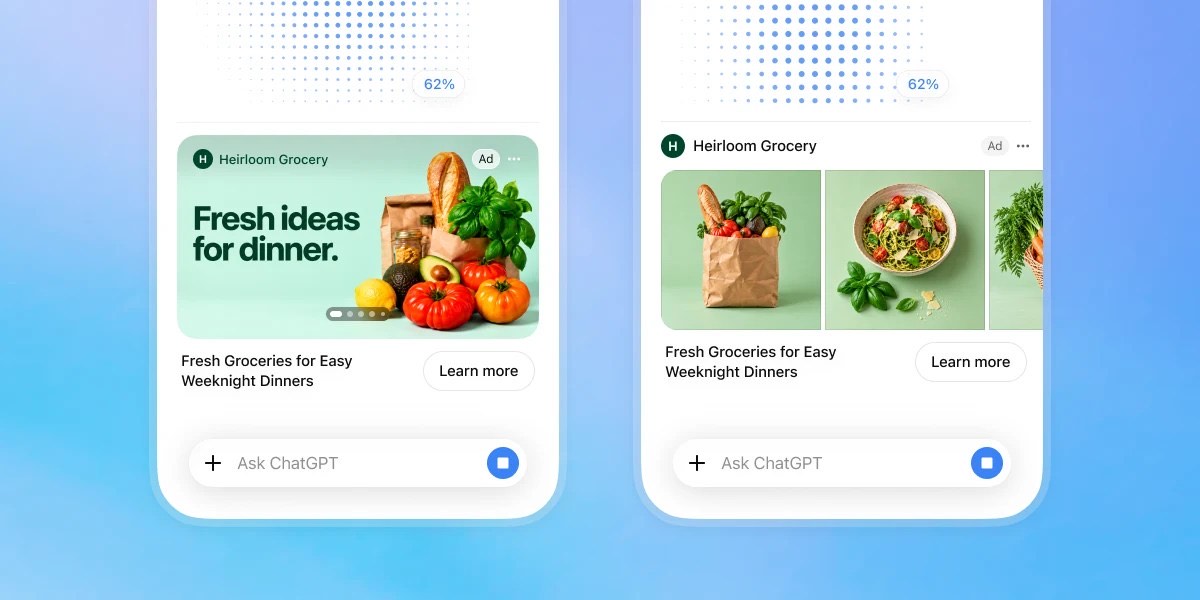
TechCrunch reported on October 5 that OpenAI will show visual display ads alongside image-generation results in ChatGPT — when a user asks the model to generate an image, related product ads appear next to the output. The company says ads will be “clearly labeled and won’t influence the answers ChatGPT provides”; a US test starts later this month with an initial group of advertisers, eventually reaching ChatGPT’s 1.2 billion weekly users. Alongside the format, OpenAI is expanding its ad-measurement ecosystem: click-attribution partners AppsFlyer, Adjust, Branch, Singular, Kochava and Tenjin, full-funnel partners Fospha, Measured and INCRMNTAL, geo-experiment support from Haus, Measured and WorkMagic, and brand-suitability pilots with DoubleVerify and Integral Ad Science.
The business model’s next step
ChatGPT ads launched earlier this year to support free and low-cost tiers, expanded to India in August, and now reach generation — the highest-frequency, closest-to-purchase action in the product. The Information reports OpenAI is simultaneously moving to help advertisers measure impact, which is the part that turns placements into spend. Image generation is a natural shopping-intent surface: an ad for groceries appearing beside “weeknight dinner ideas” has a shorter path to conversion than any search sidebar. The 1.2 billion weekly users make the inventory arithmetic trivial even at modest fill rates — and the measurement buildout is what turns an experiment into a budget line. OpenAI’s blog frames the format as showing “product inspiration, how a product is used, or the experience associated with a service” — advertising as content.
Experience versus subscription
TechCrunch flags the delicate part: ads may degrade the experience — which may be intentional. The more the free tier degrades, the stronger the pull toward paid subscriptions; ads are simultaneously revenue and pricing strategy. The competitive backdrop is Meta’s free Muse agent competing for engagement and the leaked $8 billion operating loss — “AI without ads” is becoming a transitional form.
Inside the official design
From the blog post and mockups, the ad unit sits beside the generated result with an “Ad” chip and carousel cards, and OpenAI stresses that ad selection is based on conversational intent rather than the sale of conversation contents — a distinction that is simultaneously the compliance shield and the future controversy: intent comes from the conversation, money comes from intent, and where that boundary lands depends entirely on execution. Brand-suitability and geo-experiment tooling shipping together says OpenAI is working through the checklist of a mature ad platform — attribution, funnel, geo testing, brand safety — before asking budgets to move.
Why measurement comes first
Ad-platform history says formats are easy and measurement is hard: budgets move only when returns are computable. OpenAI lining up six click-attribution partners, three full-funnel partners, three geo-experiment shops and two brand-safety vendors at once is an admission that ChatGPT inventory intends to sell at mature digital-ad standards, not at new-channel experiment discounts. It also explains why “won’t influence the answers” arrived so early — a platform without an independent measurement ecosystem could never afford the trust cost of that sentence.
Generation is the channel now
Free and low-cost tiers are the battleground for this commercialization push — ad revenue maps directly onto the compute bill. For the industry, this closes the loop on “conversation as channel”: from answer sidebars to image results, AI ad inventory now covers the generative act itself. For advertisers, the new problem is measurement — the length of the attribution-partner list signals how seriously OpenAI is preparing for brand budgets to migrate. For users, what to watch is the execution of “clearly labeled”: the boundary between ad and content sits closer to the output in generation than it ever did on a search page. There is also an immediately checkable tell once the US test starts: whether free-tier image generation quality or speed shifts perceptibly — if ad slots start competing for compute, the “won’t influence the answers” promise will need an asterisk.