Walmart opens Agent Gateway to Meta's Muse, letting agents check out under a spend cap
Walmart opened Agent Gateway to Meta's Muse on Nov 23: agents get a profile, spending cap and per-order approval, and check out at Walmart.com prices.
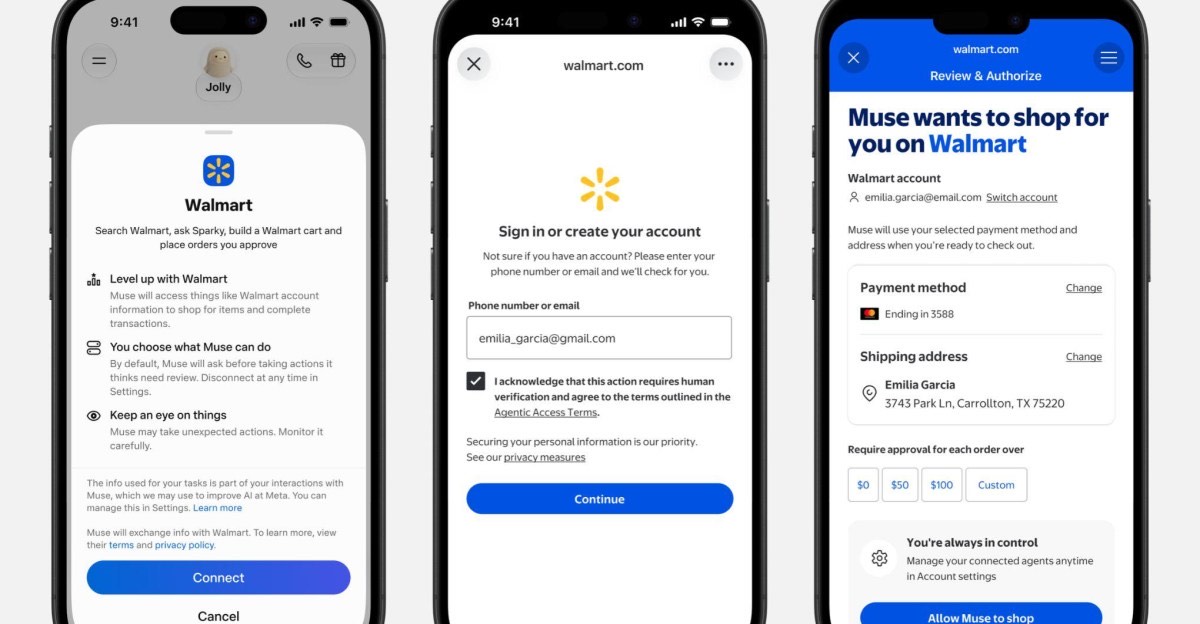
Walmart said on November 23 it would open its Agent Gateway to Meta’s shopping agent Muse, letting Muse users search Black Friday deals, build a cart and check out on Walmart’s own site. Agent Gateway is the MCP-based interface Walmart announced on October 21, built so approved AI agents can skip the human-facing web page and use a structured channel instead; It is the gateway’s first live rollout since Walmart announced it in October. The Verge reports that Walmart told the outlet after publication the launch had slipped 24 hours, so Muse shopping is set for November 24. Shoppers pay the same prices they would see on Walmart.com.
Key points
- Agent Gateway is an MCP-based beta announced October 21, with a developer entry point at walmart.com/agents; Muse is the first live consumer agent, and Walmart described it to Unite.AI as “an early beta with invitation-only access that may be suspended at any time.”
- The first time an agent shops, Walmart creates a dedicated Agent Profile linked through the customer’s Walmart sign-in; only Walmart can see it. Shoppers choose per-order approval or a spending cap — Walmart’s examples are $50, $100 and $200 — and the agent cannot view, add or change a payment card.
- Agents see the same prices as Walmart.com. Walmart’s line is “We price products, not people”; returns apply “including when an agent doesn’t act as intended,” and non-compliant agents get blocked from the site. Walmart did not disclose how many agents are connected or any transaction figures.
Background
The previous act was Amazon closing the door. Since September 20, anyone trying to buy through Muse on Amazon has hit a page saying continued access by an unauthorized AI agent violates Amazon’s Conditions of Use. GeekWire reported that Amazon first asked Meta to pull Amazon out of Muse’s shopping experience, and the wall went up after Meta declined. We covered the standoff and Walmart’s counter-move on November 1 in Amazon walls out Muse while Walmart opens Agent Gateway. At that point Walmart had only announced the interface and said Agent Profiles would arrive “in November”; this week it actually ran.
Agentic commerce has split into two tracks this season. On the merchant side, Shopify opened its checkout, Shop Pay included, to browser-based agents on September 28, then dropped its allow-list on October 13. On the platform side the poles are opposite: Amazon blocks, Walmart admits. On the assistant side the model is payment tokens: ChatGPT Wallet launched November 13, with a Face ID check on every purchase and card numbers that never reach the agent or the merchant. Walmart’s gateway sits inside a merchant’s checkout and works only on its own shelves; OpenAI’s wallet sits on the assistant side and uses card-network tokens across merchants. The two designs draw the trust boundary in different places, which matters below.
The facts
Walmart’s published Agent Gateway breaks into four parts: access, authorization, payment and enforcement. Access runs over MCP, so agents stop pretending to click a web page. Authorization lives inside the customer’s own Walmart account. The customer designates payment, and the agent only triggers checkout. Enforcement rests on terms, caps and blocking. Cross-checking Walmart’s October 21 blog, its November 19 Q3 earnings release, and The Verge and Unite.AI on November 23 gives the following verified details:
| Item | How Walmart’s Agent Gateway handles it | Source and date |
|---|---|---|
| Interface | MCP-based beta for companies and developers, entry point at walmart.com/agents | Walmart blog, Oct 21 |
| Agents | Muse is the first live consumer agent; Walmart had already sold through Muse, ChatGPT, Gemini and others via conversational commerce | The Verge, TechCrunch |
| Profile | Agent Profile auto-created on first agent purchase; linked via Walmart sign-in; only Walmart sees it | Walmart blog, Oct 21 |
| Spend control | Per-order approval is the default, or a cap ($50, $100, $200 in Walmart’s examples); Walmart may require extra approval | Walmart blog, The Next Web |
| Payment | Agent cannot see card numbers or add/change payment methods; customer designates payment, and Muse checks out with a card saved to the Walmart account | Walmart blog, The Verge |
| Pricing | Same prices as Walmart.com; offers and fees shown before purchase; “We price products, not people” | Walmart blog, The Verge |
| Returns | Walmart’s returns process applies, including when an agent does not act as intended | Walmart blog |
| Enforcement | Agents must not exceed shopper intent and may use only task-necessary data; violators are blocked from the site | Walmart blog |
| Timing | Announced November 23; delayed 24 hours; available November 24 | The Verge, Nov 23 |
One distinction deserves its own paragraph: an agent that can order is not an agent that can pay. Muse performs the checkout, using a card the customer already saved to the Walmart account; the card number never enters the conversation and never reaches the agent. The customer designates the payment method inside the Agent Profile, and the agent cannot add or swap a card. What the shopper authorizes is “this agent may spend this much on my behalf,” not “this agent holds my payment instrument.” Walmart compares it to adding a cardholder: set a limit, watch the activity, revoke access.
Walmart disclosed no agent count and no transaction data. Unite.AI calls the gateway an invitation-only beta that may be paused at any time; Walmart’s own blog only says Agent Profiles arrive “in the next month” and makes no volume commitment. The Verge’s report likewise carries no agent count or sales figure. For a story about agentic commerce entering its “how do we govern it” phase, that is exactly the number a reader wants and does not get.
What others say
Walmart frames the opening as a start. The Verge quotes Walmart saying Muse support is “just the beginning,” with more agent and app shopping experiences “on the way.” The blog’s language — “We price products, not people,” the cardholder analogy, the emphasis that “only Walmart sees this” — is meant to sell a controlled on-ramp, not an unconditional welcome. Unite.AI adds a distinction The Verge leaves out: inside the gateway, an agent can check out autonomously within the guardrails the shopper set, though Walmart may still demand extra approval; outside the gateway, every agent checkout needs a human to approve it.
The counterpoint comes from the blocked side. The Verge notes that both Amazon and eBay have barred AI agents, while Walmart presents itself as the more open option. Amazon’s earlier public position was that third-party apps buying from other businesses on a customer’s behalf should operate openly and respect whether a service provider chooses to participate; applied to Muse, that meant asking Meta to remove Amazon first, then posting the block page. Two of the world’s largest retailers looked at the same agents and answered oppositely, and each answer maps onto its own revenue structure.
Meta did not offer a public statement on the opening, and The Verge’s report contains no Meta comment. What can be confirmed is Walmart’s side of the story plus the flow Muse actually shows: sign in to Walmart, create a profile, set an approval threshold, allow Muse to shop. For readers, that leaves “what Meta thinks” blank; Walmart’s framing should not be read as a shared position.
Our take
For teams building shopping agents, the value here is not “another channel” but a productized authorization model. Agent Profile, per-order approval, spending cap and a kill switch used to be scattered across Shopify’s checkout terms, OpenAI’s wallet design and assorted platform agreements; Walmart is the first to pull them into a merchant-side interface and state plainly that the agent cannot see card numbers. Teams integrating with Walmart now face engineering questions: how to express “this order needs a human” inside MCP, how to retry after a cap is hit, how to sync returns and disputes back into the conversation. There is no documentation template for those; each merchant will negotiate its own.
For merchants and marketplace sellers, price parity is the loudest signal. Walmart says agents see the same prices as people, with offers and fees shown before purchase. If that holds, agent comparison shopping will not route around Walmart’s pricing. But it leaves two questions unanswered: whether third-party marketplace listings are covered on the same terms, and whether a seller can opt out of agent traffic. Advertising and ranking are not mentioned either. When an agent picks products for a person, do sponsored placements still enter the candidate set, and who audits the reasons behind a recommendation? Walmart’s blog is silent. Those gaps decide whether “same price” is a durable rule or a beta-era promise.
For ordinary shoppers, the honest read is that these controls are sturdier than handing an agent your password, but this is still an invitation-only beta. The caps are coarse — $50, $100 and $200 will not fit every household — and per-order approval may turn into approval fatigue during Black Friday; there is no data yet. The returns policy says it covers cases where an agent does not act as intended, but how a dispute is proven and how long it takes will be tested by the first real orders.
Set next to OpenAI’s approach, the split is clear. Walmart’s gateway is merchant-side, scoped to its own shelves, and pays with a card saved to the account; ChatGPT Wallet is assistant-side, uses card-network tokens across merchants, and requires Face ID per purchase. The first suits “I want to buy at Walmart”; the second suits “I don’t want to authorize every merchant separately.” The same authorization logic is appearing in finance: major US banks rewrote their online-banking terms to treat third-party AI agents’ actions as the customer’s authorization, and like Walmart, they are settling who authorizes and who bears the risk before opening the door. Both converge on one conclusion: an agent may initiate payment, but should not hold the payment instrument. The real contest is not who is more open, but who can make authorization, limits, returns and disputes add up.
What to watch
November 24, when Muse goes live on Walmart, is the first checkable date; Black Friday and Cyber Monday (November 27 and 30) should produce the first real orders, approval rates and return data. Walmart says more agents and apps are “on the way” but gives no list or timeline — watch whether ChatGPT and Gemini land in the same gateway. The third number is disclosure: connected agents, sales, dispute rates. Walmart has published none, and only a holiday-quarter update would show whether the model works. Last is the merchant side: whether third-party sellers can opt out, and how ads enter an agent’s candidate set. Those answers will say more about where Walmart wants agentic commerce to go than the word “open” does.