Coding#Open source#Agents#Coding agent#UI design#Frontend development#Design system#Agent Skill
impeccable: 24 design commands and a 61-rule detector for AI-built UIs
Paul Bakaus's open-source design skill gives coding agents 24 named commands and a 61-rule detector that catches AI-slop UI tells without an LLM or API key.
Skill details
npx skills add pbakaus/impeccable --skill impeccable
Ask your agent to “make the UI look better” and you get “I’ve refined the visual hierarchy” — and the same page as before. impeccable is an open-source frontend design skill by Paul Bakaus, the creator of jQuery UI. It builds on Anthropic’s frontend-design and turns that vague request into 24 commands you can name, plus a detector that runs without a model, giving coding agents like Claude Code an actual process to follow. As of September 28, 2026, the Apache-2.0 repo counts roughly 72,000 stars on GitHub.
Design work as commands
Everything runs through /impeccable <command>. init records the product’s audience and purpose in PRODUCT.md before any pixels move; document reverse-engineers a DESIGN.md from existing code. From there you name the intent: polish for the final pass, audit for accessibility and responsive checks, harden for error states and i18n, bolder and quieter to turn intensity up or down, distill to cut, live to iterate on individual elements in the browser. Each surface is first assigned a mode — landing pages Persuade, dashboards Operate, docs Read — and judged by different standards accordingly. The skill also bounds self-review: one batched inspection round, one fix pass, at most one confirmation round, then stop.
The detector skips the model
Those 61 rules run in a CLI and a browser extension that ship with the skill — no LLM calls, no API key. Purple-blue gradients, cards nested in cards, gray text on colored backgrounds, bounce easing, plus generic issues like overlong line lengths and small touch targets are all in scope. npx impeccable detect scans a directory, a single HTML file or a live URL, and --json output plugs into CI. On Claude Code, Codex and Cursor, an installed hook rescans UI files after every edit. The README offers its own caveat: a clean scan is evidence, not proof.
The official case study
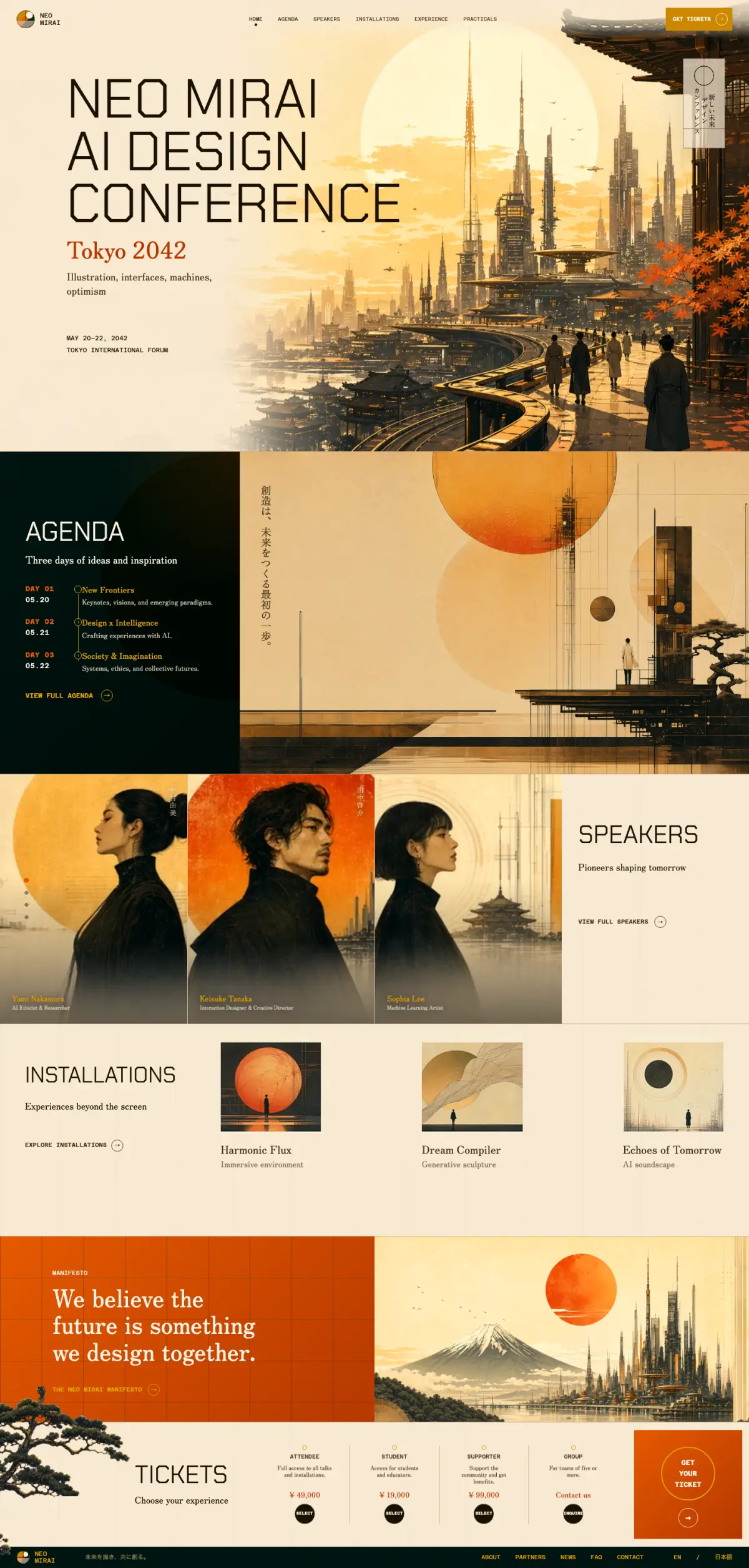
Neo Mirai on impeccable.style shows the comp-first path: two GPT Image references — a page mockup and a brand toolkit — built into a working, responsive conference site with real navigation, carousel and hover states. The full page:
Who it’s for
If you ship agent-built interfaces and keep hand-fixing the template look, this earns its install. Two steps to start: npx impeccable install in the repo, then /impeccable init in your agent. Three things to know first: the launcher downloads an engine binary into ~/.impeccable/bin/ on first run; on Claude Code the hook runs independently of model-tool approval, and the README suggests reviewing hooks before unattended sessions; and 24 commands is a wide canvas — give each task a concrete goal (“fix the signup form’s error messages”) or the polishing can wander. Cursor, Gemini CLI, GitHub Copilot and a long list of other tools are supported.