Developer tools#Security scan#Agent routing
Claude-BugHunter: 83 bug-hunting skills for Claude Code
Claude-BugHunter is an MIT-licensed Claude Code bundle: 83 bug-hunting skills across 24 vulnerability classes, with scope gates and report templates.
Project facts
GitHub Ecosystem- License
- MIT
- Language
- Python
- Stars
- 14,246
- Data checked
- 2026-11-21
Snapshot figures reflect the check date and may change over time.
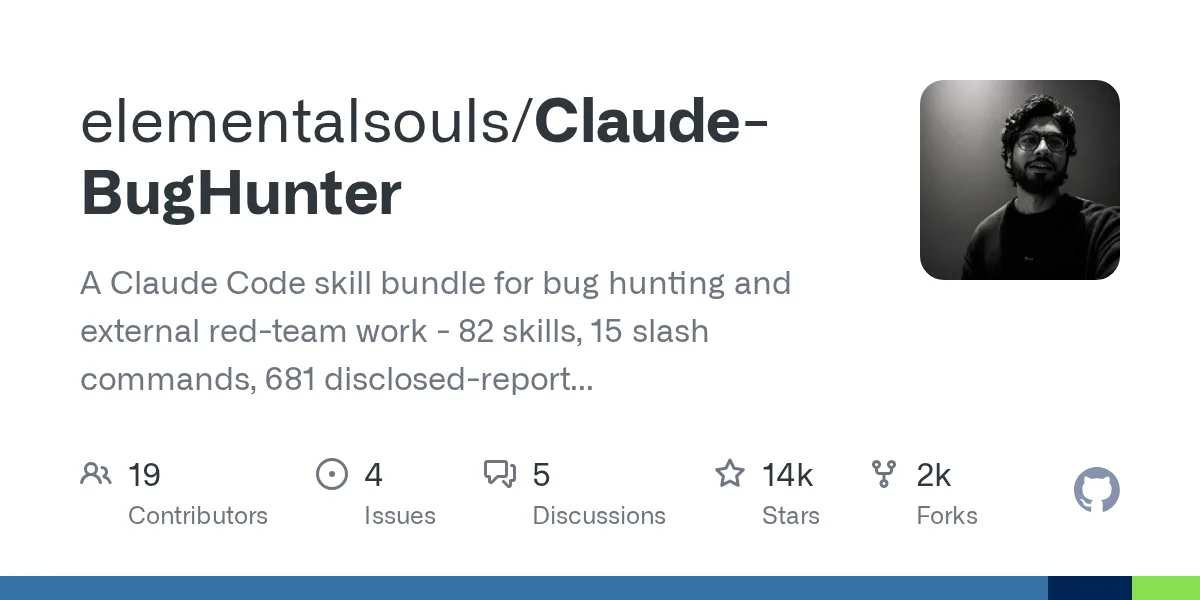
People doing authorized security work usually have the tools; what goes missing between engagements is the discipline: read the scope first, map the surface, pick a hypothesis per bug class, then run it past a validation gate before writing a word. Claude-BugHunter turns that routine into 83 Claude Code skills plus a deterministic recon engine that does not need a model to run. The repository, elementalsouls/Claude-BugHunter, was created on 2026-05-05 and had 14,246 stars and 1,699 forks under the MIT license on 2026-11-21.
Key points
- Size and shape: 83 skills under
skills/and 15 slash commands undercommands/. The README groups them as 58hunt-*bug-class skills, 10 enterprise-platform skills, 6 reporting and validation skills, 5 recon and OSINT skills, and 4 methodology skills. The repo description still says 82; the directory and README say 83. - The model is not the default driver:
engine/uses plain Python for recon and endpoint classification, maps each endpoint, parameter and bug class to a specific skill, and attaches a runnable curl. Anything that spends model tokens sits behind an explicit--huntflag. - Scope is enforced in code:
engine/scope.pyis a default-deny allowlist with deny-wins semantics, checked at recon and again at validation. Agents the engine dispatches are read-only by default; state-changing tests require--allow-intrusive.
| Item | Value (checked 2026-11-21) |
|---|---|
| Stars / forks | 14,246 / 1,699 |
| Contributors / open items | 19 / 9 |
| License | MIT; LICENSE-CONTENT puts skill text, wordlists and docs under CC BY 4.0 |
| Primary language | Python |
| Created / last push | 2026-05-05 / 2026-11-20 |
| Skills / slash commands | 83 / 15 |
| Releases | Only v2.0 (2026-05-25) and v2.1 (2026-06-05); development happens on main |
Core features
The bundle has three layers: skills that say what to look for, an engine that maps the surface and ranks it, and a gate that keeps unproven findings from reaching a report.
- Topic-triggered loading: skills match on the
descriptionfield in theirSKILL.mdheader, so describing what you are testing pulls the relevant one in by name-free association. That is Claude Code’s own skill mechanism; the bundle adds no dispatcher of its own. - One skill per bug class: the 58
hunt-*skills cover XSS, SQLi, SSRF, IDOR and request smuggling through OAuth, SAML, JWT, Spring Boot, SharePoint and CI/CD. Each carries detection patterns, payloads, bypass tables and chain templates. The catalog indocs/skills.mdalso counts disclosed reports per class:hunt-xsscites 174,hunt-misc225, whilehunt-llm-ai,hunt-rag-vector,hunt-nextjs,hunt-ldapand six others sit at 0. - The seven-question gate:
triage-validationasks whether the issue reproduces with a real HTTP request, whether the impact is on the program’s accepted list, whether the asset is in scope, whether it needs privileges an attacker cannot get, whether it is already known behavior, whether impact can be proven rather than asserted, and whether it is on the never-submit list. One no kills the finding.evidence-hygieneadds a redaction pass before any screenshot. - Deterministic orchestration:
engine/recon.pymines endpoints out of JS bundles, scans for hard-coded keys (AWS, GCP, Anthropic, OpenAI, Slack, GitHub, Stripe and others, redacted on output), and collects parameters from two independent sources,gauhistory and a livekatanacrawl.state.json,evidence/,arsenal.mdandreport.mdmake an engagement resumable. - Multiple targets, with a caveat:
/autopilotaccepts atargets.txt, one domain per line, and the engine defaults to 3 parallel agents. The/autopilotdocumentation still tells you to start a fresh session per target, because findings and stack assumptions from target A bleed into target B; switching mid-session needs/pickupto reload context. - Burp and HackerOne are optional:
cbh --burproutes CLI traffic through a Burp proxy, and conversational hunting needs the MCP Server extension from Burp Pro’s BApp Store (Java, default127.0.0.1:9876). A HackerOne API user and token only unlock private programs and your own reports; public scope and duplicate search work without them.
Where the limits are
This is a collection of methodology and report templates, not something that can be pointed at an arbitrary host and fired. The author puts the boundary in SECURITY.md: use it on assets you own or have written authorization to assess — in-scope bounty assets, a signed pentest engagement, CTFs, your own labs. Weaponized 0-days, post-exploitation and persistence, C2, evasion and mass unauthorized scanning are excluded by design; internal Active Directory, lateral movement and Kerberos chains are listed as a future, separate bundle.
A more practical limit comes from the model side. The README states that Anthropic’s runtime safeguards block “vulnerability exploitation or offensive security tooling development” requests by default. On Opus 5, exploit generation, binary-based vulnerability scanning and penetration testing fall back to Opus 4.8 instead of being refused; there is a notice and the reply is labelled with the answering model, but in a long agentic run that is easy to scroll past and looks like the model got worse. The author’s advice is to apply for the free Cyber Verification Program rather than reword an offensive engagement to look defensive. Installing the skills does not guarantee the model will comply, and that is worth knowing before the feature list.
Typical use cases
- Starting a bounty program:
hunt <program>scaffolds an engagement folder; open Claude Code inside it, have it read the program scope, then run recon and surface ranking. The folder layout andCLAUDE.mdare generated, so there is no manual setup per target. - A first practice run: the usage guide says to start on OWASP Juice Shop, Acunetix’s testphp.vulnweb.com or Hacker101 rather than a live bounty target. None of the three needs an authorization conversation.
- External enterprise red teaming: the M365/Entra, Okta, vCenter, SSL VPN and SharePoint skills carry 2024–2026 CVE chains and post-credential escalation paths. That layer is the main difference from a pure web-vulnerability pack.
- Writing the report: VRT mapping, HackerOne, Bugcrowd, Intigriti and Immunefi templates, plus out-of-scope rebuttals, live in
report-writingandbugcrowd-reporting.
What others say
Most of the attention never turned into discussion. The Show HN post from 2026-05-20 was still titled “574 Report Patterns” and, as of 2026-11-21, had 1 point and one comment (“Nice!”). Reddit has no thread on it that search can find. The 14k stars look more like GitHub’s own recommendations and aggregator reposts than the result of a community argument. That is not unusual for security tooling, but it means outside validation is thin and the reader has to supply the judgment.
The substantive feedback sits in the issue tracker, and it lands on exactly the two pieces that matter most. PR #182, opened 2026-11-19, shows that on main, out-of-scope rules written as host:port, a URL with a scheme, a host with a path, a host with a trailing dot or comma, or an IPv6 CIDR match no host at all; the deny rule is skipped without an error and the host falls through to a broader in-scope rule and gets tested. Issue #196, filed 2026-11-20, shows cbh triage answering yes to question 3 whenever the text contains the word “scope”, including “possibly out of scope”, and missing clickjacking for question 7. Neither is merged into main yet.
The industry pressure runs the other way. According to Analytics Insight on 2026-10-07, Google stopped accepting new OSS VRP product vulnerability submissions on 2026-10-01, citing a surge in automated reports that were mostly invalid; curl ended its HackerOne bounty at the end of January 2026 after receiving seven submissions in one week, none of them real. For a tool that helps draft reports, that is the direct question: generation speed is not the bottleneck, credibility is, and credibility comes from gates and scope discipline rather than more skills.
The author makes the least flattering case in engine/README.md: on benchmarkable tasks the skills added about zero capability and cost 12–15k tokens per agent to load, so the leverage is a safe, deterministic, skill-routing engine with the operator in the loop. It reads like self-deprecation and is also the most useful design note in the repo.
Quick start
The plugin route is the README’s recommendation. Skills and commands load with a claude-bughunter: prefix and nothing is copied into ~/.claude/:
/plugin marketplace add elementalsouls/Claude-BugHunter
/plugin install claude-bughunter@elementalsouls
Pin to a commit, or use the hunt scaffolder and the cbh CLI, with a clone:
git clone https://github.com/elementalsouls/Claude-BugHunter.git
cd Claude-BugHunter
bash scripts/install.sh          # Windows: pwsh ./scripts/install.ps1
pipx install git+https://github.com/elementalsouls/Claude-BugHunter   # optional: cbh CLI
Check the prerequisites first; the three modes need different things:
| Mode | What you need | Good for |
|---|---|---|
| Curl-only | Python 3.9+ | Fast recon, scripted runs |
Burp proxy (cbh --burp) | Burp Suite Pro or Community | Keeping every request in Burp history for replay |
| Burp MCP | Burp Pro, the BApp Store MCP Server, Java | Driving Repeater from inside the conversation |
You also need a paid Claude Code plan (Pro, Team or Max) or an API key with credit; free Claude.ai does not include Claude Code. After installing, describe the asset you are testing and the matching skill loads. To check the install, run hunt with no arguments; it should print usage.
Summary
Claude-BugHunter is for people already doing authorized testing who want the routine — scope, surface, hypothesis, gate — fixed in place, and for teams onboarding someone who needs a path to follow. It is not for anyone looking for a one-click button: nothing here decides for you, and nothing here grants authorization. You still choose what to test and when to stop.
The license is MIT, with skill text and docs under CC BY 4.0; it is written in Python and had 14,246 stars on 2026-11-21. It is close kin to reverse-skill, which we covered in September: both install security skills into a coding agent and both ask about authorization first. The difference is scale and orchestration — reverse-skill routes 44 rules, this one brings 83 skills, surface ranking and engagement state. If your need is defensive, the scan, verify and patch pipeline in Codex Security CLI is the better fit.
Four caveats. Scope enforcement has failed silently (PR #182 is still open) and the deterministic triage gate mishandles negation (issue #196), both of which decide whether you test something out of scope. Depth is uneven: 10 skills in docs/skills.md cite zero disclosed reports, including the LLM and RAG classes. Releases have stalled — after v2.1 there are commits on main but no new tag, so pinning means choosing a commit yourself. And installing third-party skills is a supply-chain decision: SECURITY.md cites Snyk’s 2026 ToxicSkills research on prompt injection in public skills, and notes that the repo’s own lint checks structure and secrets, not malice. Read the SKILL.md files and scripts before you install them.