Agent frameworks#Multi-agent#Coding agent
Claude Code Game Studios: a 49-agent team for game development
Claude Code Game Studios is an MIT-licensed template for game development in Claude Code: 49 role-based agents and 74 skills, with design and QA gates.
Project facts
GitHub Ecosystem- License
- MIT
- Language
- Shell
- Stars
- 27,005
- Data checked
- 2026-10-21
Snapshot figures reflect the check date and may change over time.
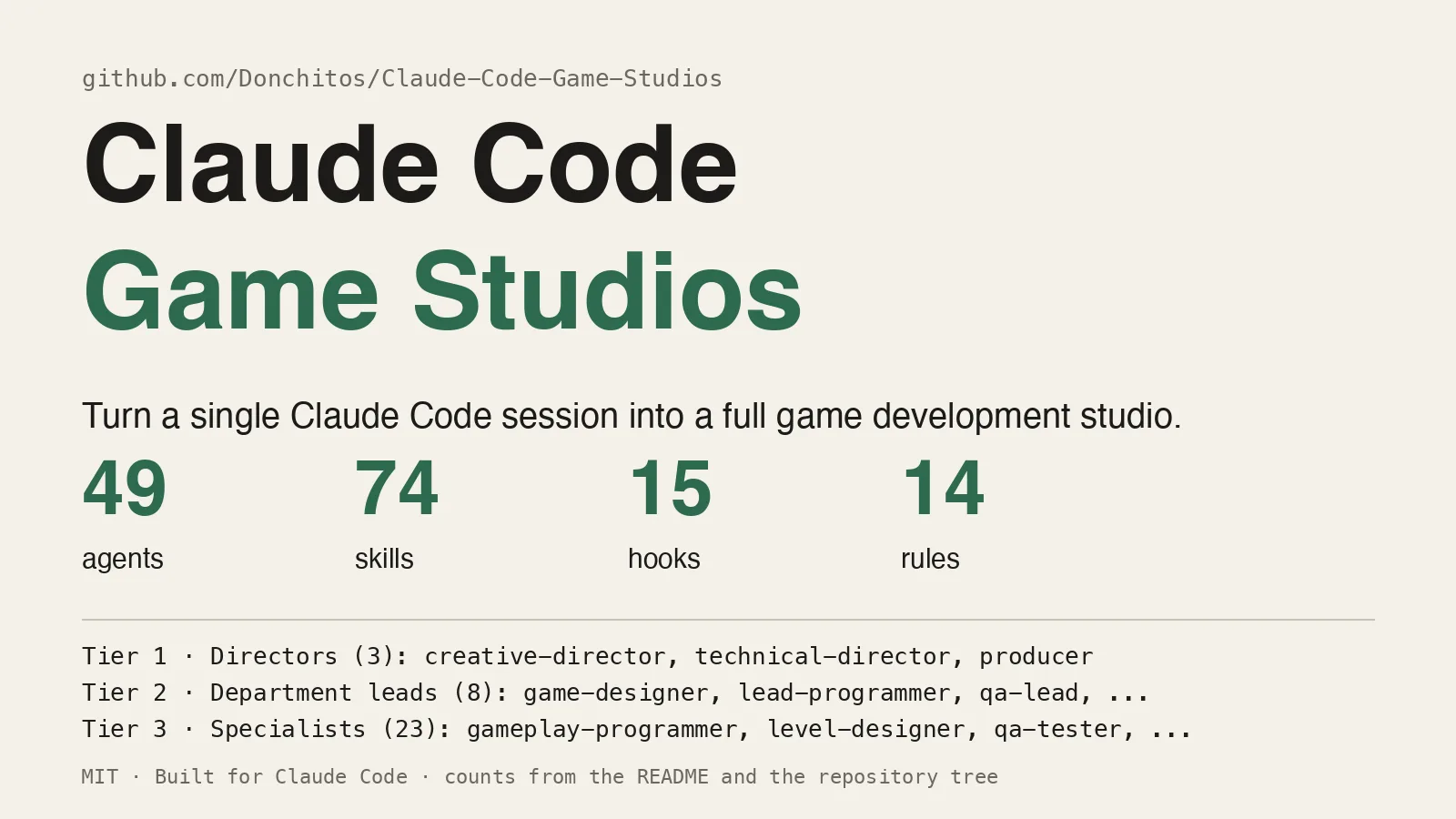
A single Claude Code chat has no structure, the README argues. Nothing stops the agent from hardcoding magic numbers or skipping the design document, and nobody asks whether a change still fits the game’s vision. Claude Code Game Studios is an MIT-licensed template that turns one Claude Code session into a small game studio: 49 role-based agents, 74 skills, hooks and coding rules scoped by path. The README says the agents sit in three tiers, as in real studios: directors guard the vision, department leads own their areas, and specialists do the hands-on work. As of October 21, 2026 the repository had 27,005 stars, and its last push was on October 19, 2026.
Core features
Claude Code Game Studios rests on a layered set of roles and a workflow with checkpoints. These six points matter most day to day.
- Three tiers of roles: The README’s tier table names 34 roles: three directors (creative-director, technical-director and producer), eight department leads and 23 specialists. Fifteen more files cover the Godot, Unity and Unreal engine sets. The README says each agent states its responsibilities, escalation path and quality gates.
- Skills for every phase: The 74 slash-command skills sit in 12 topic groups, from
/startand/setup-engineto/create-stories,/dev-storyand/release-checklist. - Checks before commits and pushes:
validate-commit.shchecks hardcoded values, TODO format, JSON validity and design-document sections beforegit commit.validate-push.shwarns on pushes to protected branches, tags and GitHub releases. - Rules that follow the path: Editing
src/gameplay/**means values come from data, and hot paths undersrc/core/**allocate nothing. Tests and prototypes have their own standards. - A launched game before “done”: A story that changes what the player sees stays open until someone has run the game and a screenshot is saved under
production/qa/evidence/. That requirement holds atminimal, where automated tests are optional. - One setting for process weight:
modes.rigortakesminimal(the default),standardorfull, and sets the GDD sections, documentation depth, QA evidence and review size together.
Typical use cases
Claude Code Game Studios has three typical uses, each matching a different project size.
- A solo developer at a game jam: Keep the default
minimalmode and follow the README path:/start,/setup-engine,/brainstormfor a one-page brief,/create-stories, then a loop between/dev-storyand/story-done. - A small team that keeps design documents:
standardrequires five GDD sections.fullrequires all eight, full QA evidence for every story type and a full director review. - Someone taking over a project: If code or design documents already exist, pick the existing-work option when
/startasks, or run/project-stage-detectto analyze the project.
Quick start
Claude Code Game Studios is set up by cloning the repository and launching Claude Code from its root. These are the README’s commands:
git clone https://github.com/Donchitos/Claude-Code-Game-Studios.git my-game
cd my-game
claude
Run /start in the session. It asks where you are starting from (no idea yet, a vague idea, a clear concept, or existing work) and writes modes.rigor and modes.automation to project.yaml only after you agree. If the clone’s origin still points at the template repository, it says so. The README also warns that starting Claude Code in a subfolder such as src/ skips the project’s hooks, deny rules and ask-first permission mode.
Summary
Claude Code Game Studios suits people who already use Claude Code and want a game workflow with design and QA gates, and teams that plan to adapt the template. It is a poor fit for anyone who wants the agent to build a small game with few questions asked. The README calls the system “not an auto-pilot”, so each step waits for your decision.
Cost comes first. The README gives no token or price figures, but it states the model each agent declares:
| Declared model | Agents | Examples |
|---|---|---|
| Opus | 3 | creative-director, technical-director, producer |
| Sonnet | 16 | lead-programmer, prototyper, devops-engineer, community-manager |
| Inherits the session model | 30 | game-designer, gameplay-programmer, qa-tester |
The three directors run on Opus, 16 agents on Sonnet, and the other 30 inherit your session’s model, so the bill depends on the model you start with. The rigor setting matters too. In one README test, a single brief produced one document before the first line of game code at minimal (0 minutes) and 30 documents at standard (58 minutes). Two blind reviewers and a human playtest ranked the standard build last. That is one brief and one measurement.
Three limits. First, the README says the main environment is Windows 10 with Git Bash, and macOS and Linux were tested, but desktop notifications only work on Windows. Second, it needs Python 3; without it, every setting silently falls back to its default. Third, it is a template with no game in it, and its tests cover the framework, not your game, so put your own tests in tests/. The license is MIT. GitHub labels the language Shell, but of the tracked files, 567 are Markdown (agent and skill definitions, plus documentation) and 52 are .sh scripts. To compare another engineering setup built for Claude Code, read everything-claude-code.
This article is based on the repository’s README and configuration files. The Frontier Now editorial team has not run the full workflow on a real project.