Agent frameworks#Multi-agent#Coding agent
LoopX: keep long-running agent goals, decisions and evidence across sessions
LoopX is a local-first control plane that keeps goals, decisions and evidence across sessions for Codex, Claude Code and other agent runtimes. Apache-2.0.
Project facts
GitHub Ecosystem- License
- Apache-2.0
- Language
- Python
- Stars
- 6,381
- Data checked
- 2026-10-21
Snapshot figures reflect the check date and may change over time.
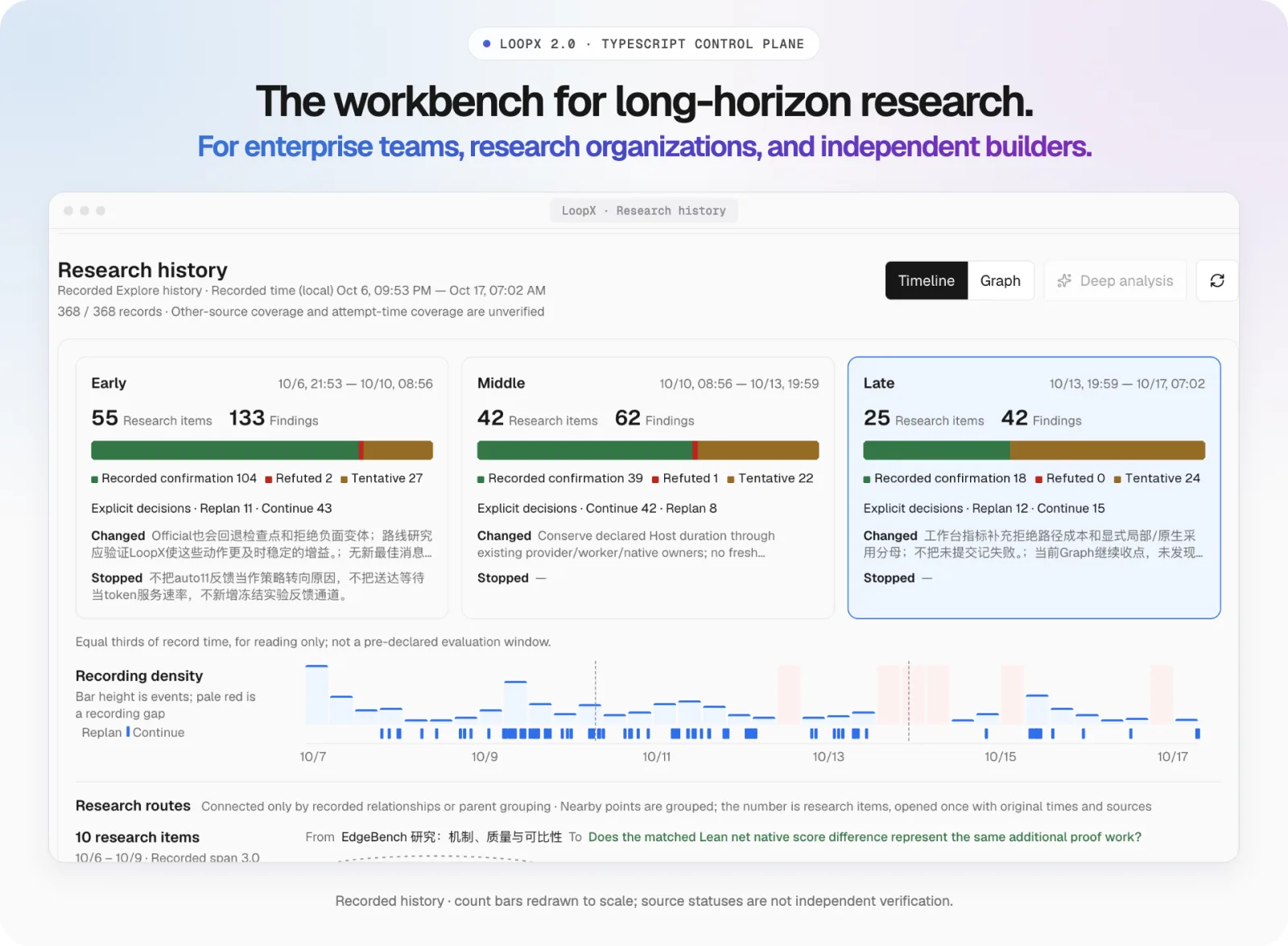
LoopX is a local-first control plane and research workbench for long-running agent goals. A goal that runs for days tends to break where a session ends: the reasons behind earlier choices scatter through a chat log, and a new tool or person cannot tell which results were checked. The README says LoopX keeps goals, decisions, ownership and evidence across sessions and runtimes. Codex or Claude Code still supplies the model and tools. LoopX keeps the state and writes results back only after validation.
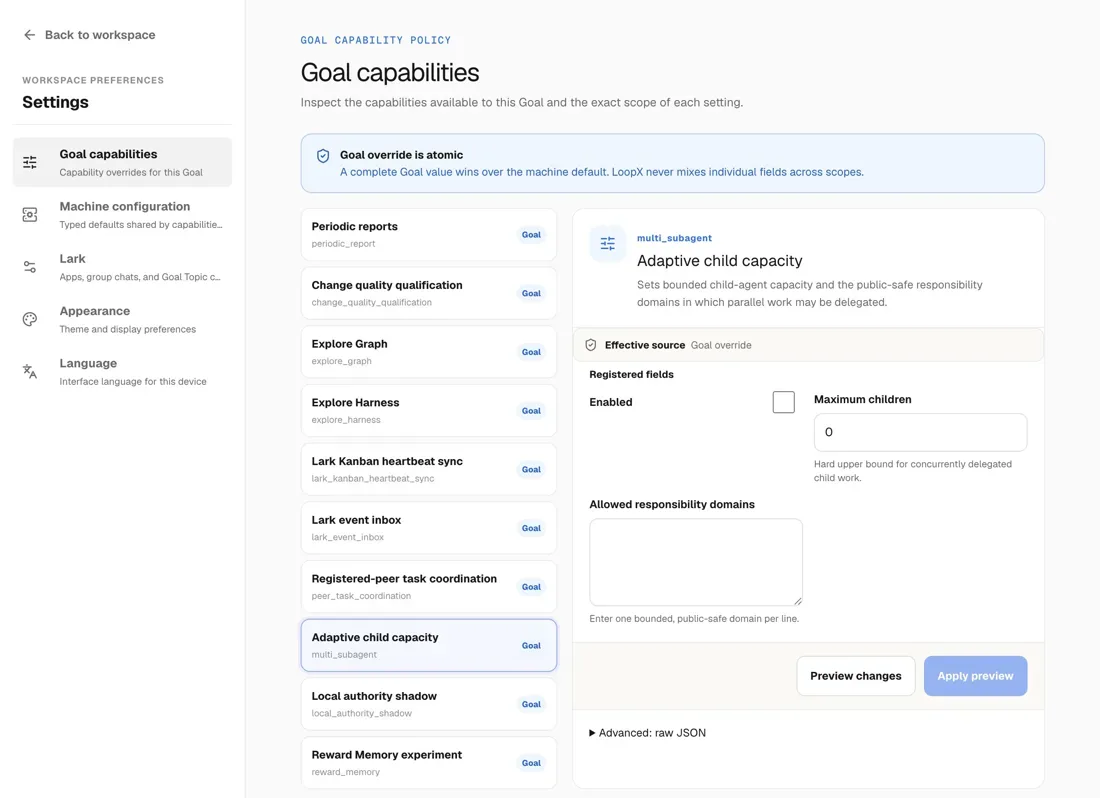
The image is a recording screenshot from the README. The page sets child-agent capacity and the responsibility domains that parallel work may use, and each change is previewed before it applies.
Core features
LoopX’s core is local state you can inspect. These are the capabilities the README describes first.
- Goals, todos and decisions stay in the project: They are stored locally and survive restarts.
loopx statusshows the current goal, the decision waiting for you and the next todo. - Quota gates every automatic turn: A turn runs
loopx quota should-runfirst. Spend is recorded only after a validated writeback, and quiet skips, failed preflight checks and dry runs do not count. - Agents own their work: Registered agents are peers with no permanent leader. An agent claims a todo with
loopx todo claimand records its change withloopx todo updateafter validation. - One state, several hosts: The README lists Codex App, Codex CLI, Claude Code, DeepSeek Harness, KunlunCode, OpenCode, Pi, ZCode, Antigravity CLI (agy), Kiro CLI, Cursor, shell scripts and custom runners.
- Research you can review later: Explore records hypotheses and findings, and it is off by default. Opening a page starts no model call, and an explicit deep analysis uses the host and account you configured.
- People keep the sensitive decisions: Dangerous permissions, publishing, production writes and final ownership stay with you. Protected changes need a typed preview and your explicit confirmation.
Typical use cases
LoopX fits work that must continue across sessions while a person keeps the final say.
- Several days of pull request feedback: Start
$loopxin Codex with the task. LoopX turns it into todos, and the next turn reads the previous state and evidence before it acts. - Code changes that need review: One agent builds on another agent’s analysis, and an independent review checks the result before it returns. The README’s collaboration guide describes this flow, and the README links a three-agent demo.
- Scheduled checks and reports: Presets cover daily triage, changelog drafts and PR watching, which
loopx preset listshows. Periodic reports come with receipts.
For a different approach to splitting work across agents, read Claude Code Game Studios. It assigns roles in a studio-style hierarchy, while LoopX registers agents as peers.
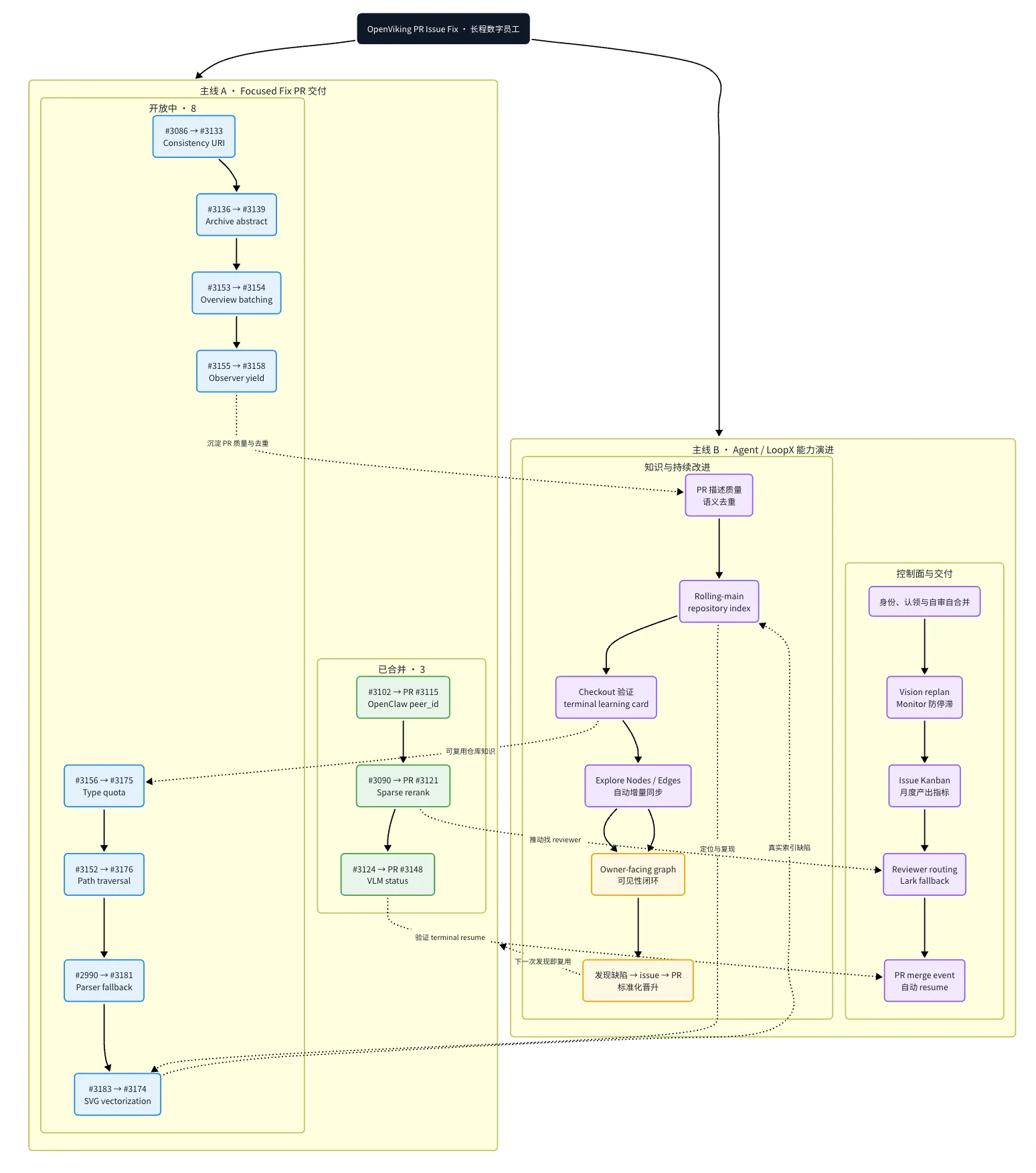
The README’s longest case is OpenViking issue-fix work by LoopX’s creator, pictured below. The README says that public contribution sequence spans more than 200 hours, from the first pull request to the latest update, and it measures wall-clock time rather than continuous model execution.
Quick start
LoopX installs with one pip command from the README. It needs Python 3.11+ and Node.js 22.22.3+.
python3 -m pip install --upgrade loopx && loopx workflow-skills --install
Restart your agent host and open your project. In Codex, type $loopx followed by a task. In Claude Code, use /loopx <task>. Then loopx status shows the goal, any decision waiting for you and the next todo.
Benchmarks
The numbers come from the Long-Horizon Terminal-Bench (LHTB) study that the README cites: 46 matched tasks, with GPT-5.6 Sol at max reasoning effort and Web Search disabled in all three modes. The README body gives no test date or hardware.
| Execution mode | Mean reward | Strict pass rate (≥0.95) | Pass rate (≥0.80) |
|---|---|---|---|
| Plain Codex | 0.4218 | 7/46 (15.2%) | 12/46 (26.1%) |
| Native Codex Goal | 0.4475 | 4/46 (8.7%) | 14/46 (30.4%) |
| LoopX 1.0.3 Heartbeat | 0.4948 | 7/46 (15.2%) | 15/46 (32.6%) |
The README reports a mean reward 17.3% above Plain Codex and 10.6% above native Codex Goal. Strict solves match Plain Codex at 7 of 46, and mean reward also credits partial progress, so the gain does not mean more tasks were fully solved. Each task and mode ran once. The README says these are observed results, not an equal-budget efficiency test or an isolated causal estimate.
Summary
LoopX suits individuals and small teams that already use Codex, Claude Code or another supported host and want durable state and human gates around long tasks. It does not suit anyone who expects unattended production work, because the README says LoopX is not a full agent platform, an agent runtime or an autonomous production controller. The license is Apache-2.0 from v0.4.8 onward; earlier releases stay under MIT. GitHub lists Python as the main language, and the README says the transaction, authority and recovery rules are in TypeScript. As of October 21, 2026, the repository had 6,381 stars.
A few things to know first. Usage statistics are on by default: a daily random-ID heartbeat and ID-free CLI counts, and the README says no content is collected. loopx usage-ping disable or LOOPX_USAGE_PING=0 turns them off. The README does not state LoopX’s own cost. Models and tools come from your runtime, and an explicit deep analysis uses your configured host and account. Upgrading from 1.x means reading the migration guide first, because installation does not convert existing state silently. Windows preview installers update manually and need a separate CLI, and the macOS app is ad-hoc signed, not notarized. The 200-plus-hour examples measure elapsed time, not continuous model execution or unattended production autonomy. The README’s copyright line reads “LoopX contributors” and names GitHub user @huangruiteng as the creator. We checked the README and repository metadata only, and we did not install or run LoopX.