Deep-Live-Cam: real-time face swap from one photo, and its limits
Deep-Live-Cam is an AGPL-3.0 real-time face swap tool driven by a single photo, with an ethics statement and content checks in the README. Consent required.
Project facts
GitHub Ecosystem- License
- AGPL-3.0
- Language
- Python
- Stars
- 97,182
- Data checked
- 2026-10-23
Snapshot figures reflect the check date and may change over time.
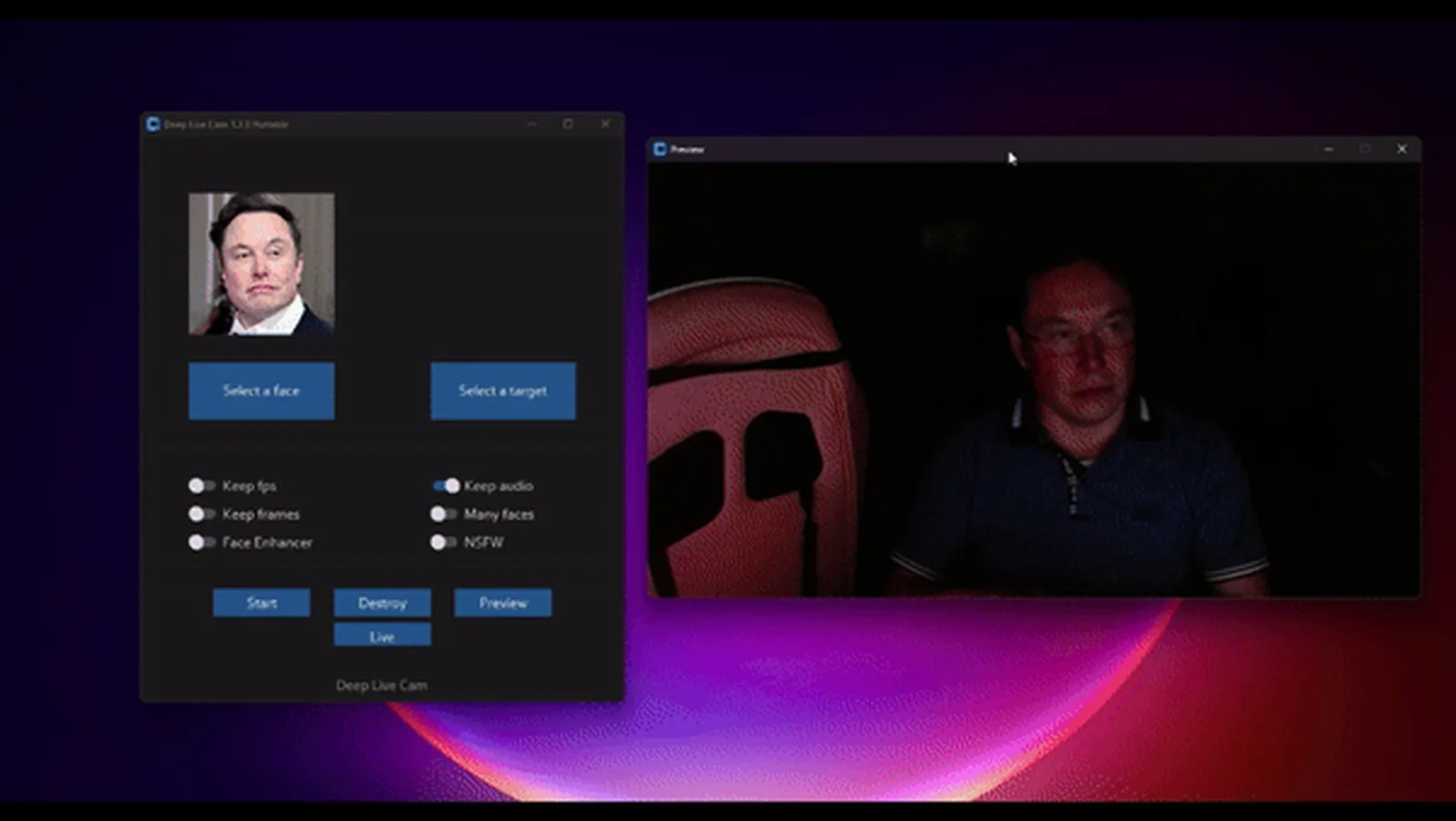
Deep-Live-Cam is a real-time face swap tool: pick a front-facing photo, pick a camera, press Live, and the face in the feed is replaced with the one in the photo. It is an AGPL-3.0 Python project, created in September 2023, with about 97,000 stars, and its last push was on October 22, 2026.
Core features
- One photo, no training: Import a single front-facing photo and it works; the first run downloads about 300 MB of models (the gfpgan and inswapper ONNX files).
- Real-time output: The README’s three steps are select a face, select a camera, press Live. The output can present as a virtual camera for OBS, Zoom and other meeting or streaming apps.
- Mouth mask: The original mouth can be preserved so speech looks natural while the rest of the face is swapped.
- Face mapping: Multiple people in one frame can be mapped to different faces at once.
- GPU acceleration: NVIDIA runs through CUDA (CUDA Toolkit 12.8 and cuDNN 8.9.7 required), and Apple Silicon runs through CoreML, supported from M1 through M5 via the requirements file.
- A paid distribution: The website deeplivecam.net sells a prebuilt “Ultimate” edition with 30-plus claimed exclusive features and priority support; those additions are not part of the open-source repository.
Typical use cases
- Content creation: Character performances, memes and live shows.
- Demonstration and teaching: Showing how deepfakes work in real time.
- Light-hearted video calls: Appearing as someone else, with that person’s consent. For a video tool that renders instead of swapping, see EdenLive.
Quick start
The README offers two routes: a prebuilt download from the website with no manual setup, or a manual install that it says requires technical skill and is not for beginners:
git clone --depth 1 https://github.com/hacksider/Deep-Live-Cam.git
cd Deep-Live-Cam
python -m venv venv && source venv/bin/activate
pip install -r requirements.txt
python run.py            # CPU
python run.py --execution-provider cuda   # NVIDIA GPU
You need Python 3.11 to 3.14 (3.14 recommended), git, ffmpeg, and on Windows the Visual Studio 2022 runtimes. The model files come from Hugging Face and go into the models/ folder.
The usage boundaries
The README spends a long stretch on ethics and law. We summarize it as written, because these boundaries decide whether the tool belongs on this site at all.
- Consent is required: Using a real person’s face needs that person’s consent, and any output shared online must be clearly labelled as a deepfake.
- Built-in content checks: The program blocks inappropriate media such as nudity and graphic content.
- The author reserves the right to shut down: The README says the project may be discontinued or the output watermarked if legally required.
- User responsibility: Compliance for end use rests with the user.
One licensing note: the code is AGPL-3.0, which carries source-opening obligations for network services. The paid Ultimate edition on the website is a separate closed-source distribution and is not covered by that license. The README also warns to download only from the official site, because copycat sites exist.
Summary
Deep-Live-Cam suits content creators and demonstrators who need real-time face swap, can set up a Python environment themselves, and will use it within those boundaries. It does not suit any use of another person’s likeness without consent; the README and this site agree on that.
A few things to know first. This is a deepfake tool, and we cover it to report on the state of such tools and their limits; that is not an endorsement of any particular use. The message that led here said “93,000 stars”; the measured count as of October 23, 2026, is 97,182. The claims of “one-second output” and “zero latency” come from that message, not the README, which gives no latency figures and says only that CPU mode is slower than GPU. And the Ultimate edition is a closed-source paid product, separate from the open-source repository.
The repository was created on September 24, 2023, its last push was on October 22, 2026, and it is not archived. The license is AGPL-3.0. We checked the README, the LICENSE file and the repository metadata, and we did not install or run it.