Learning resources#3D modeling#Motion graphics
Every Joule: an interactive physics book you can play
Every Joule is an interactive 3D physics book built with Claude Opus 5.5 and Three.js: ten lessons covering GCSE energy, Lesson 1 playable in the browser.
Project facts
GitHub Ecosystem- Language
- JavaScript
- Stars
- 23
- Data checked
- 2026-10-27
Snapshot figures reflect the check date and may change over time.
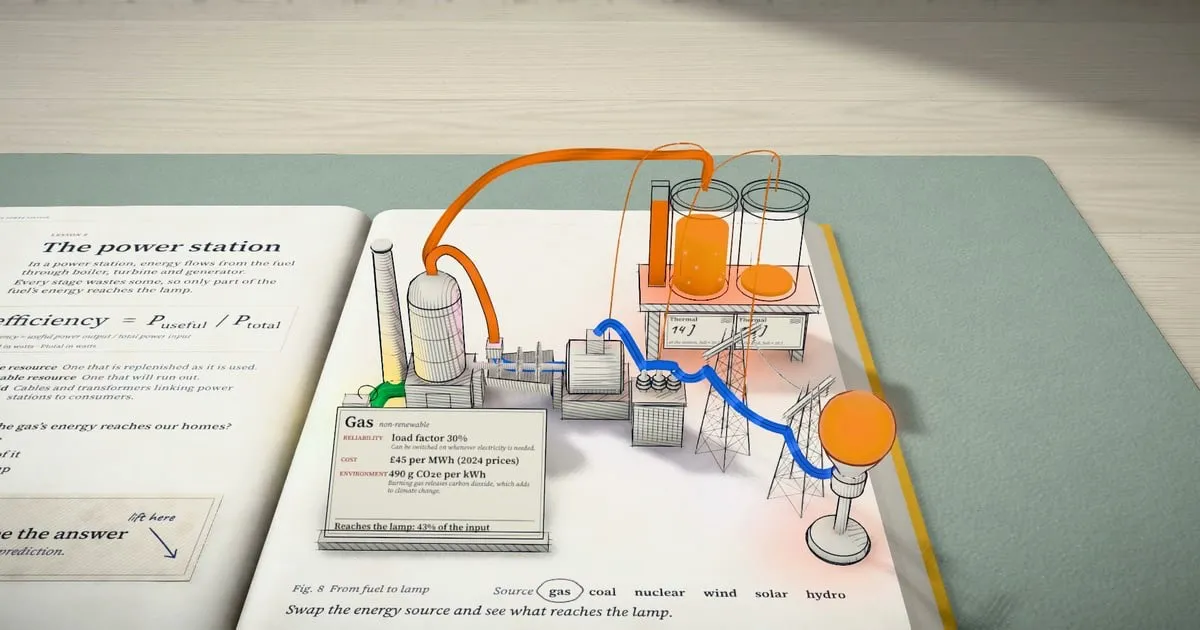
Textbooks teach energy as arrows on a flat page: kinetic here, gravitational there, a diagram of a bouncing ball that never moves. Every Joule takes that chapter off the page. It is an interactive 3D physics book from the developer behind the X account @techartist_, built with Claude Opus 5.5 and Three.js, covering the whole energy topic of GCSE physics in ten lessons — energy stores, kinetic and gravitational energy, elastic energy, the bouncing ball, heating, power, efficiency, power stations and the grid, food, and conservation of energy. Every illustration rises off the page as a 3D ink drawing, energy flows between objects as glowing color, and each lesson asks you to predict first, run the experiment, lift the flap for the answer, and earn a stamp. The author posted Lesson 1 on October 22 and a preview of all ten lessons on October 24; the main post gathered 2,684 likes and roughly 200,000 views in two days (figures checked 2026-10-27).
Core features
- A real book, not demos: the ten lessons ship as one complete pop-up book with a cover, contents, page numbers, an index, a quiz and a sources page inside. The official page promises that “teachers’ notes and every source are included”, and both live as their own pages of the book.
- Diagrams that stand up: the illustrations render as 3D ink drawings on an open spread. In Lesson 8, “The power station”, the boiler, turbine and pylons wrap around the spine while an orange pipe runs from the furnace to a lamp. Swap between gas, coal, nuclear, wind, solar and hydro and the panel updates load factor, cost per MWh and CO2 per kWh in place — those panels are the lesson text.
- Predict first: every section opens by asking you to call the result — how fast the cart leaves the ramp, how high the tennis ball rebounds, how a kettle’s power splits — before you run the experiment and check. Correct guesses feed the stamp page at the back of the book, which turns “I finished a lesson” into something visible.
- One lesson, one repo: the full source of Lesson 1, “Energy stores”, lives at iamtechartist/every-joule-lesson1 (JavaScript, repository created 2026-10-22, 23 stars as of 2026-10-27). It is a Vite-built Three.js app served as a static site, playable directly on GitHub Pages, with an accessibility mode covering keyboard input and reduced-motion preferences.
Typical use cases
- GCSE and middle-school physics classes: the energy stores, power and efficiency lessons project well as live classroom experiments, replacing flat arrow diagrams; the teachers’ notes page maps each lesson to the syllabus.
- Self-study at home: kids can flip through it on their own — the flaps and stamps give finishing a lesson a visible reward, no parent narration required.
- A case study in AI-assisted teaching: anyone wondering what “a book built with Claude” actually looks like can follow the author’s build posts on X and read how a single-lesson app is put together in the repo.
Quick start
Nothing to install: open iamtechartist.com/every-joule in a browser and the book opens on its cover. The scene needs WebGL (hardware acceleration); without it the site falls back to a text-only version. Lesson 1 can also be run from source:
git clone https://github.com/iamtechartist/every-joule-lesson1.git
cd every-joule-lesson1
# static site — any static server works
npx serve .
You land on a yellow 3D book. Click through the cover to the contents, pick “Energy stores” for Lesson 1, and drag to rotate the scene.
Summary
Every Joule is worth playing today, with one caveat: only Lesson 1 is finished. The other nine exist as preview footage, so the power-station panels shown above are still something to wait for — the author builds in the open on X (@techartist_), which is the easiest place to follow progress. The Lesson 1 repository carries no open-source license (all rights reserved by default), so ask before reusing its code, and the complete book is not open source. For the same idea taken in other directions, OpenMAIC turns a topic into a full interactive classroom with multiple agents, and ManimGX rebuilds Manim’s math animations on a 3D engine. Every Joule’s lesson is simpler: with a strong enough model, an animated textbook is one person with a clear sense of teaching rhythm away.