Creative#Video generation#Motion graphics
Lemo-Opuscar: films written in code by Claude, no video model
Lemo-Opuscar is an MIT-licensed film-style toolbox: 59 ready styles where Claude draws frames with canvas and WebGL and cuts with ffmpeg, no video model.
Project facts
GitHub Ecosystem- License
- MIT
- Language
- JavaScript
- Stars
- 5,574
- Data checked
- 2026-10-23
Snapshot figures reflect the check date and may change over time.
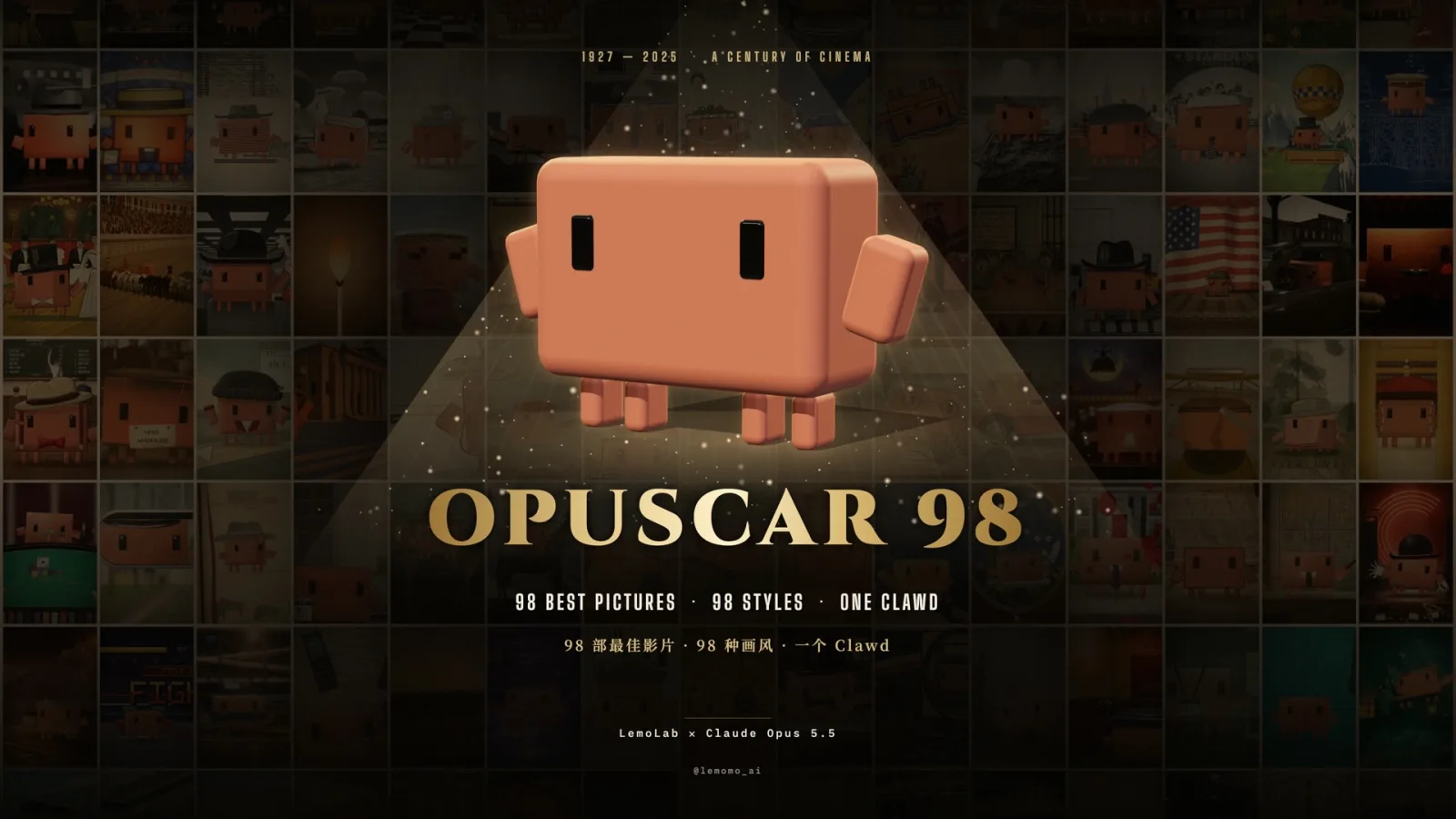
Making a short film usually means picking a video model, writing a prompt and rerolling until something works. Lemo-Opuscar takes another route: frames are drawn with canvas and WebGL, cuts are made with ffmpeg, and narration comes from text-to-speech, all written as code by Claude. No video generation model and no stock footage. The repository is MIT-licensed JavaScript, created on September 26, 2026, with its last push on October 22.
Its showcase is OPUSCAR 98: a blocky character called Clawd walks through the 98 Best Picture winners from 1927 to 2025, one style per film, in a 6:31 runtime, with every frame, note and cut generated from code. The README says those 98 styles break down into 77 in 2D, 17 in 3D and 4 in 2.5D.

Core features
- Code instead of a video model: The README says plainly that there is no video generation and no stock footage. Frames render from canvas and WebGL, scores come from free sample libraries, and narration is text-to-speech.
- 59 ready styles: Each style is a
STYLE.mdthat describes how it looks and sounds; the story is yours. Style names work in English or Chinese, and the index is instyles/README.md. - Make a style your own: Change a library style or start from a blank page. Before writing anything, it sorts the proposed changes into safe edits and changes that alter the style’s character, then shows a before-and-after summary and the cost for you to approve.
- It works like a small studio: The agent reads three guides and moves through direction, drawing, scoring and mixing.
- A storyboard first, if you want: Before starting it asks whether you want to see key shots in the real style; say yes and it stops once for approval.
- 1080p at 24 fps by default, with other sizes on request.
Typical use cases
- Anyone making a stylized short: Brand animation, explainers or product films that do not need a photoreal person.
- People who want frame-level control: Every frame is drawn by code, so one change does not mean regenerating the whole film.
- Chinese-speaking creators: Style names and docs work in Chinese, and the repo has a Simplified Chinese README.
- Designers adapting a look: Recolour and retype a library style for a brand. If you would rather use a video model for real-time rendering, see EdenLive.
Quick start
The skill install is recommended, and then it works from any folder:
claude plugin marketplace add lemomo-ai/lemo-opuscar
claude plugin install lemo-opuscar@lemolab
On first use it downloads the guides, tools and style prompts to ~/lemo-opuscar, shared by all your films. You can also clone the repository and make films in films/<name>/ inside it.
After that, say what you want, for example a 45-second film in the watercolor style about a family coffee farm, with a warm female narrator.
Limits and licence
- A film takes an agent about 30 to 60 minutes and a fair number of tokens. The README gives no token count or price.
- You need Node 20+, ffmpeg and Python 3.11+ (or uv); the agent installs the rest. The styles are tuned for Claude Opus 5.5, and the README warns that other models may not reproduce them well.
- The licence is split: code and docs are MIT; the demo films and stills in
styles/, the gallery and the releases are CC BY 4.0, so commercial reuse needs credit to LemoLab. Films you make are yours, with no credit required. Three voice tracks are not CC BY 4.0, and the README lists which ones.
Summary
Lemo-Opuscar suits people making stylized shorts who want frame-level control, and anyone curious about replacing a video model with code. It does not suit a project that needs a photoreal person or a real location: the README is explicit that this is code drawing, not video generation.
On the style count, the message that led here said 43 styles and that all 98 were open source, and neither matches the repository today. The README says 59 ready styles, styles/ holds 60 directories including the index, and 98 is the number of styles used in the OPUSCAR 98 film, which the README also says are public. This entry uses the README’s numbers.
The repository was created on September 26, 2026, and its last push was on October 22, 2026. It is not archived, had 5,574 stars as of October 23, 2026, and the licence is MIT, with the demo films under CC BY 4.0. We checked the README, the LICENSE file and the repository metadata, and we did not install or run it.