Agent frameworks#Coding agent#Runtime
OpenResearch: a local bench that turns coding agents into research agents
alphaXiv's OpenResearch gives each research direction its own agent session and git worktree; an experiment tree and local SQL memory keep runs reproducible.
Project facts
GitHub Ecosystem- License
- MIT
- Language
- Rust
- Stars
- 7,025
- Data checked
- 2026-10-14
Snapshot figures reflect the check date and may change over time.
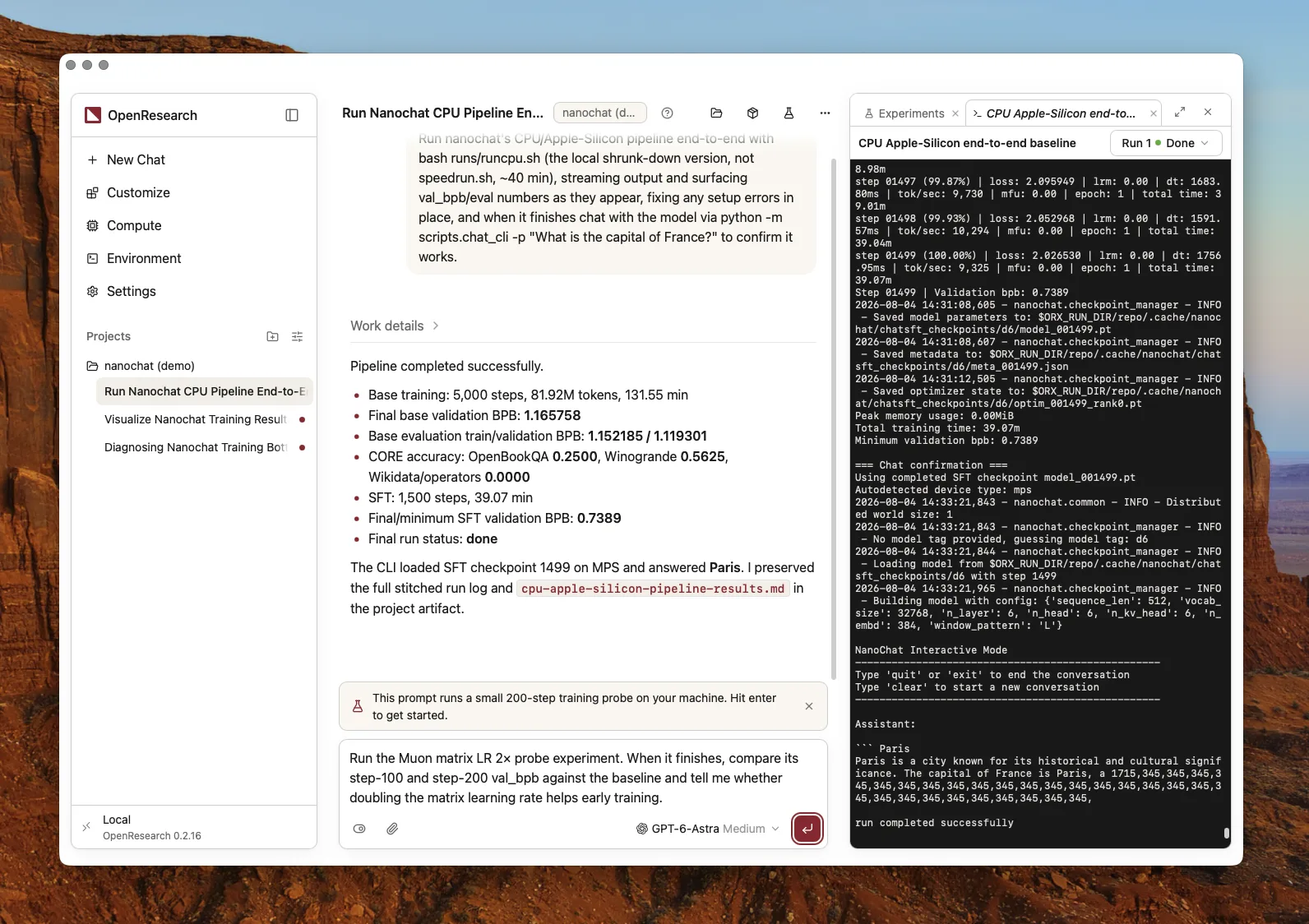
Ask a coding agent to reproduce a baseline and the usual outcome is a shrug the next morning: which files changed, which commands ran, which result belongs to which attempt — nobody can say. OpenResearch (Rust, MIT, about 7.0k stars as of 2026-10-14), open-sourced by alphaXiv, makes the research process itself a structure: every research direction gets its own agent session and its own git worktree, and every run, commit, log, diff and artifact is filed under that direction’s experiment tree. Multiple directions run in parallel on one machine without stepping on each other.
Core features
- One worktree per direction: each research direction runs in an isolated agent session and git worktree, so parallel experiments on the same machine never overwrite each other; every run, commit, log, diff and artifact stays attached to its own experiment tree, so any result can be audited later.
- Experiment memory in local SQL: all experiments land in a local database the agent can read, so past results inform what to try next — “what we already tested” stops living in a chat transcript.
- Plugs into the agents you use: works natively with Claude Code, Codex, OpenCode, Cursor and Google Antigravity; through OpenCode it can also drive local models served by LM Studio, Ollama, oMLX or a custom endpoint.
- Literature to hypothesis in one line: built-in search over alphaXiv, bioRxiv and PubMed lets the agent find related work, form hypotheses and tie experiments back to existing research; alphaXiv’s replicate flow can turn a paper into a runnable project for the agent to work on.
- Compute that follows the experiment: when the laptop is not enough, switch to SSH, Slurm, Kubernetes, Modal, Ray or Hugging Face Jobs, or use Tinker and managed OpenResearch compute — the record still lives on your machine.
- Nothing leaves the machine: projects, conversations, experiments, logs and artifacts stay local; the README states plainly that they don’t collect your code or agent traces.
Typical use cases
- An engineer sweeping three or four prompt or parameter variants at once: one worktree per variant, every change attributable, no more overlapping terminal windows.
- A researcher reproducing a paper: the agent pulls it from alphaXiv, sets up the environment, runs the experiments — and the reproduction itself becomes a browsable experiment tree.
- Anyone supervising students or a small team: per-direction evidence chains make “which run produced this conclusion” a lookup instead of an archaeology dig.
Quick start
curl -LsSf https://openresearch.sh/install.sh | sh
orx up
orx up opens a local dashboard on port 4791 where you can watch each direction’s experiments as they run. Prefer a GUI? Download the desktop app: a signed DMG for macOS 11+, a Windows beta that needs Git for Windows, and x86_64/ARM64 AppImages for Linux (glibc 2.35+).
Summary
For researchers and engineers already working with coding agents and tired of untraceable experiments; casual “fix this function” agent work doesn’t need it, and experiment design, remote-environment security and the final judgment stay with you. Written in Rust under the MIT license, at 7,025 stars as of 2026-10-14 with commits landing the same day — development is active.
Three things to know first: official release builds ship opt-out coarse usage analytics tied to a random installation ID (no code, prompts or paths — turn it off in Settings or with orx telemetry off); the Windows build is a beta, and managed Macs may block the unsigned CLI script, so use the desktop app there; managed compute and email updates want an openresearch.sh account, which purely local use does not.
If your agents need rules more than infrastructure, agent-skills collects 25 skills that close off an agent’s favorite excuses — OpenResearch governs how experiments run, that one governs what agents may not wiggle out of.