agent-skills: 25 engineering disciplines as agent skills
Addy Osmani turns spec, test and review discipline into 25 SKILL.md workflows for Claude Code, Codex and Cursor, each with an anti-rationalization table.
Project facts
GitHub Ecosystem- License
- MIT
- Language
- JavaScript
- Stars
- 105,698
- Data checked
- 2026-10-13
Snapshot figures reflect the check date and may change over time.
Coding agents take the shortest path by default: skip the spec, skip the tests, skip the security review, and forget the rules you set last turn. agent-skills, open-sourced by addyosmani (Google Chrome team) in February 2026 under MIT (about 106k stars and 11k forks as of 2026-10-13), attacks that habit directly. It does not swap the model; it writes the workflows, quality gates and best practices senior engineers use into 25 SKILL.md files, so agents like Claude Code, Codex and Cursor follow the same discipline at every phase of development.
Core features
- 25 skills across the lifecycle: 24 lifecycle skills plus the
using-agent-skillsmeta-skill. The define phase shipsinterview-me(one question at a time until ~95% confidence) andspec-driven-development(PRD before code); planning usesplanning-and-task-breakdown; building proceeds in vertical slices; verification runs ontest-driven-development;code-review-and-qualityandsecurity-auditorgate the merge. - Nine slash commands as entry points:
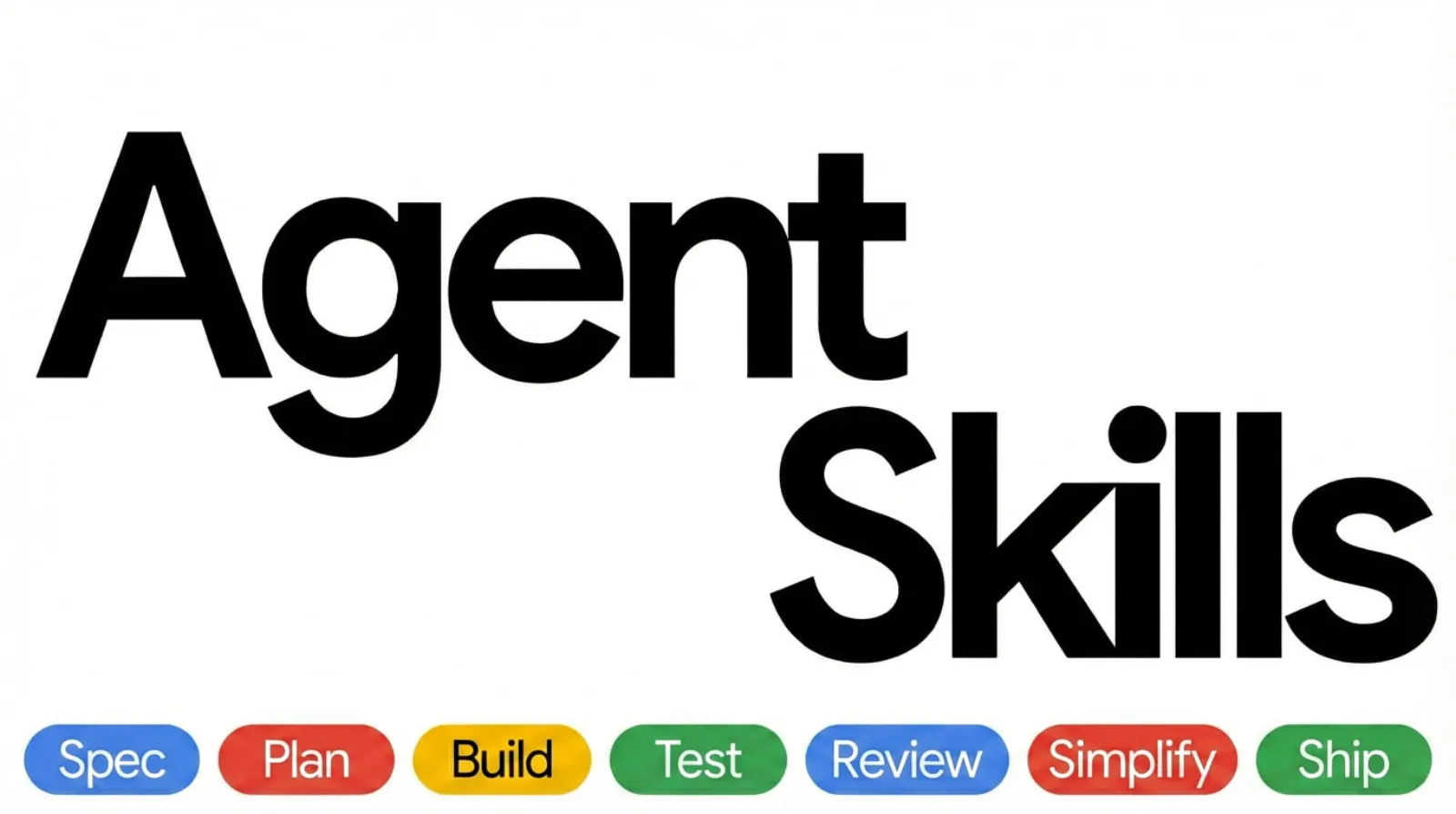
/specdefines,/planbreaks down,/buildimplements,/testproves,/constraintssets the quality bar,/reviewchecks health,/webperfaudits performance,/code-simplifyclarifies,/shipreleases — each activates the right skills automatically./build autoruns every task after one approved plan, pausing on failures or risky steps. - Anti-rationalization tables are the signature: every skill carries a “Common Rationalizations” table that lists the excuses agents use to skip steps, each with a written rebuttal. In spec-driven-development, “this is simple, I don’t need a spec” is answered with “simple tasks don’t need long specs, but they still need acceptance criteria.”
- Verification is non-negotiable: every skill ends with an evidence checklist — tests passing, build output, runtime data — and “seems right” is never sufficient. spec-driven-development even makes “stop your turn immediately after writing the spec” a hard rule; planning starts only after the human approves in a later turn.
- Four prebuilt agent personas:
code-reviewer(five-axis review),test-engineer(test strategy),security-auditor(threat modeling) andweb-performance-auditor(Core Web Vitals), invocable per task. - One command installs into 70+ agents: the open skills CLI covers Claude Code, Cursor, Codex, Copilot and Cline; a Claude Code marketplace plugin, a Cursor rules directory and an Antigravity CLI plugin are also supported.
Typical use cases
- A team whose agent-written code runs but nobody dares review it: write the gates into CONSTRAINTS.md with
/constraintsand enforce them before every commit. - Underspecified feature requests: let
interview-meextract what the user actually wants, then move to/spec. - Incremental adoption on an existing codebase: follow the Adoption Guide’s verification-first route instead of a big-bang rollout.
- Architectural decisions nobody writes down:
documentation-and-adrsforces the “why” into an ADR, so the next agent touching that code reads the decision instead of reinventing it.
Quick start
npx skills add addyosmani/agent-skills            # install all 25 skills
npx skills add addyosmani/agent-skills --list     # browse before installing
Single skills install too, e.g. npx skills add addyosmani/agent-skills --skill test-driven-development. In Claude Code, typing /spec shows the workflow in motion. Skills also activate on their own based on the work in front of the agent — designing an API pulls in api-and-interface-design, building UI pulls in frontend-ui-engineering — so you do not have to memorize names. Every integration reads the same skills/ directory; the CLI, plugin and rules files are only entry points.
Summary
Aimed at developers already shipping production code with coding agents and tired of the skipped steps; occasional scripters may find the process heavy. How many of those 106k stars are actually in use is unknowable, but the problem it treats is real — install it if your team has that problem. Three catches up front: installing a single skill drops the repo-level references/ checklists (issue #361); the Claude Code marketplace clones over SSH, so a missing GitHub key surfaces as Permission denied; and some Antigravity CLI releases report legacy commands as converted while their wrappers stay undiscoverable. For more Claude Code ecosystem resources, everything-claude-code is a maintained list; animate shows a different way to constrain an agent — writing “confirm before rendering” into the skill itself.