Agent frameworks#Multi-agent#Runtime#Agent memory
Ruflo: a multi-agent harness around Claude Code and Codex
Ruflo, formerly Claude Flow, orchestrates swarms of coding agents: routing, cross-session memory, federation and cost tracking for Claude Code and Codex.
Project facts
GitHub Ecosystem- License
- MIT
- Language
- TypeScript
- Stars
- 76,279
- Data checked
- 2026-10-18
Snapshot figures reflect the check date and may change over time.
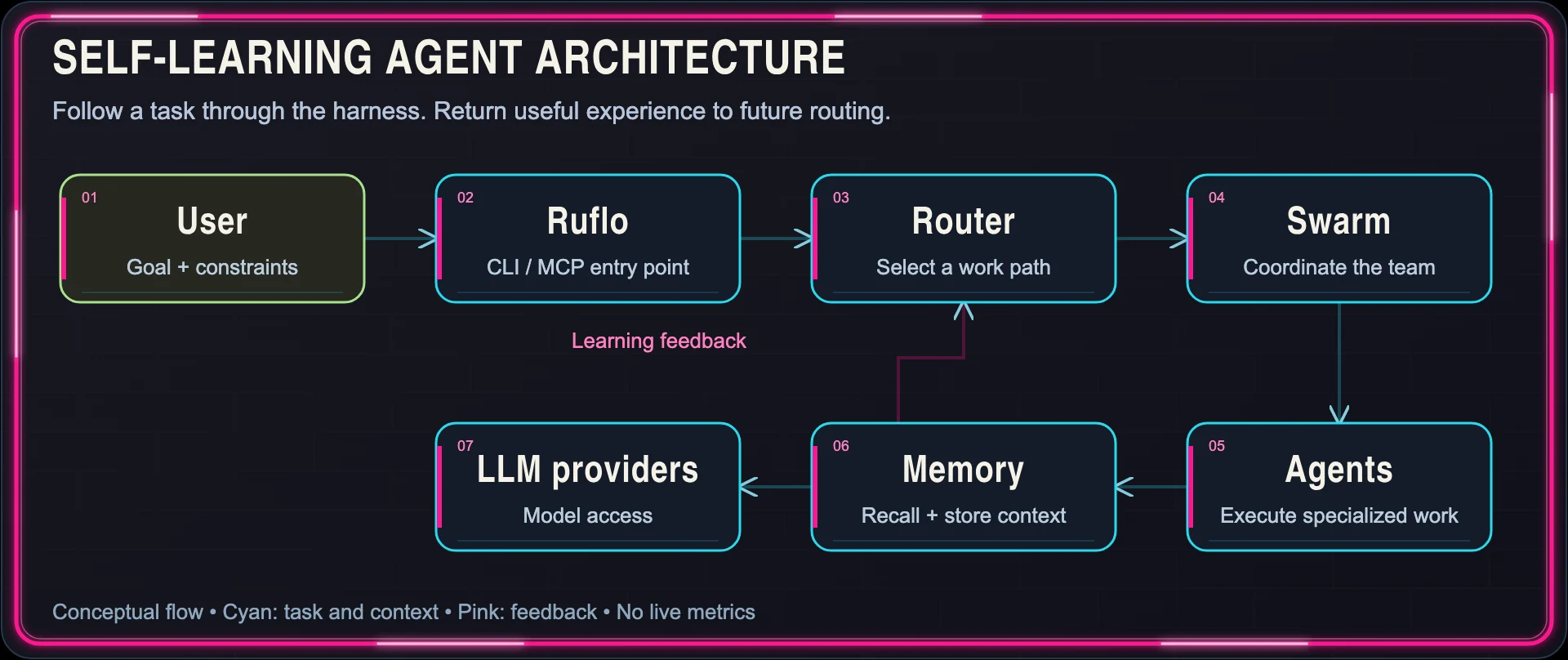
Claude Code and Codex can each finish a task, but getting a group of agents to divide work, hand results to each other and remember last session’s conclusions usually means building scaffolding yourself. Ruflo (formerly Claude Flow) is that scaffolding: an agent harness that adds task orchestration, swarm coordination, cross-session memory, federation and cost tracking around a coding tool. The repository had 76,279 stars on October 18, 2026, uses the MIT license, and is primarily TypeScript.
Core features
- Two install paths with very different footprints: the Claude Code plugin route adds slash commands and agent definitions and leaves almost nothing in your workspace; the
npx ruflo initCLI route writes.claude/,.claude-flow/andCLAUDE.md, registers an MCP server and installs hooks. The README tells you to pick by need instead of installing everything. - Swarms and routing: hierarchical, mesh and adaptive topologies with consensus, while
ruflo-modsroutes prompts and enforces policy in-process. The project also states plainly that mods run with your account’s permissions and are not sandboxed, so read them before installing. - Cross-session memory:
ruflo-rag-memorycombines hybrid search, graph hops and diversity ranking,ruflo-rvfsaves and restores session memory, andruflo-agentdbprovides the vector store. The README’s HNSW numbers carry their measurement conditions (about 1.9× at N=20k, 3.2–4.7× at N=5k versus brute force, recall@10 about 0.99) and note that at small N it can tie or lose. - Federation: agents on different machines collaborate across installations, proving identity with mTLS and ed25519, stripping PII before data leaves a node, and limiting untrusted peers to discovery information rather than memory.
- Observability and audit: the console shows workflows, agents, models, tokens and cost side by side;
ruflo-metaharnessgrades an existing agent setup, scans tool configuration for risk and tracks regressions;ruflo ejectexports a project as a standalone agent toolkit.
Typical use cases
- Complex changes that need several agents: split audit, implementation and testing across agents coordinated by a swarm instead of pushing one session through the whole job.
- Long tasks across sessions: persist conclusions so the next session does not restate the context from scratch.
- Multiple machines or collaborators: the federation layer exchanges work between environments while filtering what leaves each node.
- Teams that want to measure cost before committing: the console and cost tracker break down tokens and spend per model, which suits a trial run before wider adoption.
Read the caveats with the feature list. The documentation repeatedly marks demo animations as not evidence of completed swarm work or memory recall; results depend on the memory, learning components and feedback you configure. Mods are unsandboxed and run with your permissions. The CLI path changes workspace files and hooks, so trial it on a branch or copy. Ruflo does not replace Claude Code or Codex; it wraps them. Where XERJ focuses on retrieval and memory, Ruflo coordinates tasks and agents, and the two can be layered.
Quick start
The lightest entry is plugins only:
/plugin install ruflo-core@ruflo
/plugin install ruflo-console@ruflo
For the full harness, use the CLI:
npx ruflo@latest init wizard
npx -y ruflo@latest mcp start
For clients that support local stdio MCP servers, set the command to npx and the arguments to ["-y", "ruflo@latest", "mcp", "start"]. npx ruflo tui gives a terminal view if you only want status.
Summary
Ruflo suits teams already using Claude Code or Codex that want to move from a single-agent workflow to multi-agent coordination with observability. Orchestration, memory, federation and cost tracking live in one harness, the install paths are explicit, and eject leaves an exit. The trade-off is surface area: plugins and hooks genuinely reach into your workspace and permissions, so decide which ones to install after reading their code. MIT-licensed, primarily TypeScript, with 76,279 stars as checked on October 18, 2026.