Agent frameworks#Open source#Agents#MCP#Multi-agent#Runtime#Evals#Python
Google ADK: one framework to build, evaluate, and deploy AI agents
Google's open-source agent framework: single agents to multi-agent graphs, a built-in debug UI, adk eval testing, one-command deploys to Docker or Cloud Run.
Project facts
GitHub Ecosystem- License
- Apache-2.0
- Language
- Python
- Stars
- 21,667
- Data checked
- 2026-09-28
Snapshot figures reflect the check date and may change over time.
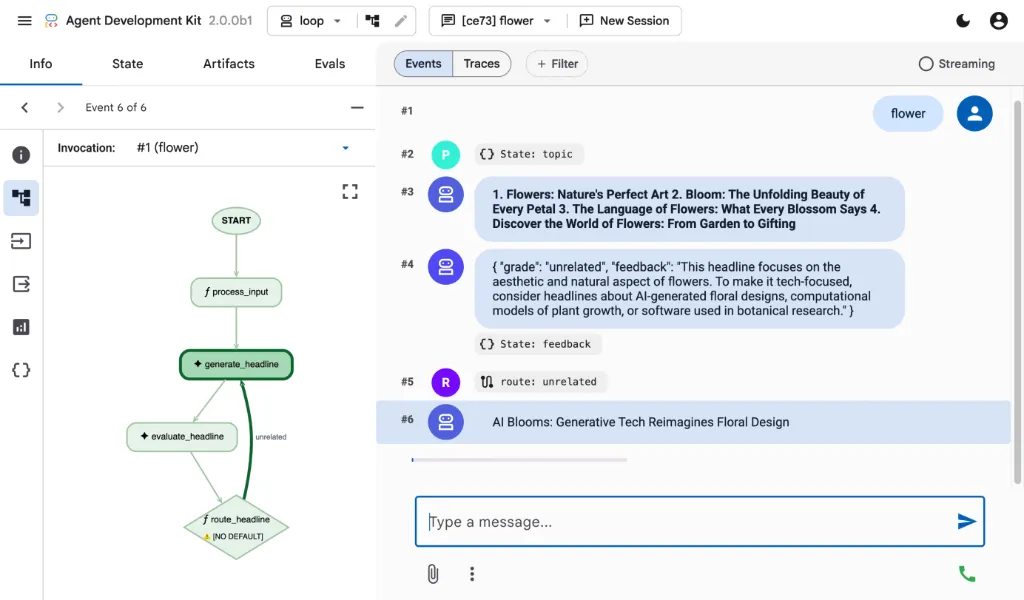
Building an agent demo is an afternoon’s work. Everything after that is the hard part: evals run by hand, debugging by print statements, a deploy script nobody wants to own. Google ADK (Agent Development Kit) is Google’s open-source, code-first Python framework for exactly that back half — Apache-2.0, about 22k stars on the core repo (checked September 28, 2026), with v2.10.0 released on September 25, 2026 and new versions landing roughly every two weeks. The Chinese dev channel 钟老师AI实战 recommended it on WeChat Channels on September 27. Its most interesting piece is the built-in dev UI: the workflow graph drawn on the left, every event, state change and eval result streaming past on the right.
Core features
ADK’s features serve one idea: treat agents as software engineering, not a prompt plus a loop.
- Two building blocks:
Agentdefines a single agent — model, instructions, tools.Workflowwires agents into a graph, with routing, fan-out/fan-in, loops, retries, state management, human-in-the-loop and nested flows built in. - Agent-to-agent delegation: the Task API hands work from one agent to another as a structured task — multi-turn or single-turn with controlled output — and a task agent can itself be a workflow node.
- Tools without lock-in: prebuilt tools, plain Python functions, OpenAPI specs and MCP servers all plug in. Gemini gets the deepest optimization, but ADK is model-agnostic and pins you to no single deployment target.
- Evals as a first-class feature:
adk evalreads an evalset JSON plus a config file and scores your agent against fixed cases; the repo ships a home_automation_agent sample to copy from. - Deploy by command:
adk deploy dockercontainerizes,adk deploy cloud_runpushes to Google Cloud, and Vertex AI Agent Engine is the managed path — both flags accept--with_uito ship the UI along. - Not just Python: official Java, Kotlin, Go and TypeScript ports exist, and Agent Config builds agents without writing code.
Typical use cases
ADK fits when a project has moved past the demo stage:
- Multi-agent pipelines — support triage, content review, routing — where you want the hand-offs drawn as a graph instead of buried in code.
- Teams whose demo runs but who are stuck on the way to production: evalsets go into regression, and
adk deploytakes over the second half. - Backend engineers wiring agents to internal APIs: point ADK at an OpenAPI spec or an MCP server and skip the glue layer.
Quick start
Three steps: install, write an agent, run it. Python 3.10+:
pip install google-adk
from google.adk import Agent

root_agent = Agent(
    name="greeting_agent",
    model="gemini-2.5-flash",
    instruction="You are a helpful assistant. Greet the user warmly.",
)
Drop the file into an agent directory, then adk run <dir> for a terminal chat or adk web <dir> for the local dev UI shown above — event stream, state graph and evals included; there’s an official demo video on YouTube. If you build agents with an AI coding assistant, the repo’s llms.txt and llms-full.txt are made to be fed to it as context. Brand new to agents? The AI Agents for Beginners course is a good on-ramp before coming back.
Summary
ADK is for teams past the “does it run” stage who intend to maintain agents like software: evalsets for regression, an event stream for debugging, commands for shipping — Apache-2.0, Python 3.10+. Skip it if all you want is a one-file script; the directory layout, evalsets and deploy configs assume you’re going all the way to production. Two honest caveats: Gemini gets the deepest optimization, and the smoothest managed eval-and-deploy path runs on Vertex AI Agent Engine — that’s Google Cloud. And the 2.0 Workflow and Task APIs are new; the official adk-samples repo is still catching up with the major version. As we argued before, an agent’s value has shifted from prompts to process and evaluation — ADK is Google baking exactly that into a framework.