Developer tools#Code generation#Coding agent
ts-rust: AI ported the TypeScript 7 compiler to Rust, 3 to 4x faster
Theo had AI port Go-based TypeScript 7 to Rust: a full T3 Code check runs 2.98x faster, 4.35x in fast mode, across 184,773 ported tests. MIT.
Project facts
GitHub Ecosystem- License
- MIT
- Language
- Rust
- Stars
- 1,382
- Data checked
- 2026-10-20
Snapshot figures reflect the check date and may change over time.
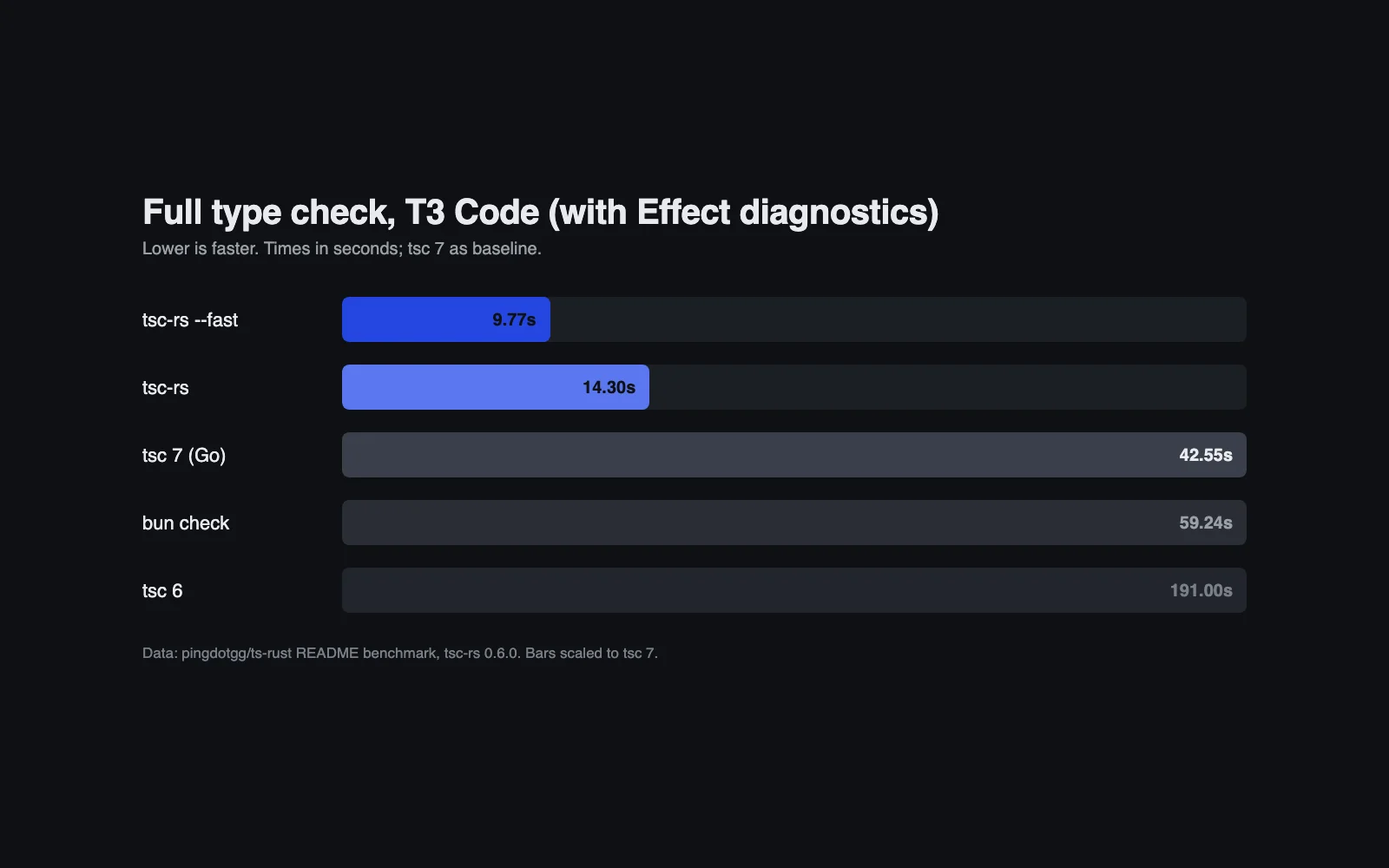
Microsoft shipped TypeScript 7, rewritten in Go, on July 8 and said full builds typically run 8 to 12 times faster than TypeScript 6. Now someone has ported it again. Developer Theo used AI to move the Go compiler and type checker to Rust, in a project called ts-rust (npm package tsc-rs). On a full type check of T3 Code, the Rust version takes 14.30 seconds by default and 9.77 in fast mode, against 42.55 for the Go version — 2.98x and 4.35x faster. The project is MIT, its primary language is Rust, and it had 1,382 stars on October 20, 2026. The line worth noticing is in the README: “I’ve never read a line of this code.”
Core features
- A complete port: The compiler, type checker and language service all moved. You keep writing TypeScript and swap only the checking and build tools, and
tsc-rskeeps the Go version’s algorithms and behaviour. - Two speed settings: Default mode is 2.98x faster on T3 Code;
--fastuses more checking threads for 4.35x, at the cost of higher CPU time and peak memory. - Compatibility bought with tests: It passes 184,773 tests ported from the Go version, plus comparison tests for the language service and API. The author says it is 100% compatible in every real-world project tested.
- Lower editor memory: Across 10,000-edit sessions it reached 232 and 249 MiB on Query core against
tsc’s 291 and 305, and 314 and 324 MiB on Hono against 417 and 422. - AI writes, the human verifies: The author spent months with OpenAI models and over $400,000 in tokens to reach about 84% compatibility; switching to Opus 5.5 produced a working v0 in 10 hours, followed by about two weeks of iteration.
Typical use cases
- CI for large TypeScript repos: A full type check drops from minutes to seconds, cutting the wait on every build.
- Anyone experimenting with type checking in WASM: One of the author’s stated motivations is a checker that runs fast in WASM.
- People studying whether AI can port large compilers: The README records the process, the cost and the failed attempts, which makes it unusually good first-hand material.
- Teams watching editor memory: Memory grows more slowly than
tscover long sessions.
Quick start
npm install -D tsc-rs
npx tsc-rs -p tsconfig.json
The author adds his own warning in the README: “Be warned, I have no idea if this will actually work.” Run a full check in CI or locally and compare the diagnostics before replacing anything.
Summary
It suits teams trying to cut type-check time on large TS projects, and anyone studying AI-assisted porting. It does not suit anyone who needs a stable production tool: the README calls it an early release, and the known problems include extra TS6059 reports in monorepos where files are reachable both through node_modules and a direct import, tsc -b reading stale output when projects build in parallel, and slow memory growth in long editor sessions.
The speed numbers are the project’s own benchmark (16 vCPU, about 62 GiB of RAM on AMD EPYC, output and incremental builds off, median of five warm runs), and I have not reproduced them. Fast mode’s advantage rests on more threads, so a CI machine’s core count and memory change the result. And that the code was written by AI and never read by its author is both the most interesting thing about the project and the risk to weigh before adopting it. Rust, MIT, 1,382 stars. Unlike Everything, which rewrites commercial apps one by one, this rewrites a compiler, and its motive is as much testing model capability as shipping a tool.