DeepSeek model card lists 11 V4.1 Flash 1017 benchmark results
DeepSeek’s V4.1 Flash 1017 card lists 11 scores above its prior snapshot; IT之家 reports web, app and API updates, with the same API alias and prices.
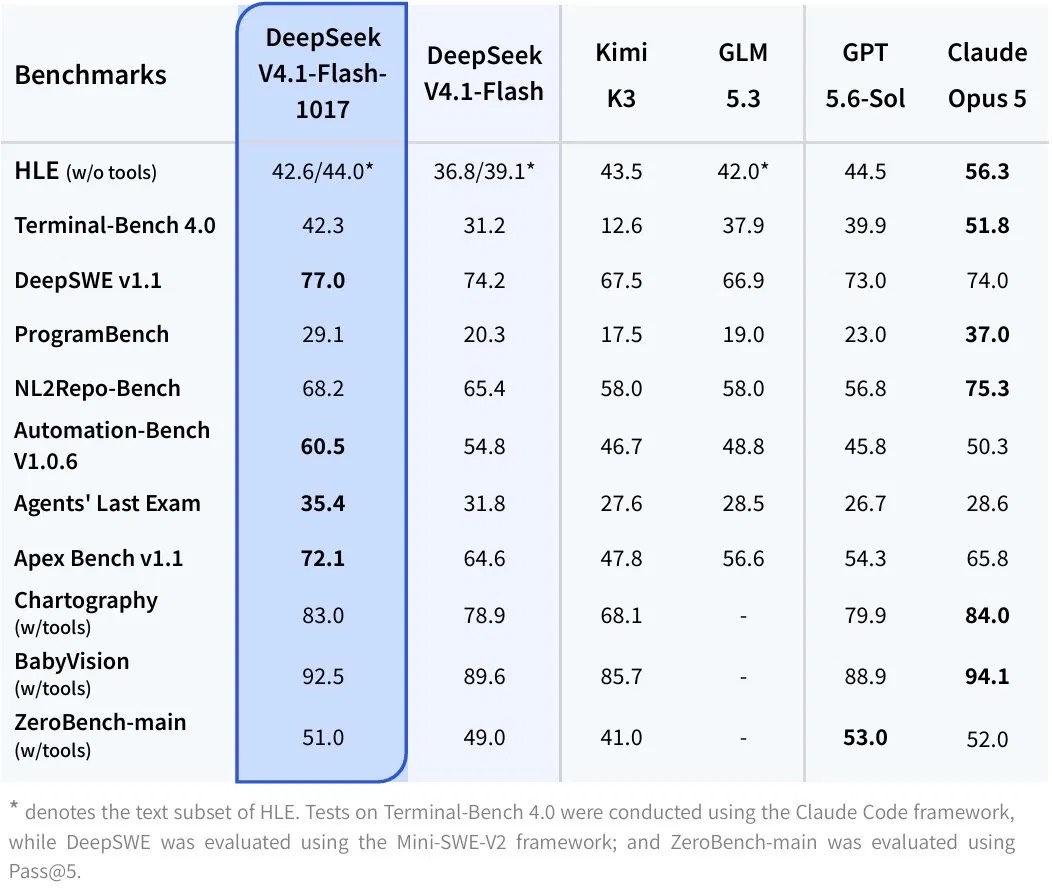
DeepSeek’s V4.1 Flash 1017 model card was created and updated on October 17, 2026, and lists results for coding, agent and vision benchmarks. The card shows 11 scores, each above the prior V4.1 Flash entry. IT之家 reported that DeepSeek’s website, app and API had been updated that day, with the API alias and pricing unchanged.
Key points
DeepSeek’s V4.1 Flash 1017 model card lists 11 benchmark scores above the prior snapshot; IT之家 reports website, app and API updates, with the same API alias and pricing.
- DeepSeek compares the new snapshot with the previous V4.1 Flash across 11 benchmarks; every listed score is higher for the new entry.
- IT之家 reports that DeepSeek’s website, app and API have been updated, while the API alias
deepseek-flashand pricing remain unchanged. - The model card gives only a few evaluation details; OfficeChai attributes its task-cost figures to a DeepSeek chart and mentions the mini-swe-agent harness.
Background
The Hugging Face page identifies the card as deepseek-ai/DeepSeek-V4.1-Flash-1017. Its metadata shows creation at 02:40:38 UTC and an update at 05:46:55 UTC; RuntimeWire lists its publication time as 05:08 UTC, between those two events. RuntimeWire reported that two users had observed a possible API refresh, while noting that their observations did not establish a separate model release. IT之家 separately reported that DeepSeek’s website, app and API had been updated, with the API alias still deepseek-flash. This timeline distinguishes card creation, its later update and the reports; the model-card ID is not the API call name, and the evidence does not establish a separate API model release.
The model card’s benchmark scores make more sense in the context of competition over coding and agent evaluation. Our earlier report on DeepSeek’s DSec training sandbox describes infrastructure for large-scale agent training and evaluation. The Arena agent leaderboard offers a different kind of evidence, based on rolling statistics from live sessions. Neither can validate scores on this new model card: they measure different things and use different evaluation setups.
The card also describes the downloadable weights. It lists a MIT license, 763 billion parameters and roughly 510.3 GB of weight files, and recommends a 1-million-token context window. Open weights and easy local inference are separate propositions at that scale. The page points to Transformers, vLLM and SGLang deployment paths; it does not suggest that an ordinary desktop GPU can run the full model.
DeepSeek Flash benchmarks
The benchmark table answers how the new snapshot compares with the previous one. It does not provide a universal quality score that transfers directly to every application. The figures below are from DeepSeek’s model card as of October 17, 2026; † marks the text-only HLE subset.
| Benchmark | V4.1 Flash 1017 | Prior V4.1 Flash | Opus 5 |
|---|---|---|---|
| HLE, without tools | 42.6 (44.0†) | 36.8 (39.1†) | 56.3 |
| Terminal-Bench 4.0 | 42.3 | 31.2 | 51.8 |
| DeepSWE v1.1 | 77.0 | 74.2 | 74.0 |
| ProgramBench | 29.1 | 20.3 | 37.0 |
| NL2Repo-Bench | 68.2 | 65.4 | 75.3 |
| Automation-Bench v1.0.6 | 60.5 | 54.8 | 50.3 |
| Agents’ Last Exam | 35.4 | 31.8 | 28.6 |
| Apex Bench v1.1 | 72.1 | 64.6 | 65.8 |
| Chartography, with tools | 83.0 | 78.9 | 84.0 |
| BabyVision, with tools | 92.5 | 89.6 | 94.1 |
| ZeroBench-main, with tools | 51.0 | 49.0 | 52.0 |
The new entry is above its predecessor on all 11 listed rows, but its comparison with Opus 5 is mixed. DeepSWE, Automation-Bench, Agents’ Last Exam and Apex Bench favor the new DeepSeek score. HLE, Terminal-Bench, ProgramBench, NL2Repo, Chartography, BabyVision and ZeroBench-main favor Opus 5. The tests cover different tasks and tool environments, so one win does not establish that the model is better at every coding or vision job.
DeepSeek discloses only part of the evaluation setup. The card says Terminal-Bench 4.0 used the Claude Code framework, DeepSWE v1.1 used Mini-SWE-V2, and † marks the HLE text-only subset. It does not provide full prompts, sampling parameters, runtime environments, run counts or error ranges for the other tests.
The weights and hosted API also need separate treatment. The MIT label is the license declared on the model page. IT之家 reports that the website, app and API have switched to the update, with the deepseek-flash alias and prices unchanged. The public card does not list the current price for an online request or identify a hosted inference provider. The 510.3 GB weight total therefore says nothing about API cost or availability.
What others report
DeepSeek’s model card describes gains in coding, agent and vision capabilities, along with shorter execution time and output length. These are the company’s claims. The card provides scores against the previous version and other models; OfficeChai says its cost figures come from a DeepSeek chart and does not present them as its own runs. These sources document what their authors report and do not establish whether other independent evaluations exist.
IT之家 adds a product-availability angle that the model card does not settle: its October 17 report says the website, app and API have been updated, with deepseek-flash and pricing unchanged. That is a reported product state. Teams whose production behavior depends on a model alias should check the version they actually receive in their own account and request path; the public alias alone does not promise a pinned version.
OfficeChai examines a DeepSeek chart comparing task cost and performance on DeepSWE v1.1. It reports costs of about $0.15–$0.20 per task for a score above 72% at the lowest reasoning effort, and under $0.25 for a 77% score at the highest setting. The article also compares those figures with Opus 5 at higher reasoning effort. The cost points are attributed to DeepSeek’s chart; OfficeChai mentions the mini-swe-agent harness but does not give enough input and output token counts, run totals or failed-task billing rules to reproduce the estimates. The article does not present them as its own benchmark runs.
Our take
For developers, the practical question is what the dated model card and the reported product update mean for an existing integration. DeepSeek’s card lists one set of weights and scores; IT之家 says the website, app and API have been updated, with the API alias and pricing unchanged. Teams maintaining code agents or automated workflows can compare the card’s figures with their baseline and test the current API response on their own tasks. Public materials do not document version pinning for deepseek-flash, so production users should check behavior and regressions.
For the listed benchmarks, DeepSeek’s card shows scores for the new snapshot above those for the prior one across all 11 rows. That comparison alone does not establish an overall win over competitors. OfficeChai’s cost curve may help teams planning repeated agent runs, but the article does not provide all the conditions needed to reproduce it. Actual spend also depends on prompt length, tool calls, retries and the harness, so a point on the chart is not a budget estimate for another system.
The model card lists 763 billion parameters, roughly 510.3 GB of files and deployment paths for Transformers, vLLM and SGLang. Those details give teams with suitable compute and operations capacity a local evaluation path. IT之家 reports that the website, app and API have been updated, with API prices unchanged. Pricing does not answer questions about latency, reliability, privacy requirements or whether the alias is pinned, so teams should choose a route against their own constraints.
How to try it
For a quick check, open DeepSeek’s website or app and try Flash with a code change or multi-step task you already know how to judge. IT之家 reports that both interfaces have been updated. Record the date, prompt, whether tools were enabled and the result. One short exchange cannot reproduce a benchmark or establish reliability.
If your program already calls the API, IT之家 says the alias remains deepseek-flash and prices are unchanged. In a test environment, run the same prompts and tool configuration and compare the output with your saved baseline. The model card also links local deployment paths for Transformers, vLLM and SGLang. Before downloading, budget for roughly 510.3 GB of weight files and verify that your chosen inference framework supports this model.