Valve's canceled Portal prequel F-STOP is now fully playable: three leaks supplied the source code and maps, Valve says nothing
F-STOP, the Portal prequel Valve canceled around 2008, is now a playable build: assets from August's 12TB Steam leak, source code and maps from this week.
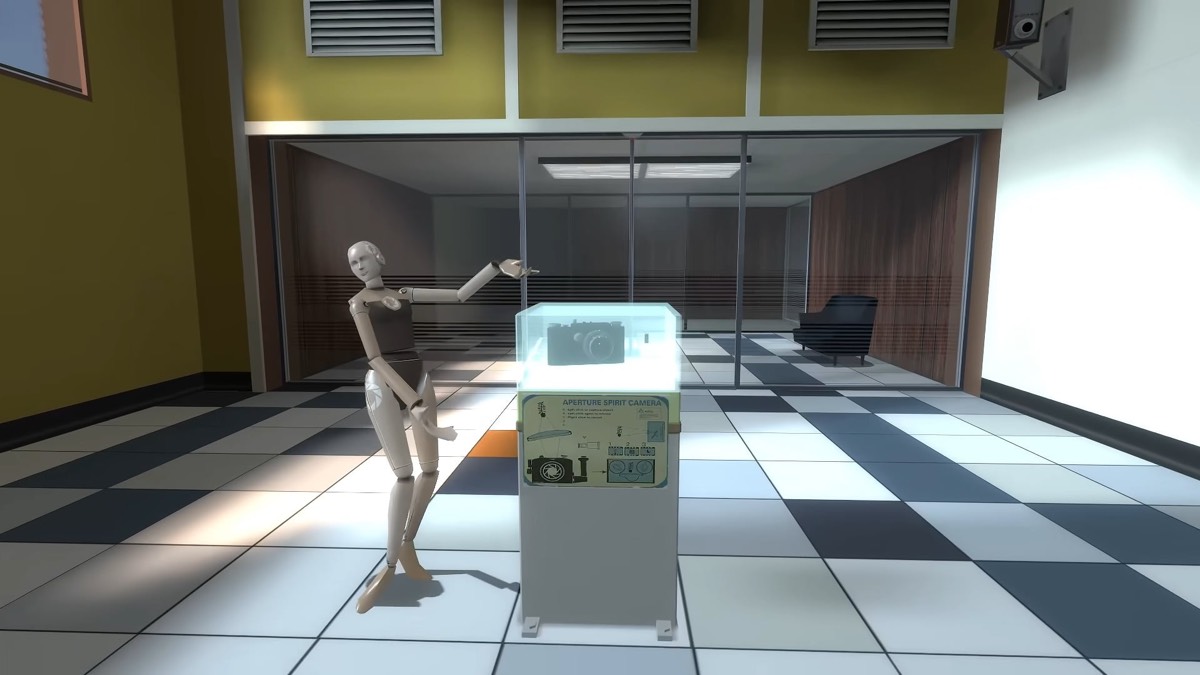
F-STOP is the Portal prequel Valve prototyped after The Orange Box shipped in 2007: instead of a portal gun, players used an experimental camera that captured objects into photos and redeposited them elsewhere to solve puzzles. It never survived playtesting, and it sat shelved for nearly twenty years. Per Kotaku’s November 1 report, the canceled project has now been assembled into a near-complete playable build — most assets came from August’s roughly 12TB Steam leak, while the missing source code and map source data (mapsrc) surfaced on the Valve Cut Content Discord between October 30 and November 1. After the community verified the files, Kotaku describes the build as “essentially 99 percent complete.” All four outlets that covered the story agree on one thing: Valve has not commented.
Key points
- F-STOP grew out of Valve’s 2007 “Directed Design Experiments”: the company split into five teams, each building one gameplay experiment, and the fifth was F-STOP. It showed at an internal “science fair” in February 2008; Newell and the internal audience loved it, playtesters didn’t, and the project died after nearly a year of development (per Half-Life Wiki’s compilation of Valve staff recollections).
- Three separate leaks produced one playable build: August’s Steam data leak — ~12TB per The Verge and Rock Paper Shotgun, ~13TB per Kotaku, both describing the same late-August dump of 2003–2013 depot data — supplied most assets; source code and mapsrc only surfaced this week on the Valve Cut Content Discord.
- The mapsrc leaker initially asked for $1,000; per Kotaku, citing the Discord’s moderators, he “just ended up giving them away for free anyway.” PC Gamer notes the Discord has since gone invite-only, and full-campaign playthrough videos are already on YouTube.
Background
The history survives mainly through staff recollections and archive sites. In November 2007, after The Orange Box shipped, Gabe Newell proposed shutting down Valve’s production pipeline and turning the company into “one big creative playground”; five teams each got about three months to build a prototype. F-STOP came from the team produced by Joshua Weier: it reused Team Fortress 2’s cel-shaded look, dressed it in 1940s Aperture Science offices, and made the whole mechanic nonviolent — photograph an object, pocket it, redeposit it elsewhere, sometimes at a different scale. Half-Life Wiki records co-founder and president cp6kz6rh’s reaction on seeing it: “Fuck yeah!” The playtests, though, kept landing on the same question: why does the sequel to Portal have no portal gun and no GLaDOS?
After cancellation, the project’s legacy scattered into later products. The 1940s Aperture setting and parts of its test-shaft designs fed into Portal 2, and PC Gamer spotted the first appearance of Aperture Personality Cores as puzzle companions in the playable build. In 2018, Valve reportedly evaluated F-STOP as a possible flagship VR title, then chose a new Half-Life game instead — Half-Life: Alyx; a 2022 datamine turned up traces of a Steam Deck remake attempt. Per Half-Life Wiki, Lunchhouse Software assembled a playable F-STOP demo with Valve’s permission, working from both Portal 2 and Left 4 Dead 2 source code, and began publishing the Exposure documentary series.
The facts
The timeline of this week’s events, as each outlet reported it:
| Step | When | What happened | Source |
|---|---|---|---|
| Asset leak | Late August | ~12TB (Kotaku: ~13TB) of 2003–2013 Steam depot data, including most F-STOP assets but no source code or mapsrc | Kotaku / The Verge |
| Source code surfaces | This week | Leaked via the Valve Cut Content Discord; community verified the files | Kotaku |
| mapsrc surfaces | Oct 30 – Nov 1 | Kotaku says “within the past 48 hours”; the leaker asked $1,000, then released it free | Kotaku |
| Playable build | Reported Nov 1 | Community assembled all three pieces; players report some missing assets and dialogue, “essentially 99 percent complete” | Kotaku |
The outlets measure “playable” differently. The Verge and Kotaku both call it a nearly complete version, with full playthroughs already online; RPS is more careful — “what exists of F-Stop is fully playable,” stressing that what runs is what survives of a canceled game, not necessarily the complete product Valve once envisioned. Both statements are true; they are measuring different things.
Access has tightened as attention grew. PC Gamer reports the Valve Cut Content Discord went private and invite-only once the story spread — “you gotta know a guy (or know a guy who knows a guy) to play it yourself” — and the outlet’s own words are that “direct access to the build seems a little shaky at the moment,” a comment on the channel, eased only as full playthroughs started appearing online. That is also why we don’t link or host the build itself — only the four outlets’ reporting and the playthrough videos on YouTube.
What others say
Each outlet lands somewhere different. The Verge compares the mechanic to 2023’s Viewfinder — both puzzles about photographing the world to change it; RPS reaches for Superliminal, finds the tone similar too, and adds a verdict: “this is a lesson in not always listening to test audiences.” PC Gamer takes the preservation angle: given that Valve went on to make Left 4 Dead and Portal 2, “I don’t really mourn the fact that we never got to play its final version,” but having the prototype preserved for posterity is “extremely cool.”
The silence itself is worth noting: none of the four reports carries any statement from Valve. Meanwhile, the boundaries of “recreating old games” are being tested from both directions this year: at the top, providers set rules — Anthropic’s Claude Code now server-side blocks game recreation, making “don’t recreate a specific existing game” a hard clause; at the bottom, player communities hand-assemble a prototype canceled nearly twenty years ago, piece by piece. In Chinese-language media, we could not find a single report on this as of November 2.
Our take
F-STOP is worth recording for reasons that have little to do with “it almost became Portal 2”: it is one of the most famous forks in game design history, a road abandoned whose core mechanic — photograph an object into a picture, rematerialize it elsewhere at a new scale — was independently turned into products more than a decade later by Viewfinder and Superliminal. The idea held up. What killed it was playtesters asking for a portal gun, which in hindsight says more about audience positioning than about the mechanic.
For anyone working on game mechanics, the playable build turns a “what if” into a sample you can run: like the old games AI carried into browsers this year, lost media becomes something you can interact with — you can photograph an object yourself and watch the levels build around that action, which no documentary conveys. The honest catch needs saying too: the build comes from leaked source code, Valve has said nothing, distribution has gone invite-only, and the legal status hangs unresolved. Gaming history holds cases of leaked source quietly tolerated and cases pursued hard. What to watch next is practical: whether Valve moves (a takedown, silent tolerance, or an official revival), and whether the 2003–2013 depot data yields another lost prototype.