Products#Coding agent#Data analysis
Andrej Karpathy launches HackerTube: two decades of HN comments pick what's on
Karpathy launched HackerTube on Oct 31: 6,454 videos across 150 topics, recommended by 20 years of HN comments, built in ~2 hours with Claude Code.
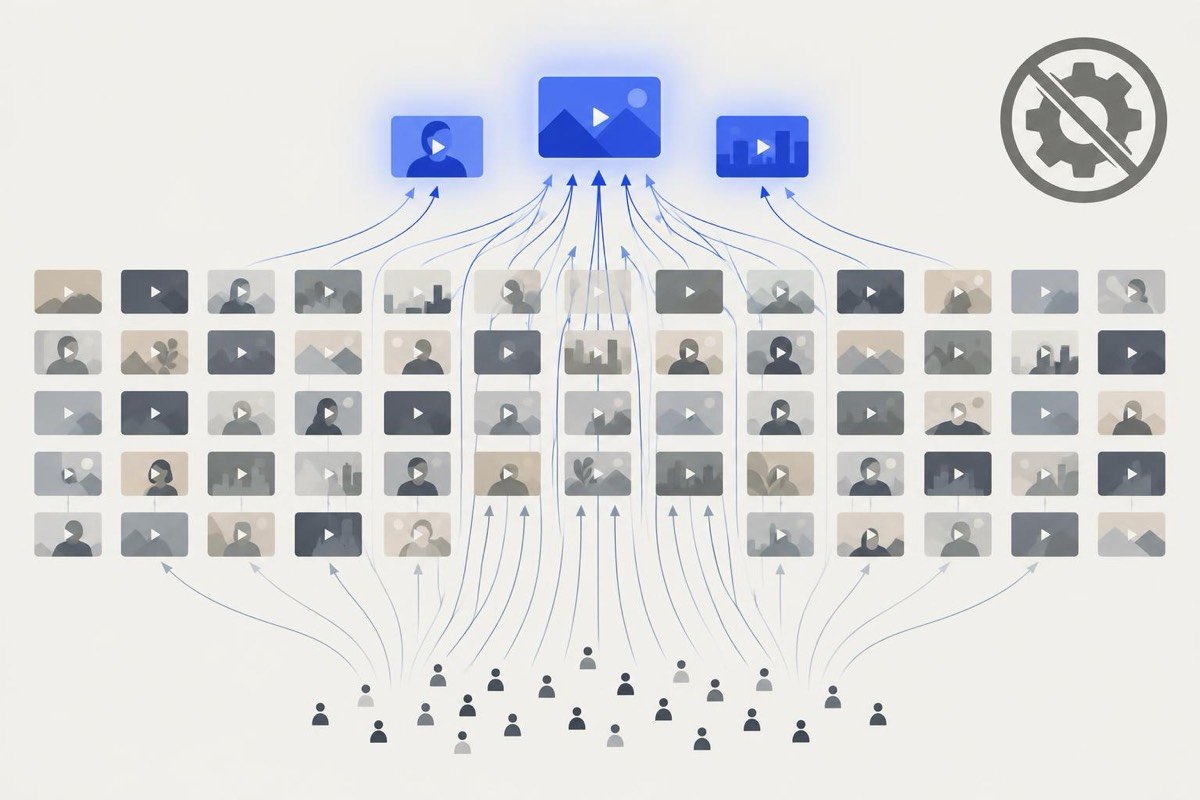
On October 31, Andrej Karpathy — former Tesla AI director and OpenAI founding member — announced HackerTube, a video site whose entire catalog comes from what Hacker News commenters have recommended over the past twenty years: 6,454 YouTube videos across 150 topics, spanning 2007 to 2026. There is no login and no personalization algorithm in the usual sense. The only recommendation signal is collective: comments where HN users actually mentioned a video. According to his blog post, the site was built in about two hours with Claude Code (Opus 5.5); his manual contribution was getting a YouTube API key, spinning up a VPS, and buying the domain. The Show HN thread reached 2,489 points and 500+ comments within a day.
Key points
- The video candidates came from the full Hacker News comment archive — the open-index/hacker-news dataset (since 2006, ~49.3M items, live-updated every 5 minutes) — filtered down to roughly 40K comments that mentioned a YouTube video, deduplicated into 6,454 entries.
- Construction: Claude Code desktop with Opus 5.5 did the engineering; Sonnet ran inside a Workflow to clean the comments and filter spam. Karpathy: “I don’t actually do anything resembling traditional engineering anymore… I only talk to Claude.”
- The server code stays closed — he calls it “a vibe coded mess” — while the full dataset ships as a downloadable zip on the about page, explicitly inviting others to build their own versions.
- Within a day of launch, direct imitations appeared on HN: HackerBooks (books, 1,270 points) and Wikihack (Wikipedia links).
Background
Karpathy has been openly critical of mainstream recommender systems. The post opens with a Friday-night scene: tired, opening YouTube, finding nothing. “I’m sure this algorithm works well for the median person on the internet, but it definitely does not work for me.” His fix wasn’t tuning — it was replacing the signal: engagement optimization out, two decades of HN commenters’ collective judgment in. A comment on HN is effectively a vote, and spam and clickbait are naturally suppressed in that signal. We covered the immediate follow-on: HackerBooks, launched November 1 by developer roansh, applies the same method to books (our earlier report). Turning a community archive into a dataset is becoming a pattern of its own — the same week, another developer ported an entire Call of Duty map into the browser with AI (our earlier report) — individual developers building in days what used to take a team.
The facts
Numbers from the blog post and the HN thread, all checkable:
| Item | Figure | Source |
|---|---|---|
| Videos indexed | 6,454 (2007–2026) | author blog |
| Topics | 150 | author blog |
| Recommendation signal | ~40K video-mentioning HN comments | author blog |
| Comment archive | open-index/hacker-news (since 2006, ~49.3M items, 5-min updates) | Hugging Face dataset page; stats.csv summed |
| Build time | ~2 hours | author blog |
| Token usage | 504M input (90% cached) / 7.6M output | Karpathy in HN comments |
| API-price equivalent | ~$250–300 (near-zero marginal cost on subscription) | senko and others estimating in the HN thread |
| Community reception | 2,489 HN points (as of Nov 2) | HN item 50319510 |
Two engineering details are worth recording. First, the cleaning wasn’t a brute-force LLM pass over everything: rules first pulled comments containing YouTube links, then Sonnet in a Workflow filtered spam and dead links in bulk — 90%+ of the tokens went to that step; the actual site engineering was the small part. Second, thumbnails skip whatever the uploader A/B-optimized and use the real frame at the video’s 50% mark instead.
What others say
The HN thread (500+ comments) is largely positive, with disagreements on three fronts. On copyright: user DivingForGold asked whether aggregating YouTube content without linking back is legitimate — in fact every video plays through the youtube-nocookie embed, so playback and metadata still flow through YouTube. On cost: mips_avatar reckoned “just the Sonnet cleaning was ~$300”; senko computed roughly $250 at API prices; Karpathy himself confirmed the token counts and noted he runs on a subscription, so the marginal cost was near zero. On longevity: worried the site would vanish, commenters got a direct answer — “not imminently, as I’d like to use it personally” — plus a pointer to the data pack on the about page. Data before code is the compromise this project chose. The imitation speed is its own data point: roansh explicitly billed HackerBooks as “HackerTube, but for books,” it hit 1,270 points in a day, and Wikihack followed on November 2.
Our take
For a viewer, HackerTube is immediately usable: no signup, and the ForYou feature stores its state only in your own browser. For a developer, it puts two facts on the table. A community’s twenty years of public discussion is a ready-made, high-quality dataset — HN comments, Reddit archives, wiki edit logs are all the same kind of material. And the engineering cost of standing up such a site has fallen to “an afternoon and one subscription”; what remains scarce is topic selection and taste. The honest catch: HN’s collective taste skews technical and English-language, so calling it “a better YouTube for everyone” oversells it; and without the server code, any replication starts from the data pack rather than a fork. Karpathy has done this before — his hn-time-capsule repo (★690 on GitHub) mined decade-old HN discussions with LLMs — so treating community archives as raw material is a continuous practice, not a one-off. Worth watching: whether the imitation wave produces non-technical community versions, and how YouTube responds to aggregators like this.