Agent frameworks#Coding agent#Data analysis
Scientific Agent Skills: reviewable procedures for research agents
Scientific Agent Skills packages 177 research workflows for scientific software, databases, and literature. Inspect individual skills before installing them.
Project facts
GitHub Ecosystem- License
- MIT
- Language
- Python
- Stars
- 51,831
- Data checked
- 2026-10-17
Snapshot figures reflect the check date and may change over time.
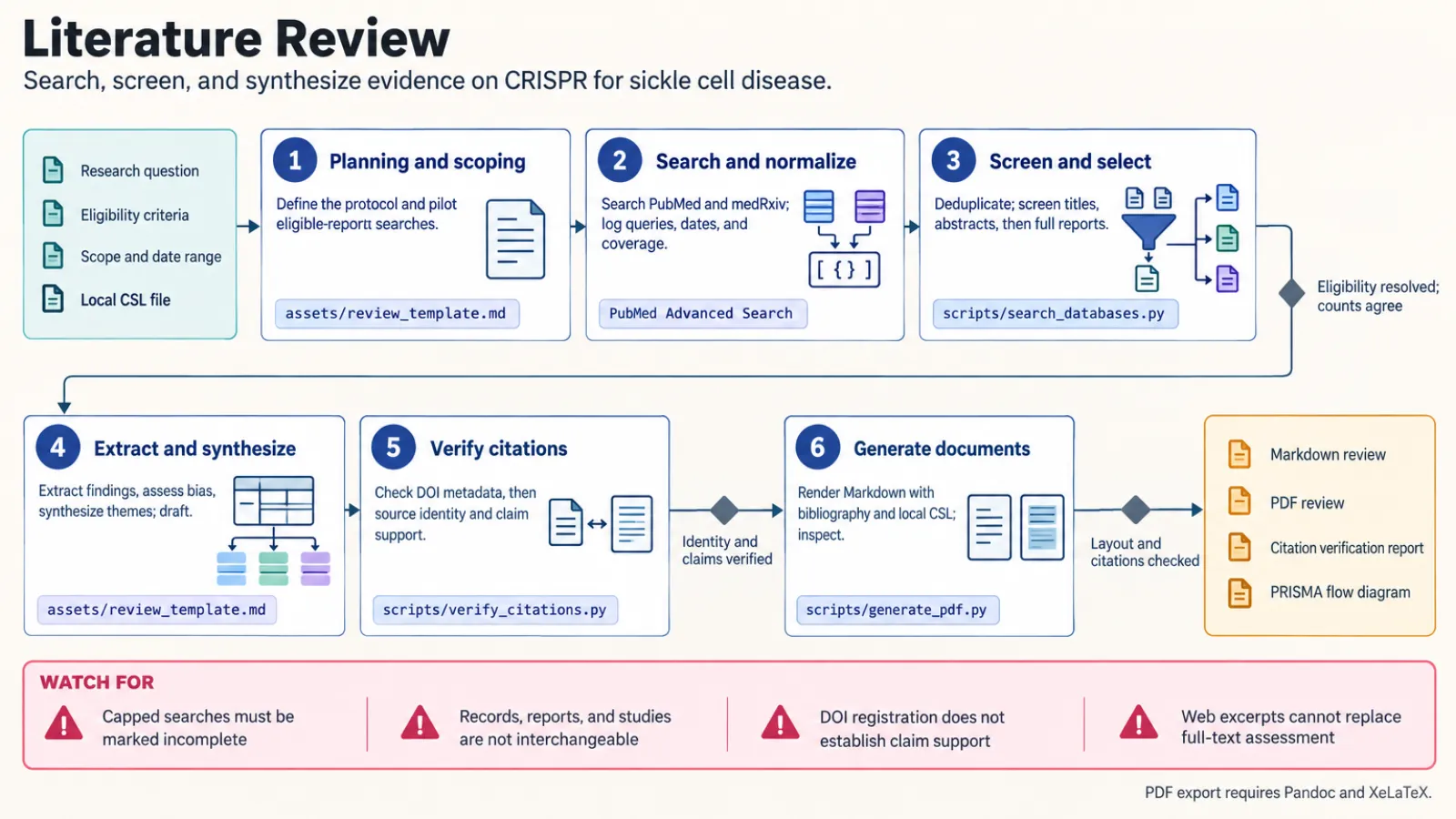
A research agent can write working analysis code without knowing which data conventions, quality checks, or evidence standards make its result defensible. Scientific Agent Skills, maintained by K-Dense, is a collection of research workflows. Each SKILL.md documents procedures for a scientific package, database, or task and is loaded when relevant. The current README lists 177 skills across biology, chemistry, medicine, Earth science, data analysis, and scientific communication. The repository is primarily Python and MIT-licensed; GitHub showed 51,831 stars on October 17, 2026. Its literature-review workflow diagram shows one concrete path from searching and screening through citation checks and report generation.
Core features
- Procedures tied to a research task: a skill can record package or database versions, reference material, examples, and validation steps. The literature-review workflow, for example, starts with a question and screening criteria, then searches, deduplicates, screens full texts, synthesizes evidence, and verifies citations. Its diagram warns that web excerpts cannot replace full-text assessment.
- Coverage across research work: the collection includes drug discovery, bioinformatics, single-cell analysis, microscopy, neuroscience, data visualization, laboratory automation, and scientific communication. The Database Lookup skill documents 80 databases; dedicated skills and multi-database packages add other sources, which is why the README describes the overall collection as covering more than 100 scientific databases and data sources.
- Several agent hosts: the repository follows the Agent Skills standard and lists Claude Code, Cursor, Codex, Gemini CLI, and other compatible hosts. Some clients can also install it as an Agent Plugin. Users can browse the collection with
npx skills addor select a single skill to avoid loading unrelated material. - Documentation does not configure the environment: installing the skill files does not install scientific packages, system tools, or API credentials. Each workflow has its own compatibility, network, and setup requirements, which need to be checked separately.
- A research paper with bounded claims: the accompanying arXiv paper describes an earlier snapshot of 163 skills across 16 practice areas and measures the context cost of the documentation. It reports no task-level evaluation and no host selection rate. Those measurements describe how the procedures are packaged, not the accuracy of an AI scientist.
Typical use cases
- Researchers working with domain-specific data: use documented workflows for Scanpy, RDKit, PubMed, UniProt, ClinicalTrials.gov, and other tools. The skill gives an agent a procedure to follow; a researcher still reviews study design and interpretation.
- Teams that need inspectable outputs: a workflow can require data provenance, software versions, validation results, and uncertainty notes, making the resulting work easier to reproduce or peer-review.
- Developers extending an agent’s toolset selectively: inspect one
SKILL.md, then decide whether its scripts, packages, and database access belong in the project. The collection is a library of instructions, not a self-contained autonomous science system.
For engineering practices that govern how an agent works across tasks, compare agent-skills. For isolated, logged parallel experiments, see OpenResearch. Those projects address different layers: this repository supplies domain procedures, while the host tools still run and manage the research.
Quick start
Browse the available skills, then install one workflow or the full collection in a compatible host:
npx skills add K-Dense-AI/scientific-agent-skills --list
npx skills add K-Dense-AI/scientific-agent-skills --skill scanpy
With GitHub CLI, install a specific skill for Codex:
gh skill install K-Dense-AI/scientific-agent-skills scanpy --agent codex
These commands come from the repository README. Installer flags and support for optional metadata vary by host version, so check the client’s current documentation before running them. Set up dependencies separately according to the selected skill.
Summary
Scientific Agent Skills suits researchers and developers who repeatedly use specialist software or databases and want an agent to follow inspectable procedures. It supplies workflow knowledge; it does not replace statistical review, experimental validation, medical judgment, or qualified professional responsibility. The repository explicitly limits clinical skills to research or preparation for qualified review, not individual diagnosis, treatment, or clinical decisions.
Review the individual skill and its scripts before installation. The project’s security report is dated October 12, 2026: it records a scan of 177 skills, 469 findings in total, including 32 Critical and 21 High findings, with 159 skills marked Safe. Automated scan findings provide a triage signal and are not an individually confirmed vulnerability list. The report is a reason to install selectively, read each SKILL.md, and check what services and data a workflow can access. Skills may execute local commands or call external APIs; the selected model or database service may receive query content. Follow the rules that apply to your research data and institution. The repository uses the MIT license and is primarily written in Python.