Products#Browser automation#Model inference
Opera proposes WebAI, a web standard that lets websites run AI models locally in the browser
Opera's WebAI, October 27: with per-site permission, websites call in-browser models — preview in Opera One, launch models include Gemma and Apple's on Macs.
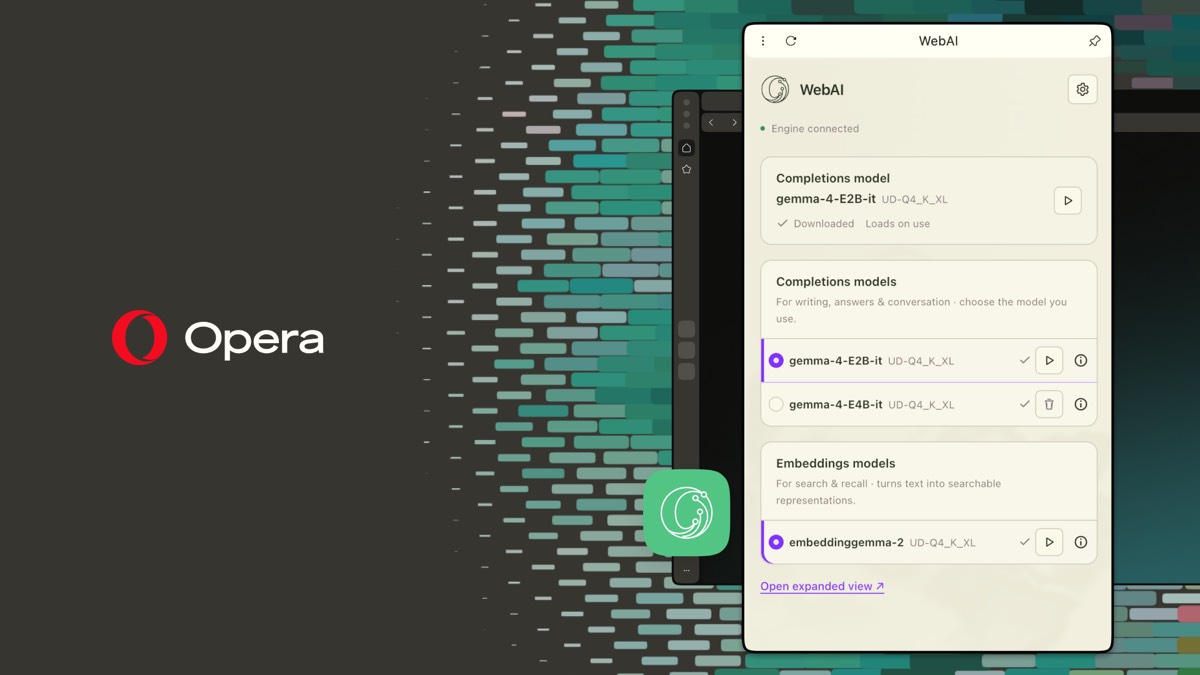
Opera announced WebAI on October 27, 2026: a proposed web standard that lets websites and browser extensions call AI models running on the user’s own device, live today as an opt-in early preview in Opera One on 64-bit Windows (Intel/AMD) and Apple-silicon Macs. Nothing downloads until the user flips “Enable Web AI API” in opera://settings/ai, and per Opera’s press release, each site still has to ask permission before it can access the local model — eight APIs, from Prompt to Summarizer to Writer, already have working playgrounds on the docs site.
Key points
- WebAI is a proposed web standard announced October 27 (Oslo) with an opt-in preview in Opera One; Opera GX and Opera Neon follow. The preview covers 64-bit Windows (Intel/AMD) and Apple-silicon Macs only.
- The developer docs list eight APIs — Prompt, Summarizer, Writer, Rewriter, Translator, Proofreader, Decision, Semantic Embedder — all running local models in the browser, each with a hands-on playground.
- Opera’s press release calls the proposal “backed by companies such as Google and Microsoft” — a self-description so far. Launch models include Google’s Gemma; on Macs, Apple’s on-device foundation model.
Background
This is Opera’s second pass at local models. Unite.AI recalls the first: in April 2024, Opera’s developer stream shipped experimental access to roughly 150 local LLM variants from about 50 model families — Llama, Vicuna, Gemma, Mixtral — each typically taking 2–10 GB of local storage, at a time when Opera claimed to be the first major browser with built-in local LLM access. That build lived in the developer stream and left the model choice to the user; the new pitch inverts the setup, with the browser downloading the model once enabled and the website just calling an API.
Local inference has meanwhile been drifting from hobbyist project toward default. We covered Google’s Foresight, a macOS meeting-notes app that works fully offline, on October 13, and Ollama’s Phonon, a local speech model under Apache 2.0, on October 27. WebAI is Opera’s bid to make “call the local model” a primitive of the web platform itself, instead of something every site assembles on its own.
The facts
From the October 27 press release and docs site, plus the developer blog (published October 22):
| Item | Detail |
|---|---|
| Announced | 2026-10-27 (Oslo) |
| Preview browsers | Opera One (live); Opera GX and Opera Neon (per Opera, coming) |
| Platforms | 64-bit Windows (Intel/AMD), Apple-silicon Macs |
| Explicitly excluded | Intel Macs, Linux, Windows on Arm |
| Launch models | Per Opera: models from Google and Apple, including Gemma (no version given); Apple’s on-device foundation model on Macs |
| Enabling | opera://settings/ai → “Enable Web AI API”; off by default, model downloads only after |
| Permissions | Per-site: each website asks the user separately |
| Documented APIs | Prompt, Summarizer, Writer, Rewriter, Translator, Proofreader, Decision, Semantic Embedder — 8 total |
| Performance | Opera’s wording: “depends on the hardware”; no minimum specs published |
Three facts worth pinning down. The permission model is per-site: the press release states “site-specific permissions enable users to decide which websites can access local AI,” so each website asks the user separately; the developer blog adds that WebAI is opt-in and nothing downloads until the user enables it. All eight APIs have in-browser playgrounds — the docs site states “The Web AI playgrounds run entirely in your browser,” no signup. And the cost claim is explicit: developers “can add AI features without running AI infrastructure or paying for every request,” while users get “no account, no fee and no data sent to an AI service.”
Shipping alongside is HTML-in-Canvas, which puts real, interactive web pages inside 2D and 3D scenes — menus and forms work in-scene, with Webpage Bulldozer and Gamer Room as demos. Per Unite.AI, it is an emerging web platform proposal already implemented in Chromium, with same-origin rules limiting developers to drawing their own content. It is the secondary story; WebAI is the main one.
What others say
TechCrunch (Lucas Ropek, October 27) frames WebAI as “a new web standard to let users deploy AI locally in their browser,” but every factual claim traces back to Opera: the named models are Opera’s picks, and there is no word from Google or Microsoft themselves, nor any third-party benchmark. TechCrunch adds two reservations — local models don’t eliminate every privacy risk but “give users a bit more control,” and local inference “puts more demand on a user’s computer,” with open-weight models carrying “some restrictions” versus fully open-source software.
Opera’s EVP for browsers and AI, Krystian Kolondra, supplies the press release’s thesis: “A lot of what people want from AI doesn’t need a data center.” That is a position, not a measurement.
Note the boundaries: as of this writing there is no public spec draft, GitHub repository or W3C issue — the primary sources and all three independent outlets say only “proposed standard.” “Performance depends on the hardware” is Opera’s wording with no minimum configuration disclosed, and Gemma ships with no version number. One inconsistency worth flagging: the October 22 developer blog says WebAI is “now in early preview across Opera One, Opera GX and Opera Neon,” while the October 27 press release has GX and Neon still to come — the later release is the safer read.
Our take
If WebAI actually matures into a cross-browser standard, what changes for web developers is the cost structure of AI features: today you either run your own inference or pay per token, and client-side AI zeroes the marginal cost — at the price of betting performance on the user’s hardware. Of the eight APIs, the narrow ones — Summarizer, Translator, Proofreader — are the most immediately useful for ordinary sites: no prompt engineering required, the browser manages the model.
But this is not a bet-your-career-on moment. It is one vendor’s preview, the backing claim is self-reported, the spec is unpublished and no independent performance numbers exist; beyond “models from Google and Apple, including Gemma,” Opera hasn’t said which model runs where. Chrome’s built-in AI (Prompt API) is a parallel track; none of our sources assert how the two relate, and we won’t either. The pragmatic move: try your own use case in the playgrounds and build AI features as progressive enhancement — use WebAI when it’s there, fall back to the cloud when it isn’t.
To try it now: install the latest Opera One, open opera://settings/ai, enable “Enable Web AI API,” wait out the model download, then work through the eight playgrounds at next.opera.com/web-ai.