Models#Benchmark#Model inference
Alibaba ships Qwen4-Max: 2.4T parameters, 58% lower cost per task
Alibaba released Qwen4-Max: a 2.4T-parameter MoE with 71B active, native vision and a million-token context, which the vendor says cuts cost per task by 58%.
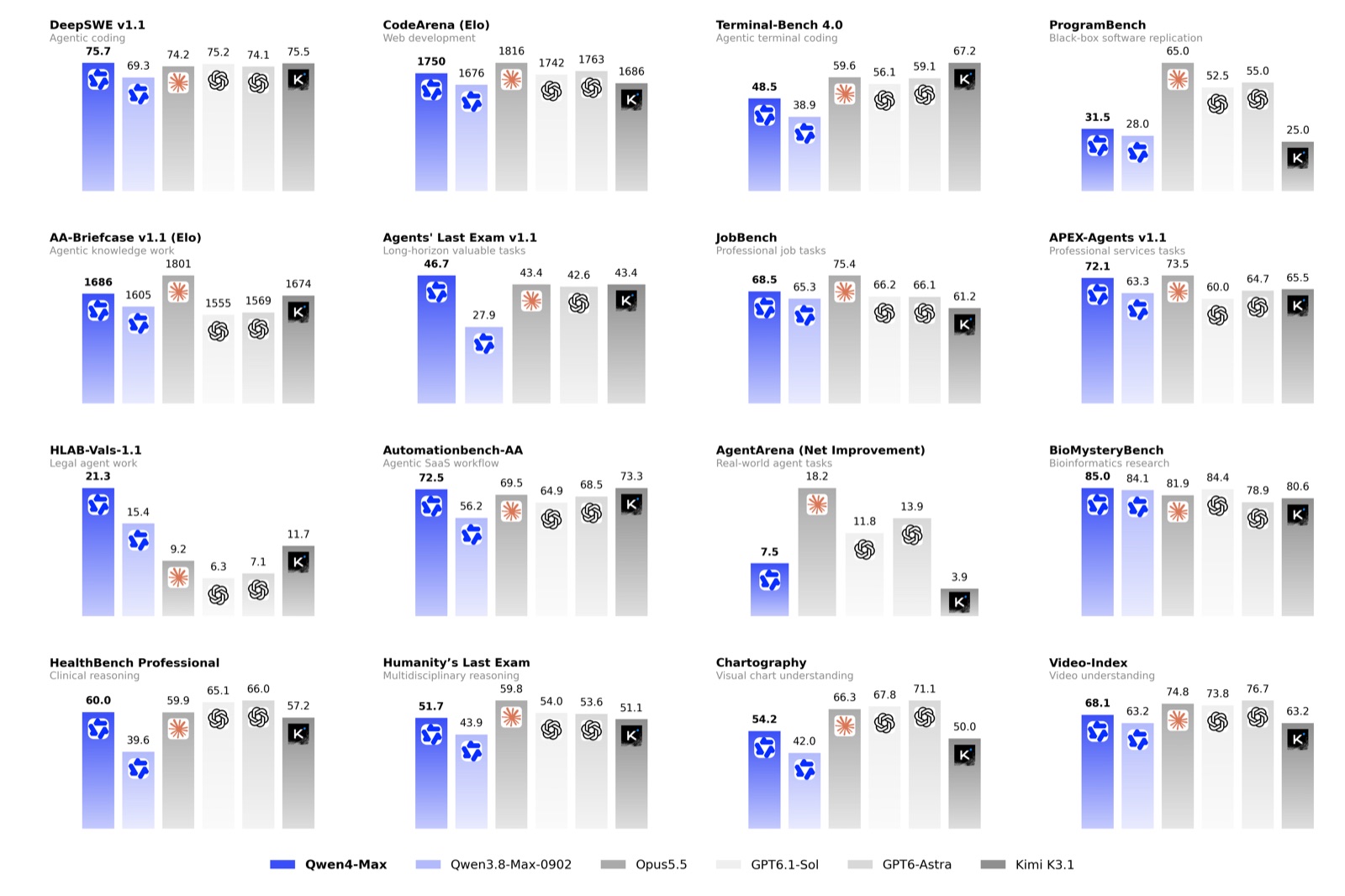
Alibaba released Qwen4-Max on November 16: a 2.4-trillion-parameter backbone with 71B active per token, plus 328B of N-gram Embedding parameters. It has native vision and a million-token context. The official blog frames it less as a leaderboard entry than as “a new teammate” for professional tool use, long-horizon task execution and deliverable-quality work. The model is available through the Qwen AI platform API, and Chinese tech outlet Kuaikeji reported a roughly 60% drop in average cost per task versus the previous generation.
Key points
- The architecture is a sparse-MoE redesign: three of every four layers use Gated DeltaNet to compress history into a fixed-size state, and the fourth uses Qwen Sparse Attention (QSA) with a lightweight indexer that selects relevant context at block granularity. A Gated Residual widens the residual stream into four parallel branches, and N-gram Embedding adds local token-pattern lookup at layer two. The vendor says pretraining at 2.4T ran without loss spikes.
- Efficiency and cost are the headline: on the vendor’s Work360 benchmark, average cost per task fell from 26.58 yuan to 11.16 yuan (-58%); Terminal-Bench 4.0 token use dropped about 48% and 49% at Xhigh and High reasoning, and Work360 about 24% and 35%. Cached input is priced down to 0.5 yuan per million tokens.
- Third-party benchmark numbers need attribution: Kuaikeji reports sixth place on CodeArena’s Webdev blind test (between GPT6-Astra and Claude Fable5.1), ALE 46.7, Chartography 54.2, JobBench 67.3 and Terminal-Bench 4.0 at 48.5 (up from 37.9). These come from vendor figures relayed by media, with no independent replication yet.
Context
Qwen4-Max is the first Max size in the Qwen4 family. The blog shows four capability areas: Blender modelling and scene creation, game development in Unity, Unreal and Godot (where the model runs the game and iterates on visual and interaction feedback), production-line planning and part design for automotive manufacturing, and long-cycle work in finance, law, medicine and frontier science. Work360 is the vendor’s industry benchmark framework for this, spanning 26 top-level domains, 182 second-level and 721 third-level subdomains.
Against Qwen3.8-Max the vendor gives three efficiency figures: base-model BPB falls 5–13% across knowledge, code, Q&A and STEM internal evaluations while per-token active parameters drop about 25%. Doing the same work with fewer tokens is what drives the cost claim, and it is the claim most worth verifying on your own workload.
Availability
Qwen4-Max is live through the Qwen AI platform API with sharply lower cached-input pricing; it can also be called via Alibaba Token Plan, or used in Qwen Office, Qoder and the Qwen app. The company says mid- and small-size Qwen4 models will be open-sourced progressively — this review found no timetable, so anyone waiting for open weights should watch for a separate announcement.
Analysis
- Read the cost number with its task set: the 58% figure is for Work360 tasks under the vendor’s pricing; input length, cache hit rate and output length will change the result on your workload. Run an A/B on your own tasks.
- Treat the benchmarks as vendor claims: CodeArena sixth place and ALE 46.7 are media relays of vendor data. Until independent evaluations land, they should not drive a selection decision — the same caution applied to Gemini 4 Carbon.
- Long-horizon execution deserves its own test: the demos emphasize multi-step tool use and iteration, such as running and debugging a game. That capability does not show up in short Q&A; evaluate with real tasks of 20 steps or more.
Summary
If your workload is coding, office documents or long-cycle industry tasks, Qwen4-Max deserves a slot in the candidate pool: fix a small set of real tasks, record token use, cache hit rate and the final bill, then compare against your current model. The blog and media coverage give plenty of evaluation leads, but the migration case has to come from your own controlled test. For the related on-device push, see Google’s on-device speech.