Research#Model training#Model inference
Sebastian Raschka put a free 11-hour video course on building reasoning models on YouTube
Sebastian Raschka put his full from-scratch reasoning-model course on YouTube for free on Oct 24: 8 episodes, 11+ hours, PyTorch code under Apache-2.0.
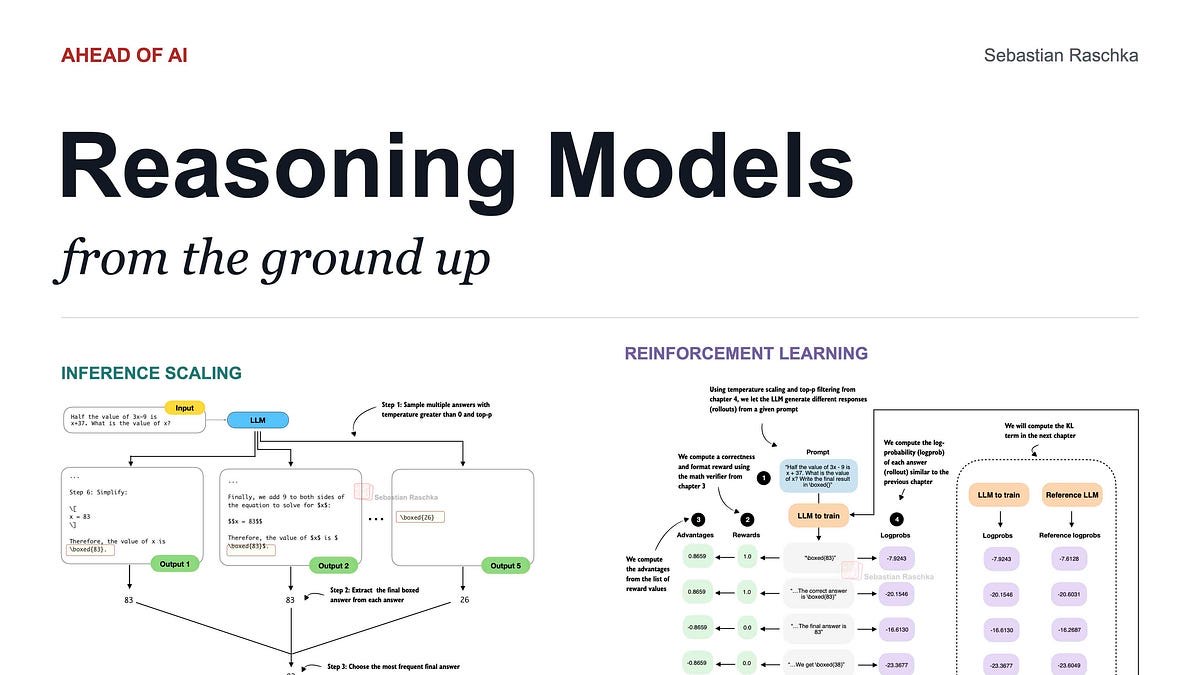
On October 24, Sebastian Raschka — an LLM research engineer who previously was a professor of statistics at the University of Wisconsin–Madison, and author of Build a Reasoning Model (From Scratch) — announced on his Substack, Ahead of AI, that all 8 episodes of the accompanying video course, more than 11 hours of recorded coding, are now free on YouTube. The course starts by loading pretrained Qwen3 0.6B weights and builds up by hand: an MATH-500 verifier, self-consistency voting, a simplified GRPO training loop, and finally distillation from DeepSeek R1 teacher data. The code lives in the GitHub repo rasbt/reasoning-from-scratch, which when we checked on 2026-10-27 stood at 5,639 stars and 898 forks under the Apache-2.0 license.
Key points
- Entirely free: all 8 episodes are public on YouTube with no paywall; the only paid piece is the Manning book of the same name, and the videos extend the book rather than advertise it.
- The full recipe: starting from Qwen3 0.6B inference, the course implements an MATH-500 verifier, self-consistency majority voting, simplified and advanced GRPO (clipping, KL term, reward hacking), then DeepSeek R1 distillation — the same core moves behind models like DeepSeek R1 and GPT-5 Thinking.
- Modest prerequisites: officially, comfort with Python and PyTorch; the previous book Build a Large Language Model (From Scratch) is “recommended but not strictly required.” Inference examples run on CPU; for training, the official guidance is that a GPU makes the work much more practical.
Background
Raschka is not new to this format. His first book came out in 2015, and Build a Large Language Model (From Scratch) became one of the most-followed implementation guides in its genre, with a repo that has held tens of thousands of stars for years. The reasoning course is its sequel: the earlier book answers how a base LLM gets written, this one answers how reasoning gets added on. The other reference point for hands-on decomposition of frontier techniques is Andrej Karpathy’s video series — the HN thread produced an instant “Karpathy 2.0!”, along with the fairer observation that both men have been at this for over a decade (Karpathy’s CS231n and Raschka’s first book both date to 2015). The Hacker News thread went up on October 26; when we checked on 2026-10-27 it stood at 518 points and 77 comments, with substantive arguments on both sides.
The facts
Numbers below come from the Substack announcement, the GitHub repository and the HN thread; all checked on 2026-10-27.
| Episode | Topic | Book chapters |
|---|---|---|
| 1 | Motivation and setup (uv, CUDA, Apple Silicon, remote GPU with VS Code) | Ch 1–2 |
| 2 | Loading Qwen3 0.6B, tokenization, greedy decoding, KV cache, torch.compile | Ch 2 |
| 3 | Verifier: answer extraction, math-equivalence checking, MATH-500 evaluation | Ch 3 |
| 4 | Inference-time scaling I: temperature and top-p sampling, self-consistency | Ch 4 |
| 5 | Inference-time scaling II: log-prob scoring, self-refinement loop | Ch 5 |
| 6 | Simplified GRPO/RLVR: relative advantages, training loop, RLHF vs RLVR | Ch 6 |
| 7 | Advanced RL: clipping, KL term, format rewards, reward hacking, checkpoints | Ch 7 |
| 8 | Distillation: soft/hard, on/off-policy, DeepSeek R1 teacher data | Ch 8 |
- Free vs paid: the videos are free; the Manning book (ISBN 9781633434677, printed in color) is the paid deep-dive. Per the repo’s README, the book mirrors the approaches used in creating large-scale reasoning models such as DeepSeek R1 and GPT-5 Thinking.
- The hardware bill: early inference episodes run on a CPU — Qwen3 0.6B fits on a recent MacBook or a single gaming GPU. For the training episodes (6–8), the announcement is blunt: bring a GPU.
- Engineering depth: the repo runs CI on Linux, macOS and Windows; chapters 2–8 each ship a main notebook plus exercise solutions (chapter 1 has no code), with appendices on swapping in larger LLMs, batching and throughput, and common LLM evaluation approaches.
What others say
The HN argument was over whether courses like this are worth the time at all. The sharpest critic, user hypfer, put it this way: anyone who truly wants to build models needs more than videos, and everyone else is making “a purchase of an identity” — paying to feel like they’re doing something. gradus_ad compared from-scratch guides to “a build your own CPU guide 10 years ago. Interesting, but not of any practical use.” torben-friis named the underlying dilemma: theory in baby steps feels pointless unless you commit like a math degree, while practice demands compute and data beyond a home hacker’s reach.
The defense tracked the course’s actual design choices. libraryofbabel quoted the book’s “a regular laptop, without the need for any special hardware” line, noted Qwen3 0.6B runs on a recent MacBook or gaming GPU, and reached for Crafting Interpreters as the analogy: the value is seeing how the thing is made, not shipping a product. kadoban argued post-training is the practical enthusiast path — “Look up LoRAs for instance,” since adding a capability takes far fewer weight changes than pretraining. fantispug did the arithmetic: fine-tuning models under ~4B parameters works on a commodity GPU. CamperBob2 invoked Karpathy’s videos — follow them to the end and “You end up with a GPT-2.0 equivalent” — defending toy models as intuition-building, “Not pointless at all.”
Our take
For an engineer who wants “reasoning model” to stop being a marketing term and become code they can modify, this is about the cheapest complete path available right now: free, 8 episodes, runnable code, and every step anchored to a benchmark or training curve you can check. It differs from reading papers because gradients actually flow, and from reading the book because someone writes the code with you. Two honest catches. First, the artifact itself — a 0.6B reasoning model — is not competitive on any public leaderboard; the value is intuition and method, not the weights, and the ceiling of production-scale open-weight reasoning models is a different story, as our coverage of Kimi K3.1 Pro shows. Second, episodes 6–8 genuinely want a GPU; without one you’re renting cards or accepting long CPU training runs — for what a local box can and can’t do, see our DGX Spark local-model teardown. The HN “identity purchase” jab lands on real courses with real price tags; this one at least drops the cost of finding out to zero.