YouTube Music starts labeling AI-generated songs “Made with AI”
YouTube Music began labeling AI-made songs on Oct 14, 2026: partners declare via DDEX/CSV metadata; undeclared tracks are tagged by YouTube's detectors.
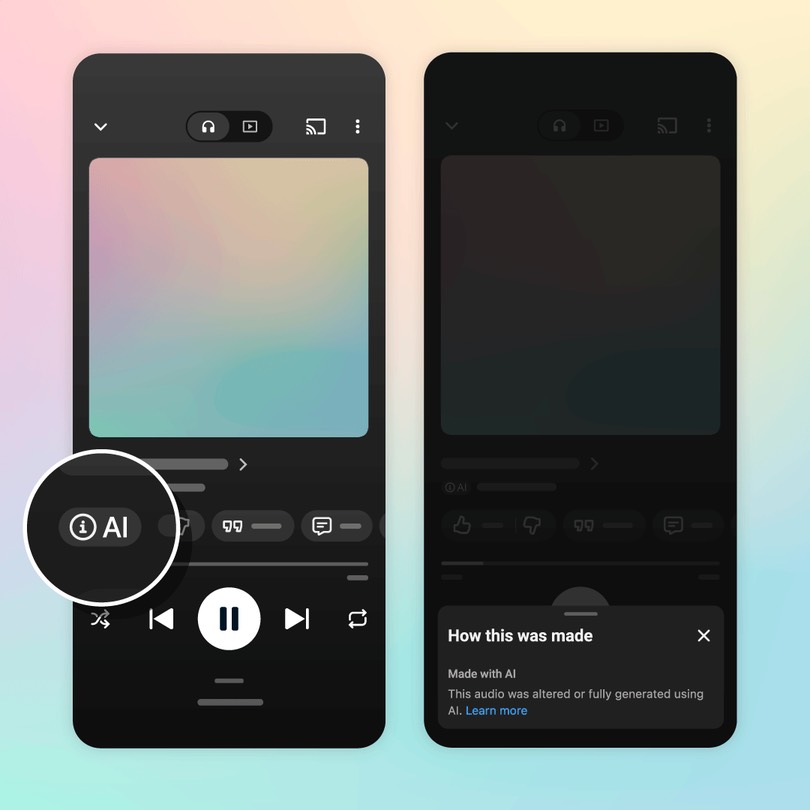
YouTube Music started showing AI disclosure labels on song player pages on October 14, 2026. The official blog post announced the rollout the same day: tracks “created primarily using generative AI” — say, a generative model writing both the composition and the vocals — now carry a label right on the player page, and tapping it opens a menu with more detail. The mechanism lives upstream of what listeners see: labels and distributors declare AI usage per asset through DDEX ERN 4.3.2+ or a CSV field named contains_ai, and when they don’t, Google’s support page says YouTube “will rely solely on those signals and may designate content as fully or partly Gen AI.” The labels reach the main YouTube app later.
Key points
- YouTube Music began labeling songs “created primarily using generative AI” on player pages on October 14, 2026; the main YouTube app follows (official blog).
- Declarations come in three tiers — Fully Gen AI, Partly Gen AI, No Gen AI — filed through DDEX ERN 4.3.2+, the GenAiDeclarationCsvTemplate’s contains_ai column, or YouTube Studio’s attribute section (support page).
- An undeclared track can be designated from YouTube’s own detection signals; per TechCrunch, AI involvement alone doesn’t cost a track monetization — a stance neither official document mentions.
Background
YouTube already labels AI content across video, and the blog says the music labels apply “the same labeling principles already used across YouTube.” Streaming at large has been moving too, unevenly. TechCrunch dates Spotify’s voluntary AI label to a September 25, 2025 policy update; The Verge calls it “earlier this year.” The two disagree, so this entry sticks with the dated one, and Bandcamp went furthest, banning AI music outright earlier this year. On the supply side, we previously covered Stability AI’s rebuild into an AI music tool company, funded and licensed by all three majors. A different technical bet altogether is OpenAI’s textGrain watermark, which marks model output invisibly — YouTube’s labels instead ride on upstream declarations plus platform detection, marking the track rather than the model.
The facts
Google’s support page splits disclosure into three tiers, and its own examples draw the lines:
| Tier | Support-page definition | Official example |
|---|---|---|
| Fully Gen AI | “All content was created using Generative AI.” | A track generated entirely from text prompts |
| Partly Gen AI | “Part of the content was created using Generative AI.” | An AI-generated bassline under live vocals |
| No Gen AI | “No content was created using Generative AI.” | Auto-Tune pitch correction, AI mastering |
- Channels. DDEX deliveries use the AI contributor composite in ERN 4.3.2+; bulk updates can run through the GenAiDeclarationCsvTemplate in Studio Content Manager, whose contains_ai column takes all, partly, none or unknown (unknown exists to clear a previous misdeclaration); everything else gets marked manually in YouTube Studio’s attribute section.
- Silence has a consequence. With no Gen AI information provided, the support page says YouTube “will rely solely on those signals and may designate content as fully or partly Gen AI,” and a blank value is read as unknown unless YouTube can determine otherwise from other signals.
- What listeners see. The blog puts the label directly on the player page, opening a menu on tap. The post’s own artwork titles that menu “How this was made,” with the line “Made with AI — This audio was altered or fully generated using AI.” The post never names the badge in its text; The Verge’s report calls the label “Made with AI,” while TechCrunch’s does not — its sole “Made With AI” mention refers to Apple Music’s planned tags.
- Monetization. Only TechCrunch addresses it: disclosure over restrictions, with AI involvement alone not disqualifying a track. Neither official document mentions monetization.
What others say
The scale argument comes from Deezer: TechCrunch cites its July figures of nearly 90,000 fully AI-generated tracks arriving per day, more than half of daily uploads. Deezer labels what it detects, keeps those tracks out of algorithmic recommendations and editorial playlists, and has a listener filter switch — though the outlets disagree on whether the switch is already live (The Verge) or still planned (TechCrunch). TIDAL goes further: it labels recordings identified as entirely AI-generated and excludes them from royalty attribution. Apple Music is next, reportedly rolling out “Made With AI” labels within its AI Transparency Tags later this year, per Variety via TechCrunch.
The sharpest critique targets the definitions. CTOL Digital’s analysis calls the badge “the last link in a supply chain,” settled in the metadata feed long before playback: “Partly” has no fixed meaning for listeners — the support page leaves DDEX’s definitions to each partner’s interpretation, so “two distributors given the same stems” could label the same track differently — and a blank field is “a gamble on a detector whose threshold nobody outside YouTube has seen.” Its advice to delivery desks is to “set contains_ai explicitly on every asset”: a declaration costs one decision up front and buys control over the outcome.
Our take
Three things are worth holding onto. First, the judgment moved upstream: the label is not triggered by listener reports or chosen by the artist at playback — it is settled in distributor metadata plus YouTube’s own detector. For an independent artist, the practical move is to chase your distributor and set contains_ai explicitly, rather than leave the call to a system whose thresholds are unpublished. Second, “Partly” is the soft spot: Auto-Tune is out, an AI bassline is partial, and everything between is interpretation — fuzziness that matters more once the labels reach the main YouTube app and its far larger audience. Third, “disclosure over restrictions” is the loosest stance among the platforms named here; Deezer and TIDAL both take something away, from recommendations or royalties. Keep in mind that YouTube also runs Dream Track, which lets select creators generate soundtracks with AI voices of participating artists — the referee is on the field. What remains unknown is the detector’s accuracy and threshold, and who adjudicates a contested designation; both matter more than the badge itself.