Zoox robotaxis join Uber in Las Vegas, its first third-party platform
Zoox robotaxis went live on Uber in Las Vegas on Nov 16: riders booking UberX may be matched with one at no extra cost, plus a multi-year MGM deal.
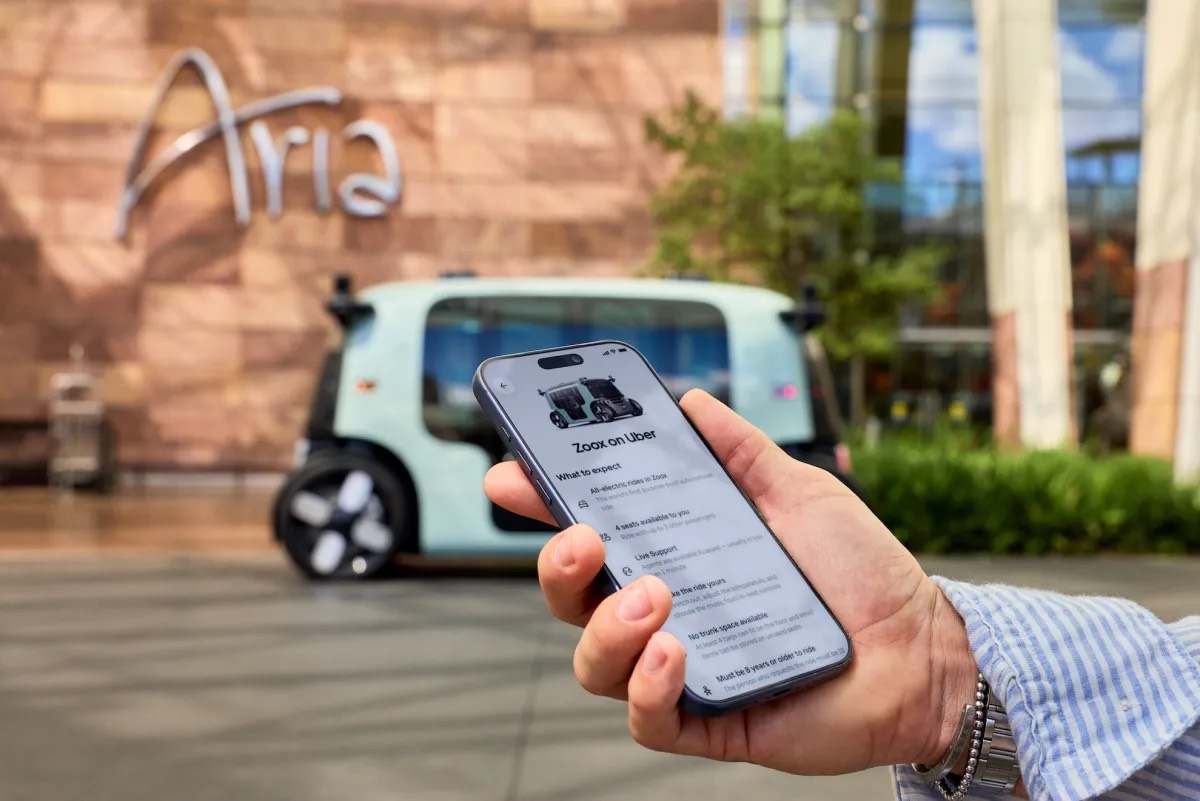
Zoox is Amazon’s self-driving subsidiary, and its robotaxi is built from scratch: no steering wheel, no driver’s seat, no pedals. Starting November 16, 2026, Uber riders in Las Vegas who order an ordinary UberX or Uber Comfort can be matched with one, at the same price as a normal car. It is the first time Zoox has put its vehicles inside a third-party ride-hailing app, according to the announcement; until now they were bookable only through Zoox’s own app, and the same announcement named Uber and Zoox the official rideshare and robotaxi partners of MGM Resorts’ Las Vegas properties under a multi-year deal.
Key points
- A match, not a choice: Uber’s wording is that riders “may be matched with a Zoox robotaxi” when requesting UberX, Uber Comfort, Uber Electric, Uber Comfort Electric or Wait & Save, at no additional cost.
- Three areas only: resorts and venues on and around the Strip, plus Downtown and the Arts District. Zoox’s own service runs 6 a.m. to 3 a.m., seven days a week.
- Tiny fleet: Zoox says it is starting with a small fleet and may expand; its own Nevada network permit caps it at 100 robotaxis, while Uber holds a separate Clark County permit for up to 1,000 through Motional and Zoox (TechCrunch, Aug 20, 2026).
Background
Zoox did not arrive in Las Vegas this week. It opened a public driverless service on and around the Strip on September 10, 2025, bookable only in its own app, which it described as the first fully autonomous ride-hailing service in a purpose-built robotaxi. In March 2026 it announced a multi-year deal with Uber for “select cities”; a NHTSA Part 555 commercial exemption, reported on July 30 and effective July 31, let it charge fares, and it began doing so in August (CNET, Nov 16). On November 11 it extended service from the Strip into Downtown and the Arts District and stretched its hours to 6 a.m.–3 a.m.
Uber’s side of the bet was laid out on its earnings call. Its CEO said in November that Las Vegas would become “the first U.S. city where riders can access two fully driverless partners through the Uber app,” starting with limited fleets and adding supply over the following months before a dedicated autonomous option appears in the app. Uber’s exclusive arrangement with Waymo in Austin and Atlanta ends in January 2028, when Waymo moves riders back to its own app. Waymo’s slower build-the-map-first expansion pattern is the one we traced in Waymo’s Toronto plan.
Service area
The service area is the part of this story most easily blurred. Uber and Zoox describe it as popular resorts and venues on and around the Strip, plus Downtown Las Vegas and the Arts District. Neither announcement lists hotels or the airport; Zoox’s own service page is more specific, with dedicated pickup and drop-off points at partner venues including Sphere and T-Mobile Arena, and airport stops at Terminal 1’s departure level and baggage claim, and at Terminal 3’s ground level (Door 55).
There is no safety driver, and the vehicle is the reason. With no steering wheel, driver’s seat or pedals, there is nobody to sit behind the wheel, and both companies call the service fully autonomous. For contrast, Bloomberg’s November 16 report notes that the Motional vehicles Uber has run in Las Vegas since March still have “a safety driver behind the wheel.” Both kinds of car now dispatch through the same app, and riders may not be able to tell which one is coming before they accept.
The launch also collides with Formula 1. Zoox’s Las Vegas page carried a notice on launch day that 12 pickup and drop-off locations — Aria, Bellagio, Flamingo, Harrah’s, Horseshoe, Palazzo, Planet Hollywood, Sphere, Topgolf, Treasure Island, Venetian and Wynn South — were unavailable because of the Las Vegas Grand Prix; FOX5 reported that Strip circuit road closures begin November 18.
| Item | Detail | Source and date |
|---|---|---|
| Launch date | Nov 16, 2026 | Uber newsroom, Zoox blog |
| Coverage | Resorts and venues on and around the Strip, Downtown, Arts District | Uber newsroom, Nov 16 |
| Hours | 6 a.m.–3 a.m. daily (Zoox’s own service) | Zoox Las Vegas service page |
| Eligible rides | UberX, Uber Comfort, Uber Electric, Uber Comfort Electric, Wait & Save | Uber newsroom |
| Surcharge | None; normal Uber fare | Uber newsroom |
| Seating | Four passengers, two facing rows | Zoox; KSNV, Nov 16 |
| Fleet | “Small fleet”; Zoox’s own permit caps it at 100, Uber’s at 1,000 | Zoox; TechCrunch, Aug 20 |
| Los Angeles | Zoox app first, Uber in 2027 | Uber newsroom; LA Times |
| MGM | Multi-year; official rideshare and robotaxi partners | Uber newsroom, Zoox blog |
Booking and pricing
The route to a Zoox runs through settings, not the home screen. Riders open Settings, then Ride Preferences, then Autonomous vehicles, and switch on “Get more autonomous rides” to improve their odds. KSNV added a detail the announcements omit: before a car is dispatched, the rider can accept the robotaxi or ask for a human-driven ride instead.
Inside, the trip runs on Uber’s interface: the app unlocks the door, and a touchscreen beside the seat starts the ride. The cabin seats four, with floor space the company says fits at least four bags. Fares follow the normal Uber calculation with no surcharge, and the app does not prompt for a tip on an autonomous trip. Both companies offer 24-hour human support through the Uber app and the in-car screen.
Zoox’s own app keeps running, on a different pricing structure: it has charged fares since August, while Uber rides are priced as ordinary Uber trips. The same vehicle can therefore be sold through two channels with different economics, which neither company has explained.
What others say
Uber frames the launch as a step toward normalizing driverless rides. Its global head of autonomous mobility called it “an exciting milestone in our partnership with Zoox, and another step toward making autonomous transportation part of everyday life,” adding that Los Angeles comes next. Zoox’s co-founder and CTO put it closer to the product: the partnership will bring the Zoox experience to more riders, “especially those who have expressed interest in autonomous rides.”
Independent coverage reads it as a competitive move. Bloomberg’s story, carried by the Los Angeles Times, sets the launch against Waymo: Uber has said it will commit more than $10 billion to robotaxi partnerships over the coming years and hopes to have more than 2,000 driverless taxis available in 2027, while Waymo has 4,000 vehicles on U.S. roads today. The same report says Uber expects its Motional cars to go fully driverless “soon” after the Zoox launch.
TechCrunch added two points the announcements left out: Uber will not provide maintenance or other services for Zoox in Las Vegas, unlike its arrangements with other autonomous-vehicle developers, and Uber has signed more than 30 such companies, only some of which have reached commercial deployment. KSNV, citing Zoox, put the company at more than 3 million autonomous miles and more than 1 million riders across its Las Vegas service and a San Francisco pilot.
One wording difference is worth recording. Uber and Zoox call the two companies jointly “the official rideshare and robotaxi partners” of MGM’s properties; KSNV splits the roles, naming Uber the official rideshare partner and Zoox the official robotaxi partner. Both describe the same deal, but MGM’s own phrasing will be the one to watch.
Our take
Zoox on Uber matters less as another city with robotaxis than as a robotaxi company treating a platform as supply. The old pattern was one app per operator and its own rider relationship; Zoox has put its cars into Uber’s UberX pool, which is an admission that at double-digit fleet size, borrowing demand beats buying it. For people building mobility products, the copyable part is the interface: no surcharge, no separate button, and a pre-dispatch choice to accept or refuse, which turns uncertainty into a reversible option.
Uber’s position changed too. It owns none of these vehicles, does no maintenance for Zoox, and simply aggregates demand and sets the price — the least risk of anyone in the chain. The cost is control: the cars are someone else’s, the supply is someone else’s, and even Waymo takes its exclusive Uber arrangement back to its own app in January 2028.
Three caveats are worth stating plainly. Zoox’s own permit allows 100 vehicles and Uber’s up to 1,000 through Motional and Zoox, but neither has published a deployment count, so a match feels like a lottery rather than a service. Formula 1 week has suspended 12 Strip pickup points during the launch’s first days. And Uber’s announcement says nothing about airport trips or operating hours on its side, so those have to be inferred from Zoox’s own terms.
Open questions: when Uber’s dedicated autonomous option ships, whether MGM’s pickup-point work has a schedule, and whether the 2027 Los Angeles date holds. A second path is moving in parallel — Tesla is selling the Cybercab to individuals, subscription and restrictions included; Zoox chose distribution. Both are betting on the same thing: while cars are scarce, whoever holds demand sets the rules.