Mass Spec Skills
DeepMind shipped Mass Spec Skills for Antigravity on November 25, chaining SIRIUS, GNPS and RDKit into a pipeline that hit ~97% on 100 benchmark compounds.
Product facts
Commercial Suite- Data checked
- 2026-11-26
Capabilities
- Parse raw MS/MS data
- Search GNPS and MoNA libraries
- Infer formulas and candidate structures
- Annotate fragments and neutral losses
- Produce an auditable report
Snapshot figures reflect the check date and may change over time.
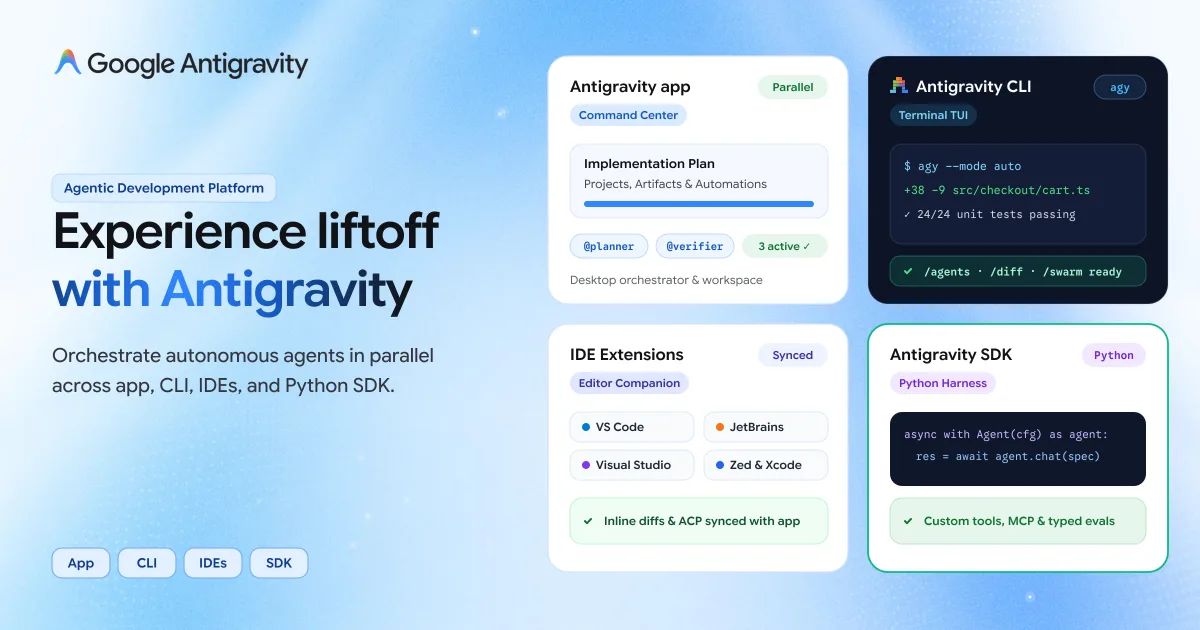
Mass Spec Skills is a set of mass-spectrometry skills Google DeepMind released for Google Antigravity on November 25, 2026. It connects Gemini’s chemical reasoning to open tools that labs already trust: matchms for preprocessing, GNPS and MoNA for library search, SIRIUS for formula inference, PubChem for candidate structures, MAGMa and MetFrag for fragment annotation, and RDKit for a final check. You describe the sample and the instrument tolerance in plain language; the agent runs the whole workflow or just the step you ask for.
Core Purpose
The bottleneck in mass spec is not the instrument, it is the people. A single MS/MS spectrum needs a precursor mass, a neutral mass calculation, background removal, then a decision between library search and de novo interpretation, then a peak-by-peak explanation. In a busy lab that is hours to days per compound, and samples queue up. DeepMind’s answer is not a new end-to-end model that guesses structures; it is an orchestration of existing tools with an audit trail, where the agent schedules work, compares outputs and cross-checks them.
Skill packs are not new — the Claude Skills Library collects the same shape, where the value is the orchestration of domain steps rather than model capability.
That differs from handing a spectrum to a model and asking for a structure in one place that matters: the ranking is not the language model’s intuition. Library hits are scored by cosine similarity, candidates come from PubChem, ties are broken with chemistry — bond connectivity and functional groups checked against fragmentation pathways — and RDKit validates the final structure. In the worked example the agent identified the formula C20H21ClN6O, ranked 845 PubChem isomers and accounted for 97.7% of summed fragment intensity across 14 of 19 peaks. Every intermediate stays in the report, so a reader can see which step to doubt.
Key Scenarios
- Untargeted metabolomics triage. After an LC-MS/MS run, use the skills to label compounds that match a reference library and send only the rest to a human. This is the strongest use case, because a library hit is a claim with evidence behind it.
- Ranking candidates for an unknown. For a peak with no reference spectrum, infer formulas with SIRIUS, pull isomers from PubChem, and take the agent’s ranked list and reasoning as a starting point before confirming with a standard or NMR.
- Teaching and reviewing annotations. The report keeps the precursor, neutral mass, fragment assignments and the tool used at each step, which makes it useful for showing students how a structure gets derived and for re-checking published annotations.
Trying it and its limits
Inside Antigravity the skills are available through the app and the Mass Spec plugin; enterprise accounts can pick “Use Business Account” and sign in with Google Cloud credentials. DeepMind is also offering 10,000 scientists the highest usage tier free for six months, subject to eligibility, capacity and selection. The skills follow Antigravity’s conventions: a folder with a SKILL.md, whose name and description the agent sees every turn and whose full text it reads only when relevant. You can also invoke one directly as /skill-name, and a skill you write yourself in .agents/skills/ loads after /skills reload.
The limits matter. The ~97% figure comes from 100 Enamine REAL compounds that have reference spectra in MoNA; without a library entry there is no exact match to make. For genuinely new molecules the agent cannot confirm a structure — it returns a predicted formula, peak assignments and an annotation table as a starting point. Some isomers and mirror-image pairs cannot be separated by MS/MS at all without retention time, ion mobility or NMR. And the skills ship only inside Antigravity, through the app and the plugin, so they are not something you can lift out and run elsewhere; the underlying tools are open, the orchestration is Google’s.
For analytical chemists, the value is not a replacement for judgment but a way to compress the repetitive part into minutes and leave behind a record someone else can audit. For teams building science agents, it is a reusable shape: do not retrain a model to guess the answer, chain the domain tools and let the model schedule and explain them. The Ant Group health models from November take the other road, training their own weights instead of orchestrating existing tools.