Commentary#Price comparison#CRM
Free Salesforce alternatives: Twenty and the open-source CRM lineup
Salesforce starts at $25 per user per month with no free tier. Six free alternatives compared with official pricing and GitHub data, checked 2026-10-11.

The first line of the Salesforce pricing page is where many teams stop and think: the cheapest tier, Starter Suite, costs $25 per user per month; Pro Suite is $100 (billed annually, contract required); the Enterprise and Unlimited editions don’t show prices at all — you talk to sales. There is no free tier, only a 30-day trial. So the search for a free Salesforce alternative is a practical question, and the market answers it in two very different camps: closed cloud services that cost nothing but lock features, and open-source projects whose software is free but whose operations are yours. This piece puts the six options worth a look side by side — every price verified against the vendor’s own pricing page on 2026-10-11, every open-source project checked for GitHub stars, license and latest release — and ends with a pick-by-team-profile guide.
Key points
- Salesforce’s cheapest tier, Starter Suite, is $25 per user per month; Pro Suite is $100 with an annual contract, and there is no free tier (official pricing page, checked 2026-10-11).
- The headline open-source alternative, Twenty, self-hosts for zero software cost (mostly AGPLv3) or runs on cloud at $9 per user per month — about a third of Salesforce Starter. It has 58,193 GitHub stars and shipped v2.45.0 on 2026-10-05.
- If you’d rather not run a server, the closed camp has real free tiers: Zoho’s free edition for 3 users, HubSpot’s for 2 users and 1,000 contacts; the self-host camp — Odoo Community (LGPL-3.0), EspoCRM and SuiteCRM (both AGPL-3.0) — charges nothing for the software.
The Salesforce bill
What makes the Salesforce bill expensive is the structure, not one number. Seats are billed per user per month and scale with headcount; the extras come on top — the pricing page itself lists the Premier support plan at 30% of net license fees, while Enterprise and Unlimited prices require a conversation with sales. A three-person team pays $900 a year to start on Starter Suite; a ten-person team pays $3,000 — for the entry tier.
The less comfortable part is where the data and the customization live. Workflows, fields and reports are configured the Salesforce way, deep customization goes through its development stack (Apex, the AppExchange marketplace), and moving out means an export project. For a five-person team, that structure is hard to justify on its own terms. This is also why demand for “free alternatives” clusters around two things: a usable free tier, or self-hosting that brings the data back in-house. Office software went through the same migration a round earlier — we compared ten free Office suites in a separate piece.
Twenty: CRM as code
Twenty is the loudest open-source CRM right now: 58,193 stars on GitHub (2026-10-11), written in TypeScript, with a repo description that says outright “the open alternative to Salesforce, designed for AI”. The fundamental break from closed SaaS is how customization works: objects, fields, views and workflows are all definable as TypeScript through an SDK, configuration lives in Git and ships through review — a CRM change becomes a reversible commit instead of “something an admin clicked last week”.
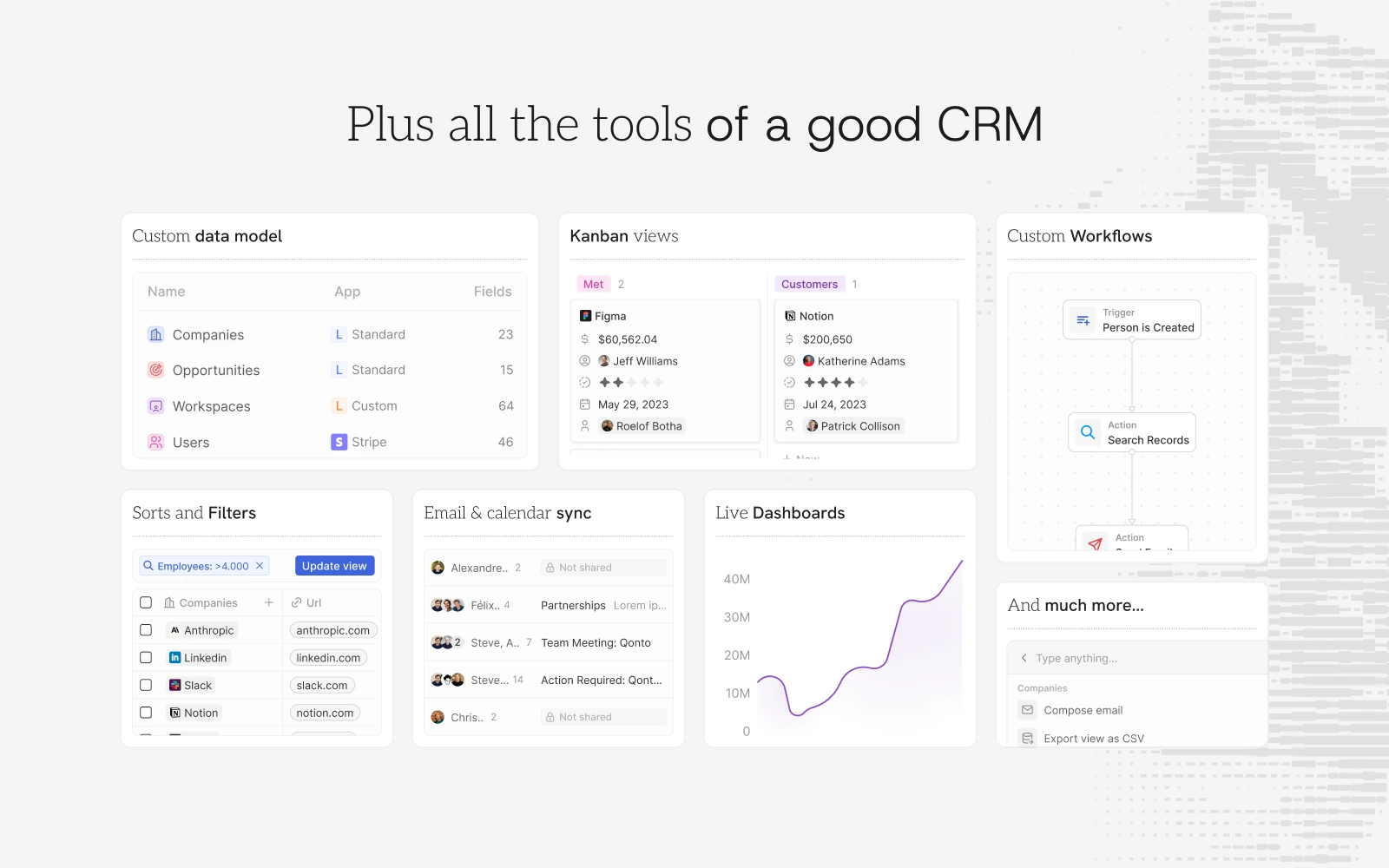
The AI is in the product, not on a roadmap: Ask AI answers “what deals do I have in my pipeline?” with a live summary, workflow nodes can run AI agents, and models come from Anthropic, OpenAI, Google and others. The team also ships app skills for coding agents — Claude Code, Codex and Cursor can build Twenty apps directly. On price, cloud Pro is $9 per user per month (billed yearly) with workflow automation metered in credits — 50 a year included on Pro — Organization is $19, and Enterprise starts at $50k a year. Self-hosting costs nothing in software and runs on Docker Compose. Both paths being real is what separates it from pure-cloud products. We have a closer breakdown in our Twenty entry.
The boundaries: no permanent free cloud tier (30-day trial), API rate-limited to 50 calls per minute on Pro, and a license that is mostly AGPLv3 with files marked /* @license Enterprise */ under a commercial license. If what you need to replace is the whole Salesforce ecosystem — Apex codebases, a thousand AppExchange apps, mature reporting — Twenty doesn’t cover that yet; the pick-by-profile section below comes back to this.
The open-source veterans
Open-source CRM didn’t start with Twenty. Three older projects already hold very different positions in this space, and all three self-host for free:
| Project | GitHub stars | License | Language | Self-host | Cloud |
|---|---|---|---|---|---|
| Twenty | 58,193 | mostly AGPLv3 | TypeScript | supported, free | from $9/user/mo |
| Odoo (Community) | 54,963 | LGPL-3.0 | Python | supported, free | one app free online |
| SuiteCRM | 5,792 | AGPL-3.0 | PHP | supported, free | unpriced (SuiteASSURED support) |
| EspoCRM | 3,473 | AGPL-3.0 | PHP | supported, free | from $15/user/mo |
Data from the GitHub repos and vendor pricing pages, checked 2026-10-11.
Odoo is really an open-source ERP suite where CRM is one module among dozens — a plus for teams that also need inventory, accounting or helpdesk. Its online edition has a one-app free tier with unlimited users, the self-hosted Community edition is LGPL-3.0 with zero software cost, and the paid online edition is geo-priced (AUD 34.40 per user per month and up for Standard in the Australian store). The cost is weight: teams that just want contacts and a small pipeline will drown in it.
EspoCRM and SuiteCRM are the lightweight PHP pair, both AGPL-3.0. EspoCRM is the more modern of the two, with cloud tiers at $15 per user per month (Basic — minimum 3 users, 3GB storage and 100,000 records per user), $25 (Enterprise, minimum 5) and $69 (Ultimate, minimum 10) — the flattest cloud-to-self-host price gap in this comparison. SuiteCRM is the oldest and broadest; the community edition is free and the vendor monetizes SuiteASSURED (a supported build with warranty and care hours) and hosting, unpriced on the site — you talk to them. The shared trade-off: the stack and the interface belong to an earlier era, and someone on the team should know PHP.
The free cloud tiers
If you’d rather not touch a server, closed cloud free tiers are the lowest-friction start. HubSpot’s free plan is “100% free” by its own wording — 2 users, 1,000 contacts, contact and deal management, email tracking, live chat, quotes, no credit card — and paid seats start at $15 per seat per month on Starter. Zoho’s free edition covers 3 users with contact management, workflows, standard reports and 5,000 API calls a day; paid tiers are geo-priced (the site currently serves the Indian store, with the CRM Plus bundle marked from $20 per user per month).
The real cost of these tiers lives elsewhere: feature gating nudges you upward, the data sits on the vendor’s platform, and exporting is always a project of its own. The walls are specific — the third HubSpot user crosses into paid, and so does contact number 1,001; Zoho’s free API budget of 5,000 calls a day gets tight for anything integrated. For one or two people who mainly want records in one place, they are the fastest route; when the business grows, the closed-platform pricing curve reappears — from a lower starting point than Salesforce.
What a five-person team actually pays
Converting “free” into annual bills makes the trade-offs concrete. On 2026-10-11 pricing, a five-person sales team on Salesforce Starter Suite pays $1,500 a year to start — the entry tier, scaling with seats. The same five on Twenty cloud Pro cost $540 a year with unlimited customization (the pricing page says so explicitly for all tiers). Self-hosting Twenty or EspoCRM zeroes the software line and leaves one server plus some ops time. The saving is real, and so is what it buys away: leaving Salesforce means giving up its reporting depth and ready-made integrations, exporting and re-importing your own data, and retraining the team. The math only works when you weren’t deep in that ecosystem to begin with.
The matrix below lines up where each option’s “free” comes from:
| Project | How it’s free | Free-tier limits | Paid starts at | Built-in AI |
|---|---|---|---|---|
| Twenty | self-host, zero software fee | no free cloud tier, 30-day trial | cloud $9/user/mo | Ask AI, workflow agents |
| Odoo Community | self-host, zero software fee | online free tier is one app | geo-priced online | not listed |
| EspoCRM | self-host, zero software fee | Basic: 3GB storage, 100k records per user | cloud $15/user/mo | not listed |
| SuiteCRM | self-host, zero software fee | paid is support/hosting, unpriced | talk to vendor | not listed |
| HubSpot | free tier | 2 users, 1,000 contacts | Starter $15/seat/mo | Breeze assistant |
| Zoho | free tier | 3 users, 5,000 API calls/day | geo-priced (CRM Plus from $20) | not listed |
Details summarized from the vendors’ pricing pages, checked 2026-10-11; “not listed” means the page we checked did not state it.
Self-hosting or cloud
“Open source is free” skips the ops side of the ledger. Self-hosting Twenty, Odoo or EspoCRM means one server, a backup policy, upgrade duty and data security, all yours. For Twenty specifically, the documented path is Docker Compose with PostgreSQL and Redis alongside — none of it hard, but backups and upgrades move onto your calendar instead of the vendor’s. For a team with platform engineers, that’s the CRM becoming part of your own infrastructure (Twenty even ships CRM config as code); for a sales team without ops, it’s trading selling time for server time.
Licenses deserve a look too. Odoo Community is LGPL-3.0, the most permissive here for commercial use; Twenty, EspoCRM and SuiteCRM are AGPL-3.0 — internal business use is fine, but if you modify the source and offer it as a network service to outside users, AGPLv3 requires releasing your changes. Teams building a product on top of these should run that past legal.
One pitfall either way: switching systems is a real data migration — field mapping, attachments, email history all need a careful pass. Before committing, take an export sample of your real data and run it through an import in the new system. That tells you more than any feature list.
How to choose
None of the six wins everywhere; fit beats rankings:
- One or two reps, records before process: Zoho free (3 users) or HubSpot free (2 users, 1,000 contacts) — usable in an afternoon.
- Technical teams that want CRM in version control and AI in the loop: Twenty — $9/user/mo cloud for zero ops, self-hosted for the full SDK and agent story; nothing else here takes “CRM as code” this far.
- CRM plus inventory, accounting or helpdesk: Odoo Community self-hosted, or the one-app free tier online to start.
- Light self-hosting, or cloud that doesn’t punish growth: EspoCRM, from $15/user/mo with the flattest gap to its free self-host.
- Traditional industries with existing PHP skills: SuiteCRM, the broadest coverage of the veterans.
- Deeply invested in the Salesforce ecosystem (Apex, AppExchange, existing integrations): stay put — migration costs more than the subscription you’d save.
There is also DeskcommCRM, an open-source CRM from the same stable with a narrower bet: AI agents that sell over WhatsApp. For businesses whose customer conversations already live there, it complements the six above rather than competing with them.
The order of operations is simple: pilot a free path for two weeks — HubSpot or Zoho free if you don’t want a server, self-hosted Twenty or EspoCRM if you do — load an export of your existing customers, and let real users log data for a week. If the walls (seats, contact counts, feature gates) never show up, keep going; if they do, you’ll be negotiating the upgrade with real usage numbers instead of a sales estimate.
FAQ
Can Twenty replace Salesforce?
For core CRM — contacts, opportunities, kanban pipelines, email and calendar sync, workflows, reporting — yes, and $9 per user per month against Starter Suite’s $25 is a real difference. No, if the team runs Apex customizations, industry apps from AppExchange or Salesforce’s deep reporting: Twenty has no equivalent ecosystem yet. It fits teams that were never locked into that stack.
AGPL and commercial self-hosting
Internal use is unaffected. The obligation appears when you modify the source and offer it as a network service: AGPLv3 requires releasing your modifications to those users. Pure internal deployment — unmodified, not offered externally — doesn’t trigger it.
Do the free tiers stay free?
Zoho’s free edition is “free forever for 3 users” by its own wording, and HubSpot’s is “100% free” with no expiration (2 users, 1,000 contacts). Both are acquisition layers with feature gates above them, but the tiers themselves currently carry no time limit. Self-hosting has no expiry concept at all — only an ops cost.