Images#Image generation#Infographic
Watch tech-sheet prompt: requirements as Python
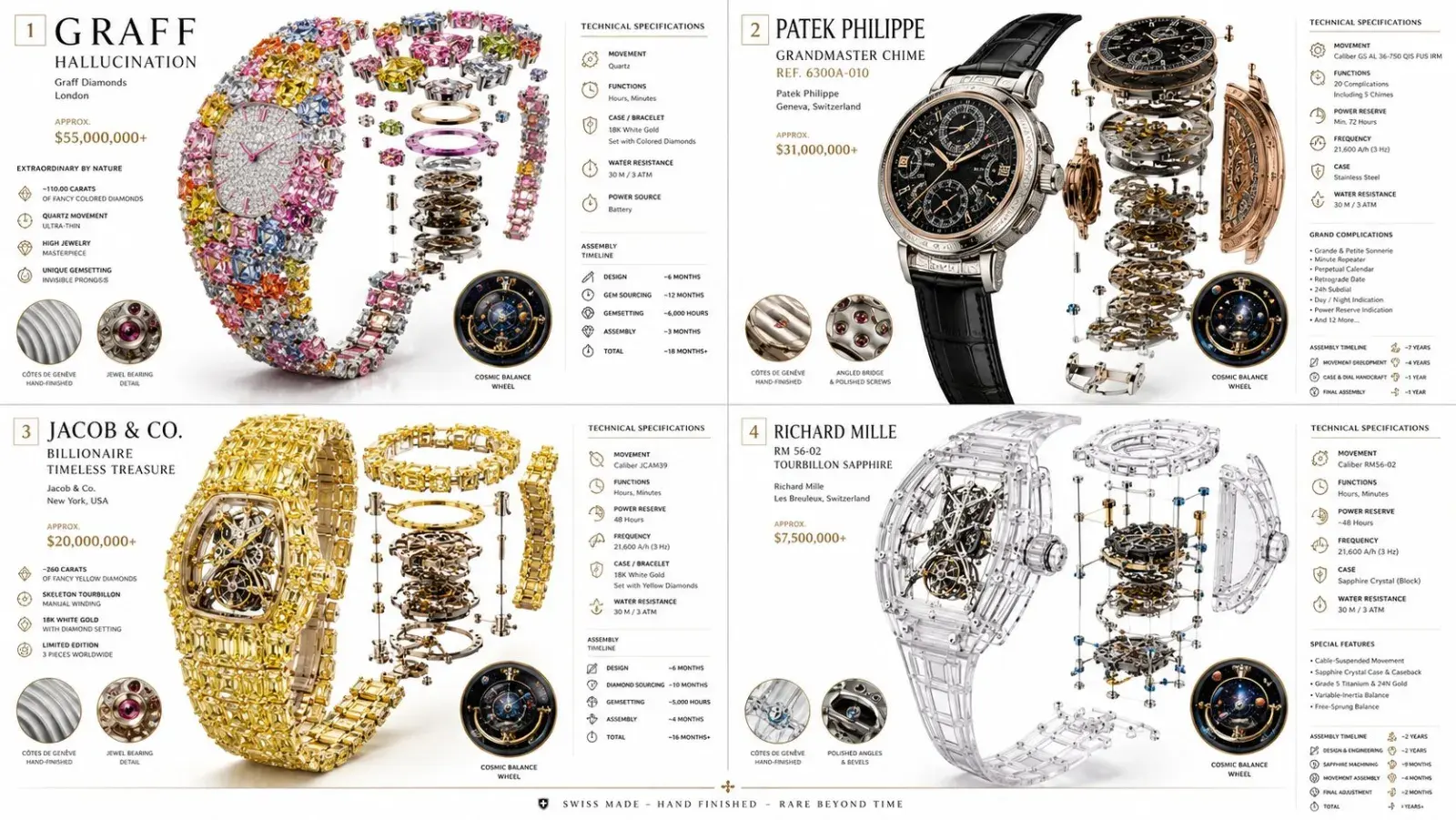
A watch-encyclopedia prompt written as a Python class: parents set the look, mutations set the info layers, weights set the mix — one render, a 2x2 grid.
ModelsGPT Image 2
The prompt
2x2 grid 16:9, do this for 4 most expensive strangest watches ever made:
class Haute_Horlogerie_DNA:
    def __init__(self):
        self.subject = "[TIMEPIECE]"
        self.parents = {
            "composition_parent": "Exploded movement diagram with transparent case",
            "material_parent": "Brushed titanium, sapphire crystal, rose gold gears, alligator leather",
            "graphic_parent": "Swiss manufacture technical brochure with elegant data panels",
            "atmosphere_parent": "Crisp daylight studio, pure white background, subtle reflection on polished surfaces"
        }
        self.mutations = {
            "semantic_mutation": "The balance wheel reveals a miniature cosmos ticking inside",
            "information_mutation": "Power reserve indicator, frequency, complication callouts, hand-finishing grades, assembly timeline",
            "medium_mutation": "Smooth matte premium paper with embossed logo",
            "scale_mutation": "Grain-level view of Côtes de Genève finishing and jewel bearings"
        }
        self.style_mix = [0.30, 0.30, 0.25, 0.10, 0.05]

    def generate_subject(self):
        subject = """
        [TIMEPIECE] shown in its full mechanical glory. The dial, hands, movement,
        and strap float in perfect alignment against a bright, clean background.
        Every gear and spring is highlighted with exacting clarity.
        """
        return render(
            subject,
            format="luxury watch advertisement with technical insert",
            title="[MODEL REFERENCE]",
            subtitle="[MANUFACTURE / COLLECTION]",
            constraints="bright white space, metallic brilliance, hyper-detailed, modern elegance"
)Writing requirements as code is this gallery’s most distinctive school. Here a Python class splits style into parents and information layers into mutations — the model never executes it; it reads the relationships between fields.
- The four parents stay independent: composition, material, graphic language, atmosphere. Swap any one without dragging the others.
- Mutations own “what to emphasize”: the miniature cosmos, spec callouts, paper stock, macro scale — each information boost is an explicit field.
- style_mix turns blending into a recipe with percentages, instead of “a bit of A plus a bit of B”.
Details worth keeping
- The opening line “2x2 grid 16:9” pins the layout before anything else, so the four cells never merge.
- Change
[TIMEPIECE]and the same class renders any collectible codex: sneakers, cameras, grand pianos. - “A miniature cosmos ticking inside the balance wheel” is the only poetic field in the class — and it sits exactly where semantics belong.
- The original case was posted by @Gdgtify on X; the prompt here is curated from the open-source repo freestylefly/awesome-gpt-image-2 (MIT license), and the example image is the case’s own. Source material comes from the open community; rights holders can ask us to take it down at any time.
- For the other structured-layout prompt in this set, see the exploded product poster prompt.