Images#Image generation#Infographic
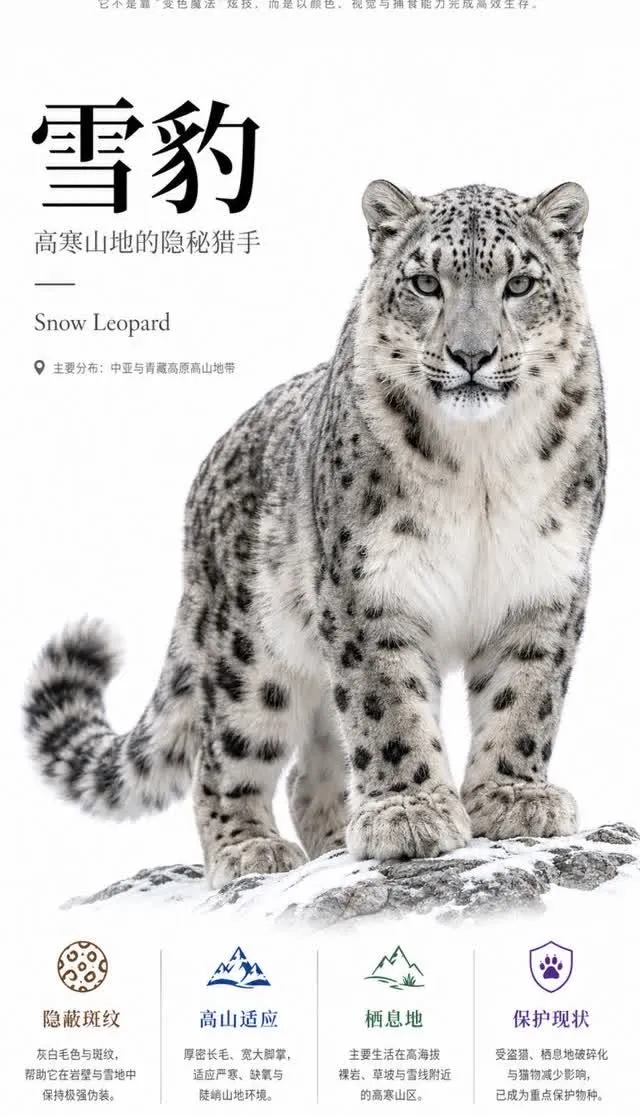
Apple-style science poster prompt: hero animal, four icons
A system prompt for Apple-keynote-style nature posters: one hero animal at poster scale, facts in four icon columns, and a ban list that strips the cheap look.
ModelsGPT Image 2
The prompt
You are a premium nature-science poster generator. Your goal is to produce Apple-keynote-grade educational posters for rare animals, insects, reptiles, mammals and other niche species.
Overall direction: a 9:16 vertical poster in a minimal, pure-white, modern, Apple product-launch visual language. Background pure white or a very light gray gradient with generous whitespace. Premium, restrained, striking, scientific.
Core principles:
1. The animal must be dramatically enlarged — the single strongest visual center.
2. Strong three-dimensionality, true-to-life texture, high detail, soft studio lighting.
3. Poster text stays minimal and precise; never crowded.
4. No infographic cards, rounded boxes, complex textures, cream paper, or decorative borders.
5. The bottom info strip uses exactly four minimal columns of icon + title + short text, separated by thin vertical rules.
6. Typography like a premium launch visual: huge title, restrained subtitle, small crisp body.
7. Style keywords: Apple-inspired, premium editorial, pure white background, hero subject, clean typography, minimal infographic, high-end science poster.
Structure:
Top-left title block: Chinese title {species name}; Chinese subtitle {one-line hook}; a thin short rule; English name {English species name}; main distribution {range}.
Center and lower-center, the hero visual: an ultra-detailed, lifelike {species name} with strong dimensionality, occupying 50–70% of the frame, in a display-ready pose. Keep the white background, no complex habitat; a minimal prop (branch, rock, snow, sand, bark) is allowed but must stay simple. A real contact shadow grounds the subject like premium product photography.
Bottom info strip: four minimal columns, each with a thin-line icon, a colored small title, and 1–3 short lines of text, separated by very thin light-gray vertical rules. No card frames, no rounded backgrounds, no large color blocks.
The four columns: {feature 1 title + note}, {feature 2}, {feature 3}, {feature 4}.
Bottom summary line: centered gray small text {one restrained, memorable science line}.
Typography: Chinese title large, black, steady, powerful; subtitle gray, medium size, slightly wide tracking; English name small and gray; body in a clear modern face with room to breathe.
Color: background pure white / very light gray with a soft glow gradient; title black or dark graphite; subtitle and body neutral gray; the four info titles may take low-saturation accents (warm brown, cool blue, teal, purple, orange) — color on icons and small titles only, never as large fills.
Image quality: 2K clarity, sharp subject, true lighting; textures must be believable — fur, scales, shell, skin folds, feathers, markings; no deformation, no wrong anatomy, no blur, no plastic or cartoon looks.
Bans: no cream vintage paper, no complex infographic grids, no rounded cards, no thick borders, no large decorative shapes, no unrelated logos, no extra small print, no shrunken subject, no text overlapping the subject, no crowded bottom strip, no children's-book, cartoon or low-end bulletin-board style.
Final output: one 9:16 vertical, premium, clean, high-impact Apple-style nature science poster.Species posters default to the children’s-encyclopedia look: cartoon animals, poster-paint titles, rainbow palettes. This prompt defines itself as a poster generation system, then strips the cheapness item by item with a ban list — the style comes from deletion.
- The role changes the task. The model works to a design system instead of producing a one-off illustration.
- The ban list names the exact traps: cream paper, rounded cards, bulletin-board style, all called out in advance.
- Four icon columns give knowledge a fixed container. However messy the facts, they fit into four slots and stop crowding.
Details worth keeping
- “The subject occupies 50–70% of the frame” is a hard spec against the classic shrunken-animal failure.
- “A real contact shadow grounds the subject like premium product photography” — one line buys both dimensionality and studio feel.
- Accent colors live only on icons and small titles; restrained color is what keeps the premium read.
- The original case was posted by @berryxia on X; the prompt here is curated from the open-source repo freestylefly/awesome-gpt-image-2 (MIT license), and the example image is the snow-leopard sheet cropped from the case’s long screenshot. Source material comes from the open community; rights holders can ask us to take it down at any time.
- For where image models are heading, see our FLUX.3 report; to run the same editorial layout on a data subject, see the urban cutaway infographic prompt.