Design#Video generation#Coding agent#Motion graphics
huashu-art-motion: Turn Coding Agents into Code-Driven Animation Directors
An open-source agent skill by Huashu packing 35 art style recipes and 9 explainer grammars to generate frame-accurate Canvas animations with code.
Skill details
npx skills add alchaincyf/huashu-art-motion --skill huashu-art-motion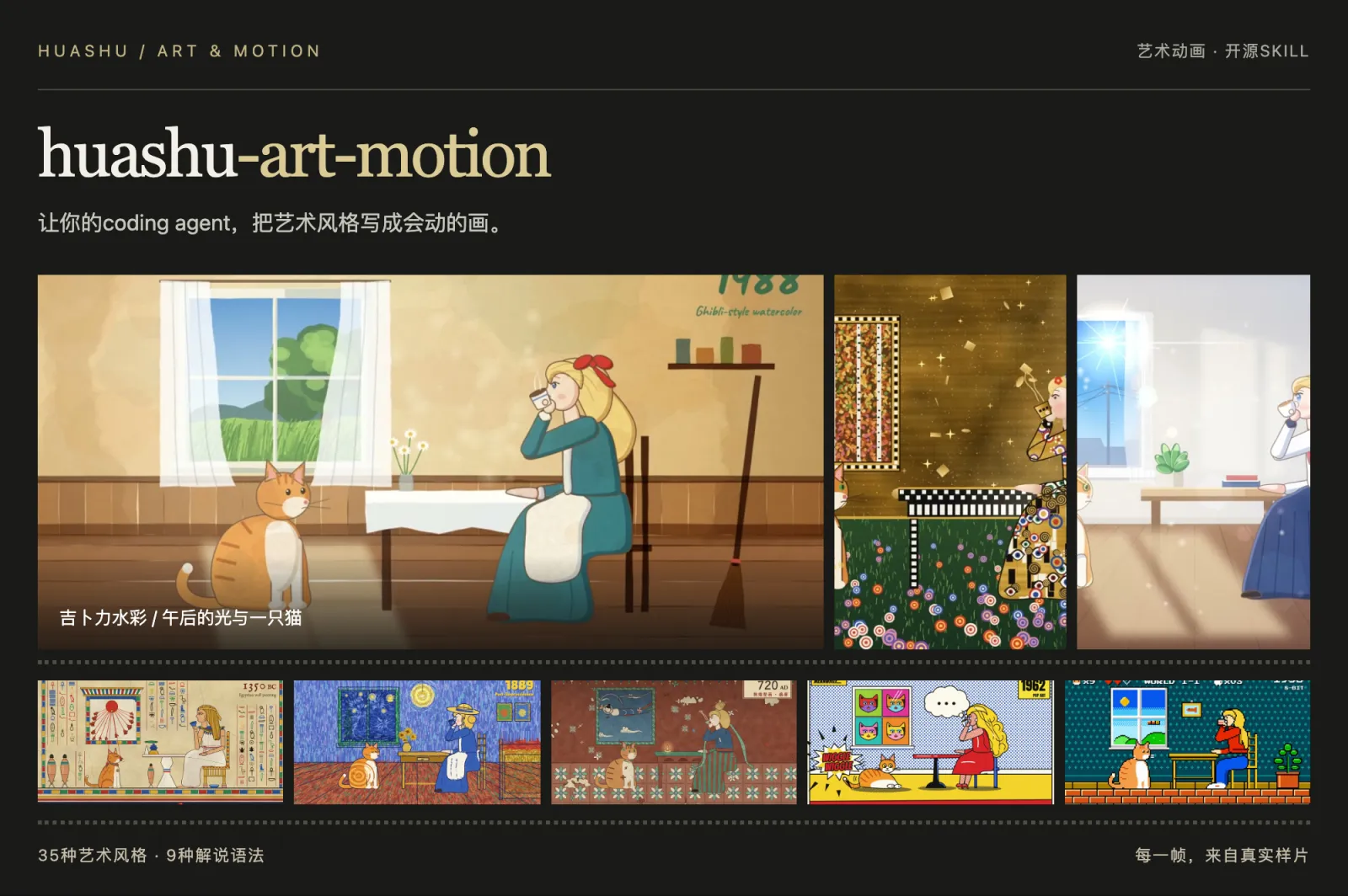
Generating explainer clips or art animations with generic video models often feels like a lottery: subtle details resist frame-by-frame adjustments, transitions morph unpredictably, and voiceovers rarely align with visual cues. Created by developer and creator Huashu, huashu-art-motion is an open-source AI skill (MIT license, created in October 2026, reaching 2.9k GitHub stars as of 2026-10-10). When installed in Claude Code or compatible coding agents, it directs the agent to paint scenes with programmatic Canvas code and orchestrate movement across a deterministic timeline.
The order it works in
Unlike srt-whiteboard-animation, which focuses solely on subtitle-driven line drawings, huashu-art-motion packages an end-to-end animation direction pipeline across 12 core guidebooks and an executable engine. When you outline an animation request, the agent follows a disciplined sequence:
- Breakdown and measurement: When provided with a reference clip, it runs

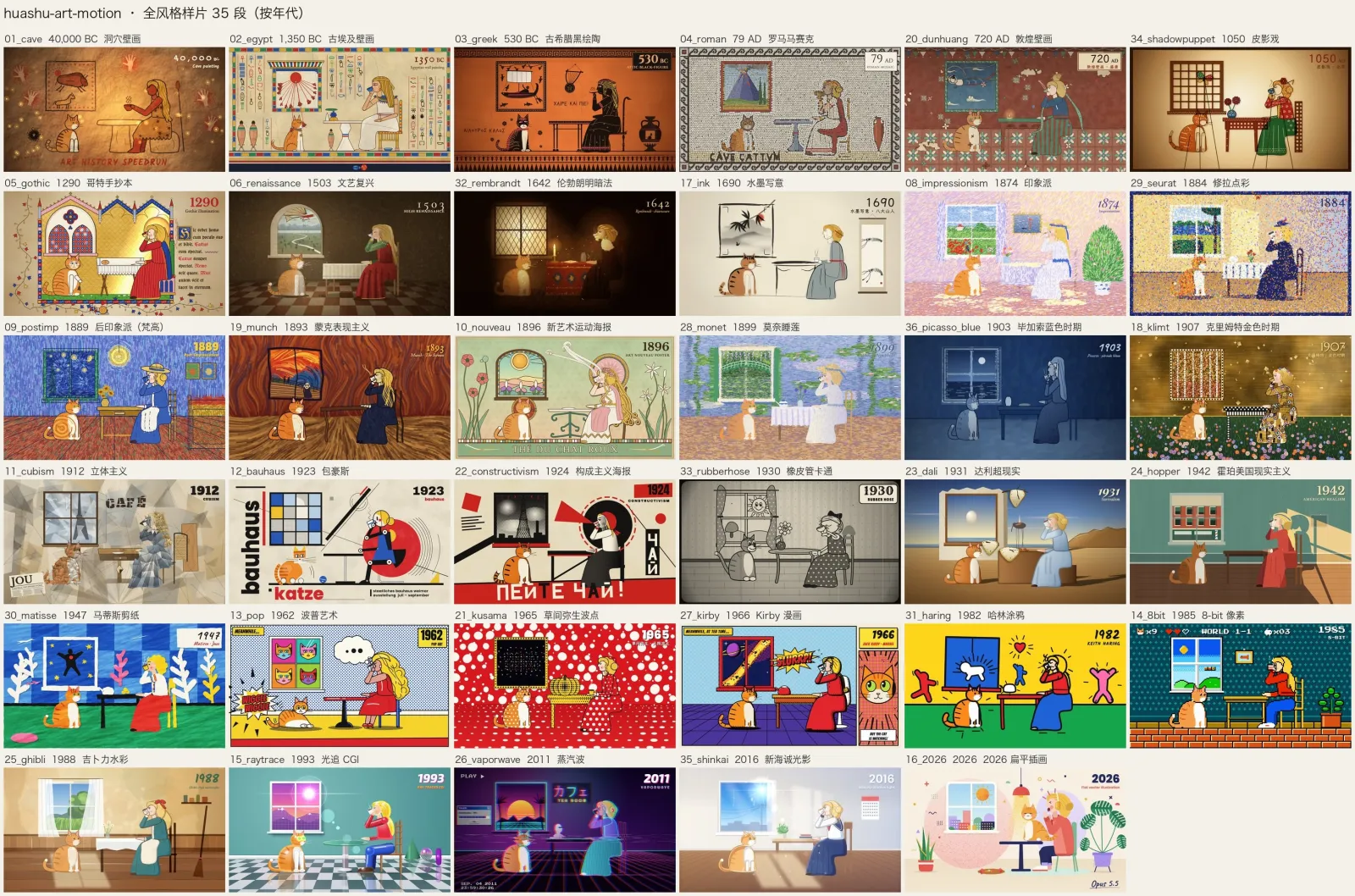
breakdown.pyto calculate transition timestamps, BPM beat grids, and motion heatmaps, turning the source video into a quantitative geometric blueprint. - Single-frame prototype: Selecting from 35 art style recipe cards (including prehistoric cave paintings, Egyptian murals, Van Gogh, Bauhaus, Japanese ukiyo-e, and 8-bit retro gaming), the agent first designs a static frame to lock composition, lighting, and palette before writing animation loops.
- Layered drawing and camera motion: Scenes, decorative props, and signature transitions are rendered programmatically via Canvas code. If photorealistic human characters are required, an image generation model produces sprite keyframes, while the code controls positioning, scaling, frame swaps, and green-screen compositing.
- Digital QA and independent review: Before delivery,
qa.pybenchmarks visual stability, frame compute efficiency, motion intensity, and playback smoothness. Finally, an independent agent that had no role in production audits the final video from a viewer perspective to identify visual flaws or pacing issues.
What it constrains
- Motion is mandatory: Every scene must feature at least one primary action and two ambient motif loops. Self-inspection measures frame difference deltas to prevent animations from devolving into static slideshows.
- Extract mechanics rather than copying pixels: When analyzing reference clips, the agent studies pacing, layering, and transition rules instead of tracing pixels, ensuring that newly synthesized scenes remain original.
- Deterministic seeded randomness: All procedural movement and noise shaders bind to explicit pseudo-random seeds, guaranteeing that re-rendering identical frames yields byte-identical output across diverse operating environments.
- Three-direction selection gate: When exploring an unfamiliar style or character design, the agent must generate three distinct visual options on a single frame for user approval, even when a genre was pre-selected.

Who it is for
Creators producing educational explainers, technical breakdowns, visual essays, or social media animations benefit most from this skill. Beyond 35 art recipes, the repository includes 9 battle-tested explainer grammars such as Kurzgesagt flat transitions, Vox collage highlights, 3Blue1Brown geometric transformations, and whiteboard sketch reveals, allowing users to export frame-accurate clips via simple JSON configurations without complex timeline editing software.
Two practical constraints deserve attention: local rendering requires Python, uv, ffmpeg, and Playwright Chromium, requiring an initial browser binary download. Additionally, lifelike character sprites require external image generation workflows, and certain long-form narration examples are structured as code snapshots that demand custom audio and storyboard assets from the creator.