mattpocock/skills: small, editable agent skills for real engineering
mattpocock/skills: small, editable agent skills for planning, test-first coding, bug diagnosis and architecture review, for engineers who want control.
Project facts
GitHub Ecosystem- License
- MIT
- Language
- Shell
- Stars
- 298,875
- Data checked
- 2026-10-21
Snapshot figures reflect the check date and may change over time.
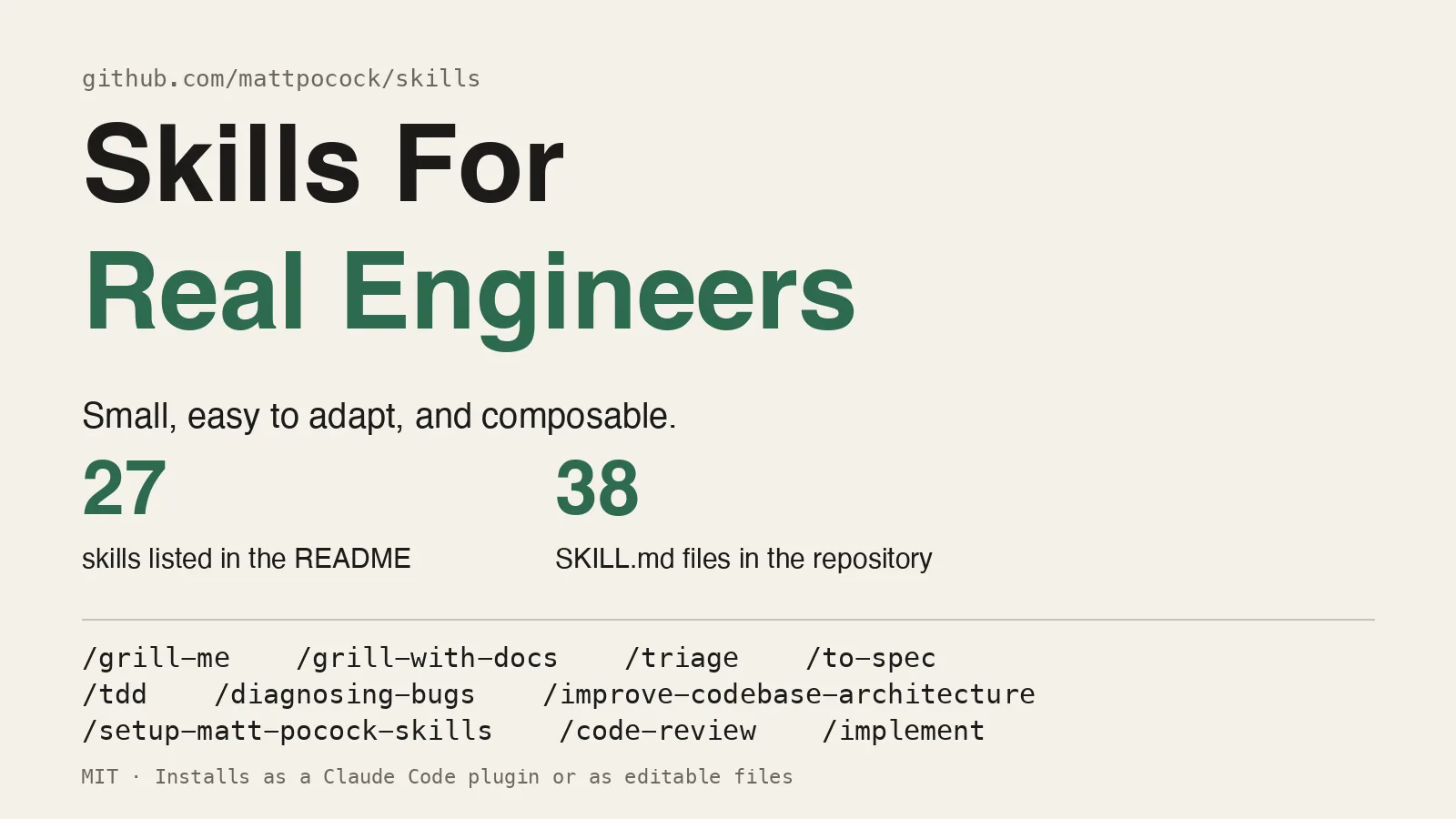
Coding agents tend to fail in four familiar ways, the mattpocock/skills README says: they build the wrong thing, they write too much, the code does not run, and the codebase turns into a mess as it grows. mattpocock/skills is a set of small, editable agent skills from the repository owner, mattpocock, under the MIT license. Each skill is a folder built around a SKILL.md file, and the README says they work with any model. The README criticizes frameworks such as GSD, BMAD and Spec-Kit for owning the process and taking control away. As of October 21, 2026 the repository had 298,875 stars, and its last push was on October 19, 2026.
Core features
mattpocock/skills is built from separate skill folders, so you can use one as it is or rewrite it. The five points below follow the problems the README describes, and the last one is a one-time repository setup.
- Align before building:
grill-meis a thin wrapper: its SKILL.md body is one sentence that tells the agent to call thegrillingskill.grillingquestions each branch of a plan until every branch has an answer. The README calls these its most popular skills and says to use them for every change. - Test first, at agreed seams:
tddasks for a failing test before the code that makes it pass, and writes tests only at seams you confirm in advance, one vertical slice at a time. Refactoring belongs tocode-review, outside the red-green loop. - A red command before any hypothesis:
diagnosing-bugsrequires a command that reproduces the bug before any hypothesis, then shrinks the reproduction until every remaining step is needed. Hypotheses come as three to five ranked predictions that can be proved wrong, and debug logs carry a[DEBUG-xxxx]tag so one grep removes them. - Architecture review that reports first:
improve-codebase-architecturelooks for shallow modules, whose interfaces are nearly as complex as their implementations. It writes an HTML report and asks which candidate to explore. It proposes no interfaces until you pick one, and its steps include no code edit. - One-time repository setup:
setup-matt-pocock-skillsasks where issues live, which triage labels to use and where domain documents go. It then writes the answers intoCLAUDE.mdorAGENTS.mdand intodocs/agents/, after you confirm them.
Typical use cases
mattpocock/skills has four uses, all described in the README and the skill files.
- Someone whose plan is still fuzzy: run
/grill-mebefore writing code. For code changes,/grill-with-docsalso updatesGLOSSARY.mdand architecture decision records (ADRs), according to the README. - An engineer who wants test-driven work: ask for
/tdd. The skill has you confirm the seams before any test is written. - A team stuck on a hard bug or a performance regression: start with
/diagnosing-bugsand build the feedback loop before anyone discusses a fix. - Someone inheriting an old codebase: the README suggests running
/improve-codebase-architectureevery few days. It calls the skill “a survey, not a rescue” and says it won’t untangle the mess for you.
Quick start
mattpocock/skills installs into Claude Code with one command. This is the README’s version:
claude plugin install mattpocock-skills@claude-plugins-official
The plugin updates itself. After that, run /setup-matt-pocock-skills once in each repository. It reads the git remote and any existing CLAUDE.md or AGENTS.md, asks about the issue tracker, triage labels and documentation layout, and writes files only after you confirm. The README lists a separate install command for Codex, GitHub Copilot, Gemini CLI and other agents.
Summary
mattpocock/skills suits engineers who work in Claude Code, Codex or a similar agent and are willing to read and edit the skill text. It does not suit a team that wants a hosted process to run the project for them. Unlike the frameworks the README criticizes, these skills leave the process in your hands: they are files you can change. They are not a test harness either, so your project still needs its own tests and CI.
Four things to check before you start. First, the plugin updates itself, but skills copied with npx skills@latest add need a manual update, and the README warns against installing both ways for one agent, since each skill would then appear twice. Second, the repository holds 38 SKILL.md files, while the README reference lists 27. The other 11 sit under skills/in-progress/ and skills/misc/, and the README does not describe them. Third, the HTML report from improve-codebase-architecture loads Tailwind and Mermaid from CDNs, so styles and diagrams may not appear offline. Fourth, on GitHub the setup skill can create triage labels with gh label create, which changes the remote repository, so read the list before you confirm.
If you want to compare another skill set written in the same SKILL.md format, read agent-skills. This article is based on the repository’s README and skill files. The Frontier Now editorial team has not run these skills on a real project.