Audio#Text to speech#Voice cloning
Ming-3.0-tts: an open speech synthesis model with voice cloning
Ming-3.0-tts is an MIT-licensed open speech synthesis repository with 0.5B and tiny models, zero-shot voice cloning and inference code.
Project facts
GitHub Ecosystem- License
- MIT
- Language
- Python
- Stars
- 120
- Data checked
- 2026-10-21
Snapshot figures reflect the check date and may change over time.
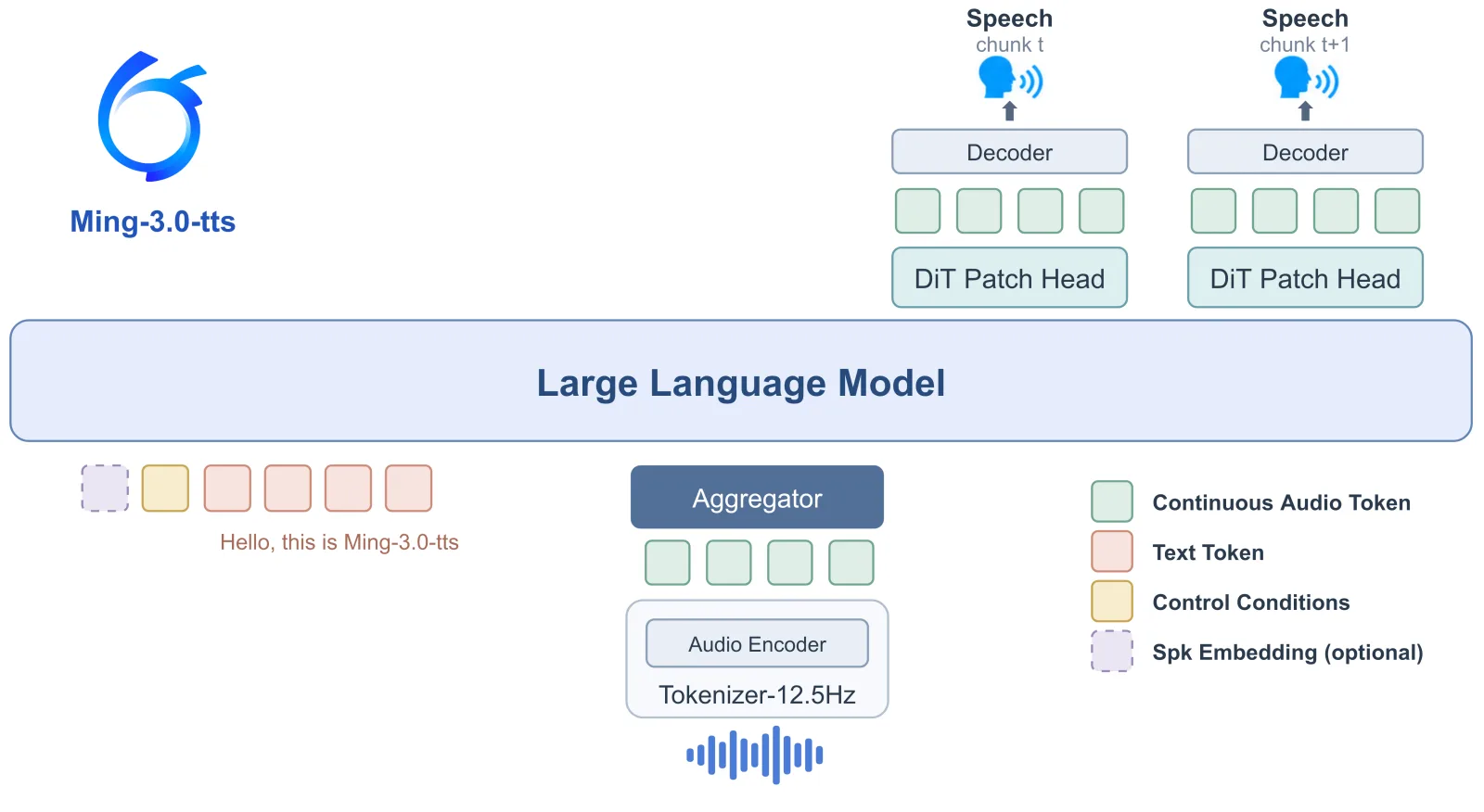
Ming-3.0-tts is an open speech synthesis repository from the inclusionAI organization, released in October 2026. It ships two models. The 0.5B model is dense. The tiny model uses a mixture-of-experts design with 7.9 billion total parameters and 1.3 billion active, built on Ling V3. The repository is MIT-licensed and includes inference code, task examples and evaluation tables. A Chinese news roundup attributes the family to Ant Group’s Bailing team. The same family includes speech-recognition and audio-understanding repositories.
Core features
- Two models, two designs: The 0.5B model is dense, and tiny is a MoE model. Both are on Hugging Face and ModelScope. The README says ModelScope is usually faster from mainland China.
- Voice cloning and voice design: You can clone a voice from a reference clip with
prompt_wav_path, design one from a text description, or pick from more than 100 built-in Chinese voices and five English voices. - Emotion and prosody controls: You can set an emotion and adjust speed, pitch and volume.
- Multi-speaker dialogue (tiny only): Given a script and speaker references, the model generates a conversation.
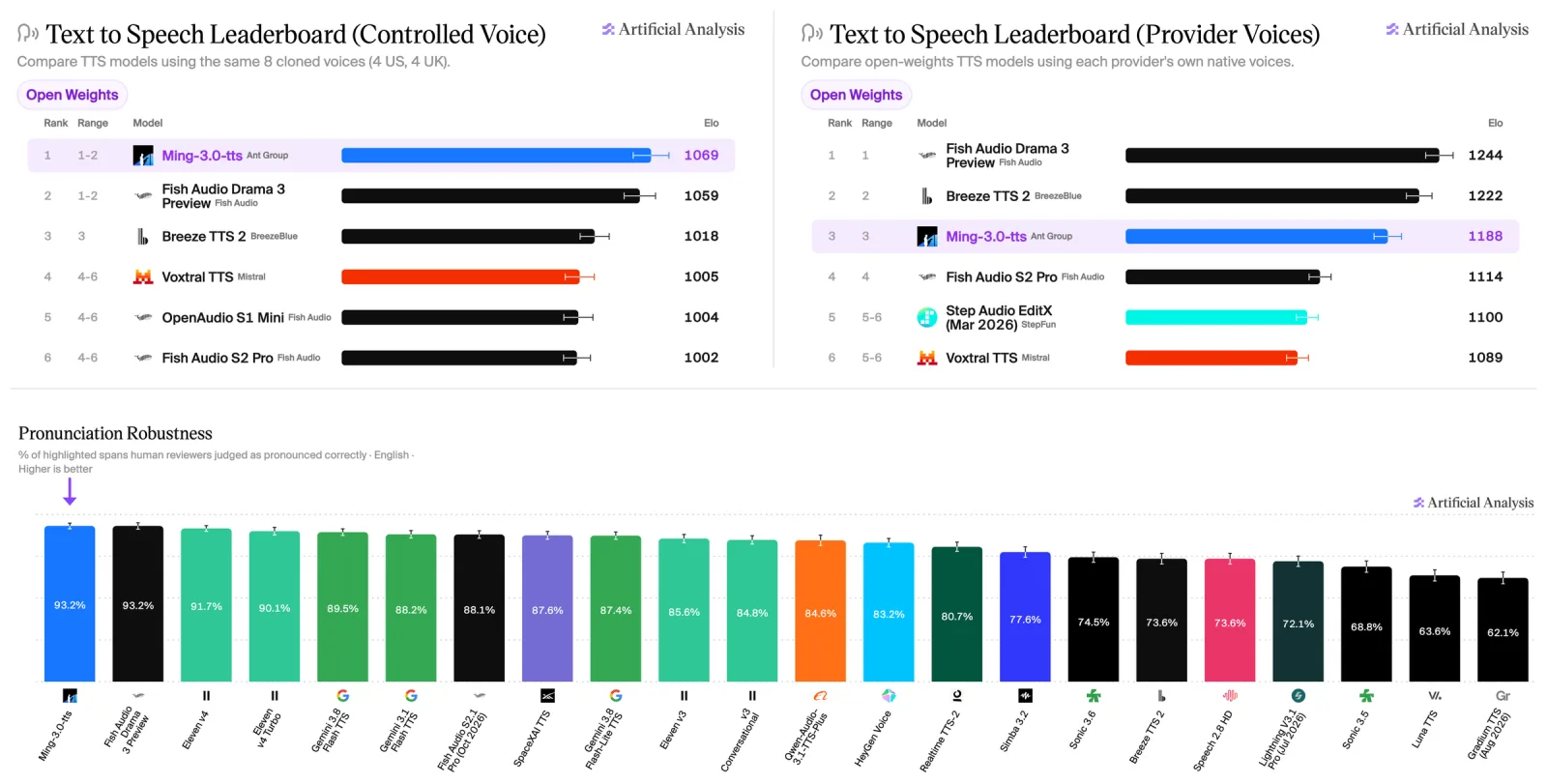
- Third-party leaderboard results: The README cites Artificial Analysis leaderboards from October 2026. Ming-3.0-tts ranks first among open-weights models on Controlled Voice at an Elo of 1069, first overall on Pronunciation Robustness at 93.2%, and third among open-weights models on Provider Voice at an Elo of 1188.
Typical use cases
- A team producing audio content: Generate narration or short-video voiceovers in one reference voice, then adjust the tone with emotion controls.
- A developer who wants to host speech synthesis on their own GPU: The weights are public, so you can run the model on your own machine instead of sending text to a cloud API.
- A researcher comparing speech models: The README includes leaderboard and evaluation figures that help you cross-check results.
Quick start
git clone https://github.com/inclusionAI/Ming-3.0-tts.git
cd Ming-3.0-tts
pip install -r requirements.txt
hf download inclusionAI/Ming-3.0-tts-0.5b --local-dir Ming-3.0-tts-0.5b
These steps set up the 0.5B model. A few details matter:
- The 0.5B environment was tested on NVIDIA H800-80GB and H20-96G cards. flash-attn is optional, and inference falls back to PyTorch SDPA without it.
- The tiny model needs its own environment: Python 3.10.15, torch and torchaudio 2.7.1 built for CUDA 11.8, transformers 4.46.3, and the dependencies in
requirements-tiny.txt. - In mainland China, the README suggests ModelScope. Swap
hf downloadformodelscope download. - The README also describes a Docker image for the 0.5B model, built on torch 2.6 and CUDA 12.4.
After the download, the README loads the model with a MingTTS class, using the repository path. Its zero-shot cloning example passes a reference clip through prompt_wav_path. If you care about music rather than speech, see the audio generation entry for YuE2.
Summary
Ming-3.0-tts suits developers who have an NVIDIA GPU, want to host speech synthesis themselves, and care about voice cloning and emotion control. It does not suit someone who wants a web tool and has no GPU.
Voice cloning needs care. The README says the cloning and built-in character voices are for research and legitimate creative use. Do not use them to impersonate a real person without consent, to deceive anyone, or for any illegal purpose. The authors accept no liability for misuse. Get consent before you clone someone’s voice.
The same family includes inclusionAI/Ming-3.0-asr, a speech-recognition repository created on October 19, 2026, and inclusionAI/Ming-3.0-audio-flash, created on October 15, 2026. Both are MIT-licensed and live in their own repositories. This entry covers only the TTS repository.
We checked the README, the LICENSE file and the repository metadata. We did not install or run the code, and we did not open the Artificial Analysis pages behind the README’s leaderboard numbers. Model weights may carry different terms from the repository, so read the license on each Hugging Face model page before use. As of October 21, 2026, the repository had 120 stars, was created on October 19, 2026, and is not archived.