Developer tools#Market research
NiubiGEO: open-source AI brand visibility monitoring
Self-hosted auditing of how AI models describe your product and who they recommend instead — every finding links to raw answers and citations. Apache-2.0, BYOK.
Project facts
GitHub Ecosystem- License
- Apache-2.0
- Language
- TypeScript
- Stars
- 4,858
- Data checked
- 2026-10-02
Snapshot figures reflect the check date and may change over time.
Buyers increasingly skip Google and ask an AI which tool to use, and most teams have no way to check whether their product makes the answer. Commercial platforms sell you a score — Profound’s entry tier is $99 a month for ChatGPT alone (vendor pricing page, September 2026) — and won’t show how it was computed. NiubiGEO goes the other way: Apache-2.0 licensed and self-hosted, it keeps the raw model answers, the citations and even the failed runs, and ties every conclusion back to the text it came from. The repository was created on September 3, 2026, gathered 4,858 stars in a month (checked October 2, 2026), is written in TypeScript, and shipped v0.2.1 on September 28.
Core features
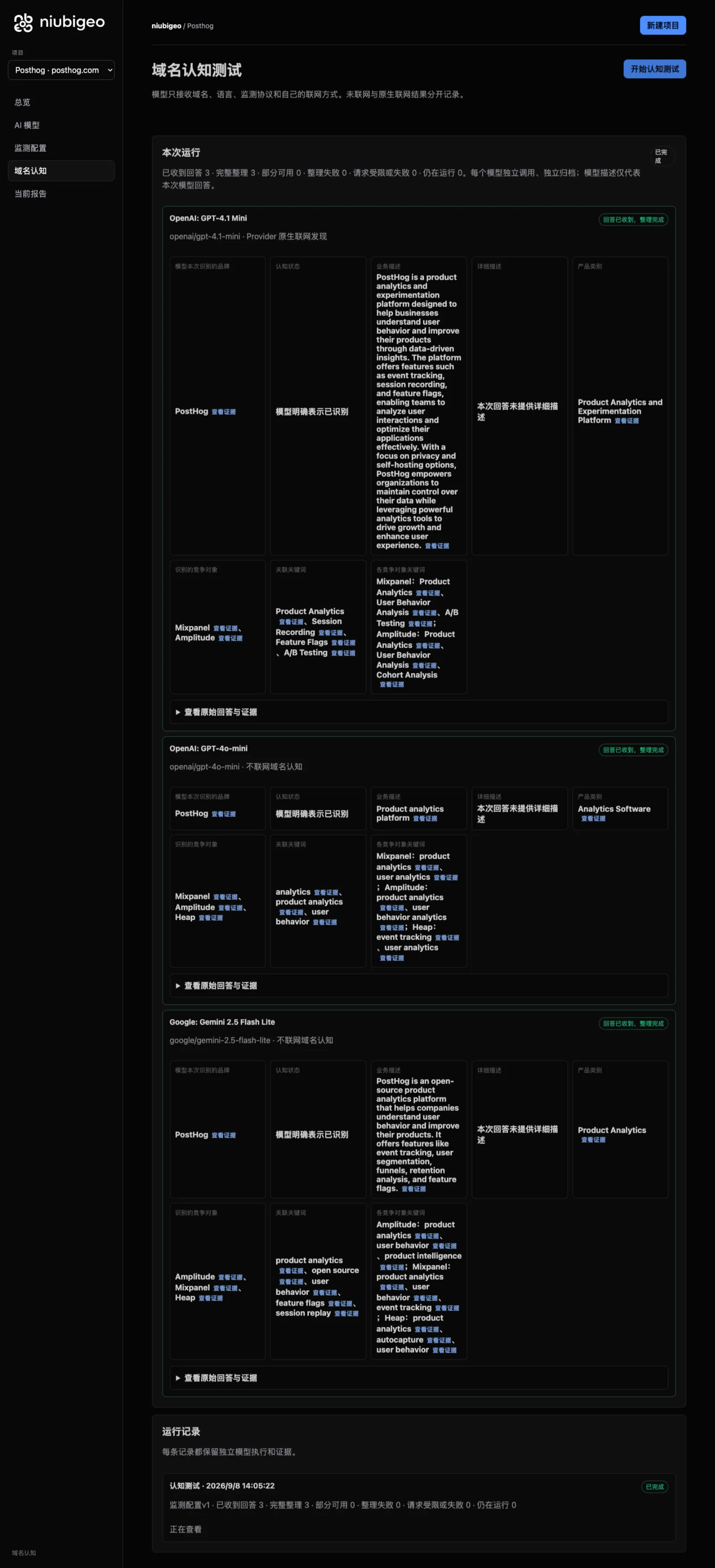
- Domain tests: create a project from a domain and each model answers four questions on its own — how it describes you, what it thinks you do, which products it names as competitors, and which keywords it attaches to your brand. When models disagree, the disagreement itself is the lead worth investigating.
- Keyword tests: ask a neutral need (“prototyping”, in the Figma case) without naming your brand and see who shows up. Being mentioned and being recommended are kept as two separate signals here; most monitoring tools blend them into one score.
- Evidence trail: every run keeps the raw answer, the provider citations and the failures, and evidence files carry SHA-256 hashes so you can check later that nothing was altered. Each conclusion in a report links to the answer text behind it.
- Mixed model sources: OpenRouter, direct provider APIs and custom OpenAI-compatible endpoints can share one test; 16 platform shortcuts prefill the endpoint, and web search is toggled per model. Results stay separated by endpoint, model and search setting, so same-named models never bleed into each other.
- Ongoing observation: a monitoring worker re-runs tests on a schedule to build comparable time series; the roadmap puts competitor-detection and continuous keyword-monitoring dashboards in v0.3, targeted for late October. The repo also ships 20 real cases — Notion, Figma, PostHog and more — browsable without installing anything.
Typical use cases
- Open-source authors and indie developers: after launch, find a similar product among the 20 public cases first, then spend a few dollars of API credits testing your own domain.
- Product and marketing teams: measure before and after a content push or GEO effort, and use the raw answers — not a score — to see what changed and which model misunderstood your positioning.
- Competitor research: see how rivals get recommended in keyword tests and which sources their answers cite, then look for the content gaps that explains it.
Quick start
You need Node 22.13+ and your own OpenRouter API key; model and search calls are billed to you:
git clone --branch v0.2.1 --depth 1 https://github.com/Albert-Weasker/niubigeo.git
cd niubigeo
npm ci
cp .env.example .env
# edit .env and set OPENROUTER_API_KEY
npm run server
Open http://localhost:8787 to create your first project. A Docker image is available if you’d rather not set up Node, and the UI ships in English, Simplified Chinese and Brazilian Portuguese.
Summary
This is for developers and small teams who want to verify for themselves what AI says about their product. Teams that need consumer-surface results or a hosted marketing workflow are explicitly not the target — the README keeps a comparison table of Profound, Peec AI, Otterly and others for exactly that case. Three expectations to set: it queries provider APIs, which the docs state outright are not the same as the ChatGPT or Gemini consumer apps; a few minutes of tests do not make a trend; and the single-process, file-backed design comes with 14 documented known issues (mixed retry results, no cross-process locks, incomplete budget gates) that you would need to fix before running it as a multi-user service. One piece of context: the sponsoring company, NiubiStar, sells RMB-denominated services (a ¥99 diagnostic report, human testing, article placement), so the open-source tool doubles as its storefront — the code itself is Apache-2.0 with no strings attached. For the classic SEO side of the house, see our earlier entry on open-seo: keyword ranks and backlinks are its home turf, with AI visibility as one module among many.