Menlo Ventures: 89% of US enterprise open-source model spend goes to Chinese models
Menlo Ventures' 2026 report: 89% of US enterprise open-source model spend goes to Chinese models — Kimi 61%, Llama 7%. Survey of ~400 US decision-makers.
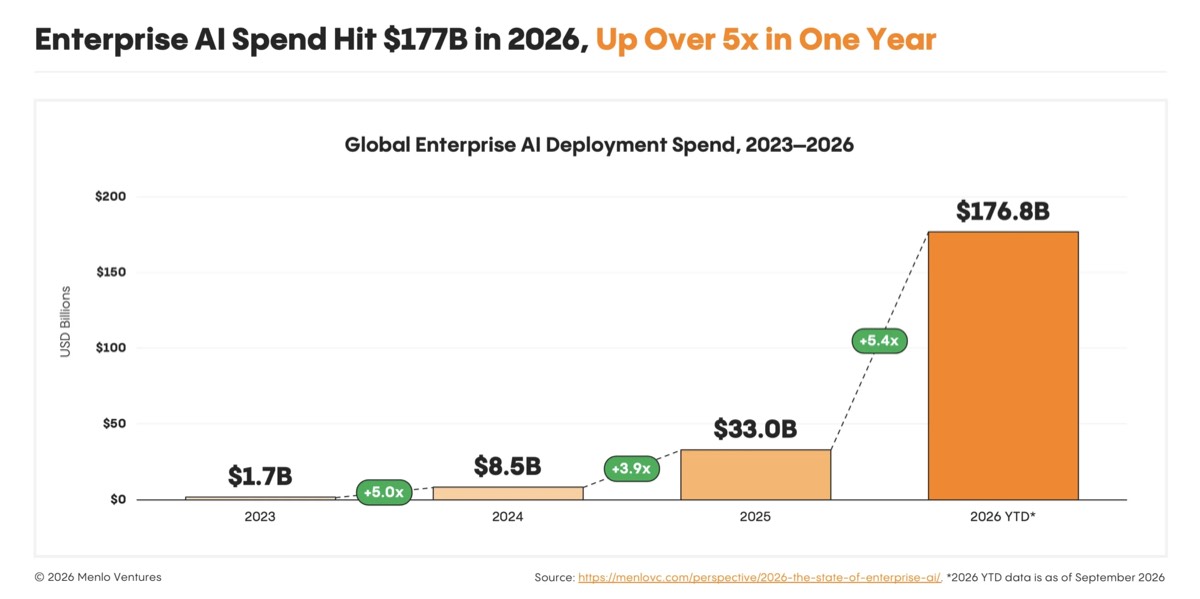
Menlo Ventures published its annual report “2026: The State of Enterprise AI” on November 3, and the number that will shape model-selection debates is this: 89% of US enterprises’ open-source model spend now goes to Chinese models — Kimi takes 61%, DeepSeek 15%, GLM 11%, while Meta’s Llama holds 7%. The figures come from a Morning Consult survey of nearly 400 US enterprise AI decision-makers, fielded September 8–26, 2026, among respondents responsible for more than $4 billion in combined AI spend. The same report puts global enterprise AI deployment spend at $176.8 billion as of September (the chart caption reads “Global”), up 5.4x in a year.
Key points
- Per the report itself (published 2026-11-03, checked 2026-11-08): “Chinese models grew to 89% of open-source spend, led by Kimi (61%), DeepSeek (15%), GLM (11%), and Qwen (3%)”. Llama is the most popular Western open-source model at 7%.
- The survey was run by Morning Consult (September 8–26, 2026) among nearly 400 US enterprise decision-makers responsible for over $4 billion in AI spending. The scope is US enterprises — Chinese reposts headline it as “global”, which the source does not say.
- A second dataset points the same way: OpenRouter says Chinese models passed US models in token share in early June, and DeepSeek led its platform with 29.8% of requests in the week of October 26.
Background
Scope first. The survey covers US enterprises: the report says “nearly 400 U.S. enterprise decision-makers,” with Morning Consult fielding interviews September 8–26. IT之家, a Chinese tech outlet, republished the findings on November 8 under a “global” headline, crediting a South China Morning Post report from the day before; its piece carries neither the sample size nor the survey dates, so the report page remains the only place to verify the numbers as stated.
The survey window matters when reading the shares. Fieldwork closed September 26, so everything that landed afterwards is missing from the data: Moonshot released Kimi K3.1 Pro weights on November 4, Unsloth published quantized DeepSeek-V4.1-Flash builds on October 30 that run on 64 GB machines, and on the Western side Mistral opened Large 4 weights on October 29. The uptake question for all three is open. Earlier in the year, TechCrunch’s July 18 piece “Kimi: Threat or menace?” captured how seriously the market already took these models: the Nasdaq dropped about 1% on the release-day selloff in chip stocks, and an OpenAI executive called Kimi “a very good model” whose performance could not be “explained away by distillation or anything like that.”
The facts
Open-source model spend shares among surveyed US enterprises, verbatim from the report page (fetched 2026-11-08):
| Model | Share of open-source spend |
|---|---|
| Kimi (Moonshot AI) | 61% |
| DeepSeek | 15% |
| GLM (Zhipu) | 11% |
| Llama (Meta) | 7% |
| Qwen (Alibaba) | 3% |
The market-wide numbers come from the same page: global enterprise AI deployment spend reached $176.8 billion by September 2026 ($1.7B in 2023, $8.5B in 2024, $33B in 2025), a 5.4x expansion year over year; the “building” side alone was $102.5 billion, up 5.3x. The authors (Tim Tully, Joff Redfern, Deedy Das and colleagues) also estimate that every $1 of deployment-side AI spend corresponds to about $1.70 of deployment AI revenue.
Spend share and usage share are different metrics, and they disagree on the ranking. OpenRouter’s June 30 blog analysis says US models carried roughly three-quarters of tokens in 2025, then “Chinese models actually surpass[ed] American ones in token share as of early June”; DeepSeek climbed from 9% of weekly tokens in January to nearly 20% by early June and had been the platform’s top model since mid-May. In the latest public rankings (week of October 26), DeepSeek leads with 29.8% of requests, ahead of OpenAI at 18.8%, Google 14.4%, Z.ai 11.9% and Anthropic 5.7%, with Llama at 1.5%. Both metrics point the same direction; the leader differs — Kimi takes over half of spend, DeepSeek leads tokens. That divergence is expected: cheap models burn enormous token volumes without moving spend much.
What others say
OpenRouter framed 2025 as “the year of American tokens” and treats the early-June crossover as this year’s turning point, based on 450 trillion tokens of real platform traffic. On the practitioner side, a Hacker News thread on ops tooling estimated that open-weight models like GLM and Kimi, hosted by US inference providers, “do fine on day-to-day work” while costing “sometimes 5x-7x cheaper” than frontier models. Meta does not appear in the report page’s quotes; the report’s entire commentary on Llama is that it is “the most popular Western open-source model” — the page offers no attribution for the 7%-versus-89% gap.
On the Chinese circulation of the story: IT之家’s repost widened the scope to “global”, and that wording has already propagated across aggregator sites. One more verification note: while writing this entry we saw a claim circulating that OpenRouter data shows Chinese models exceeding US models in token volume “for 27 consecutive weeks.” We could not find that figure anywhere on OpenRouter’s report page, blog or rankings; the verifiable statements are the early-June crossover and the current weekly board, and this entry relies only on those.
Our take
What moved here is not the capability leaderboard but the answer to “whose models do enterprises actually pay for.” For engineering teams selecting models in the US market, open weights have shifted from “should we try” to “why not” — and for Western open-model vendors, 7% of spend is now a number that demands an explanation. Be equally honest about the limits: 61% is spend already committed, not a verdict on the best model for tomorrow’s workload. Token-share leadership belongs to DeepSeek, and the price gap with frontier closed models remains an order of magnitude (OpenRouter’s own example: V4 Flash at $0.09 per million input tokens versus $5 for GPT-5.5). The report page does not explain why Qwen sits at 3%, and it gives no timeline for Llama’s slide; the sample is roughly 400 companies surveyed in September, so treat it as a snapshot, not a trendline. The report itself is a single page with complete charts — worth reading directly.