Developer tools#Code generation#Coding agent
RSIGame: an agent that plays, fixes and re-tests the games it builds
RSIGame is Apache-2.0 research code where an agent plays, diagnoses and fixes the games it builds. The arXiv abstract reports 61.38 on Godot for a 27B model.
Project facts
GitHub Ecosystem- License
- Apache-2.0
- Language
- Python
- Stars
- 152
- Data checked
- 2026-10-21
Snapshot figures reflect the check date and may change over time.
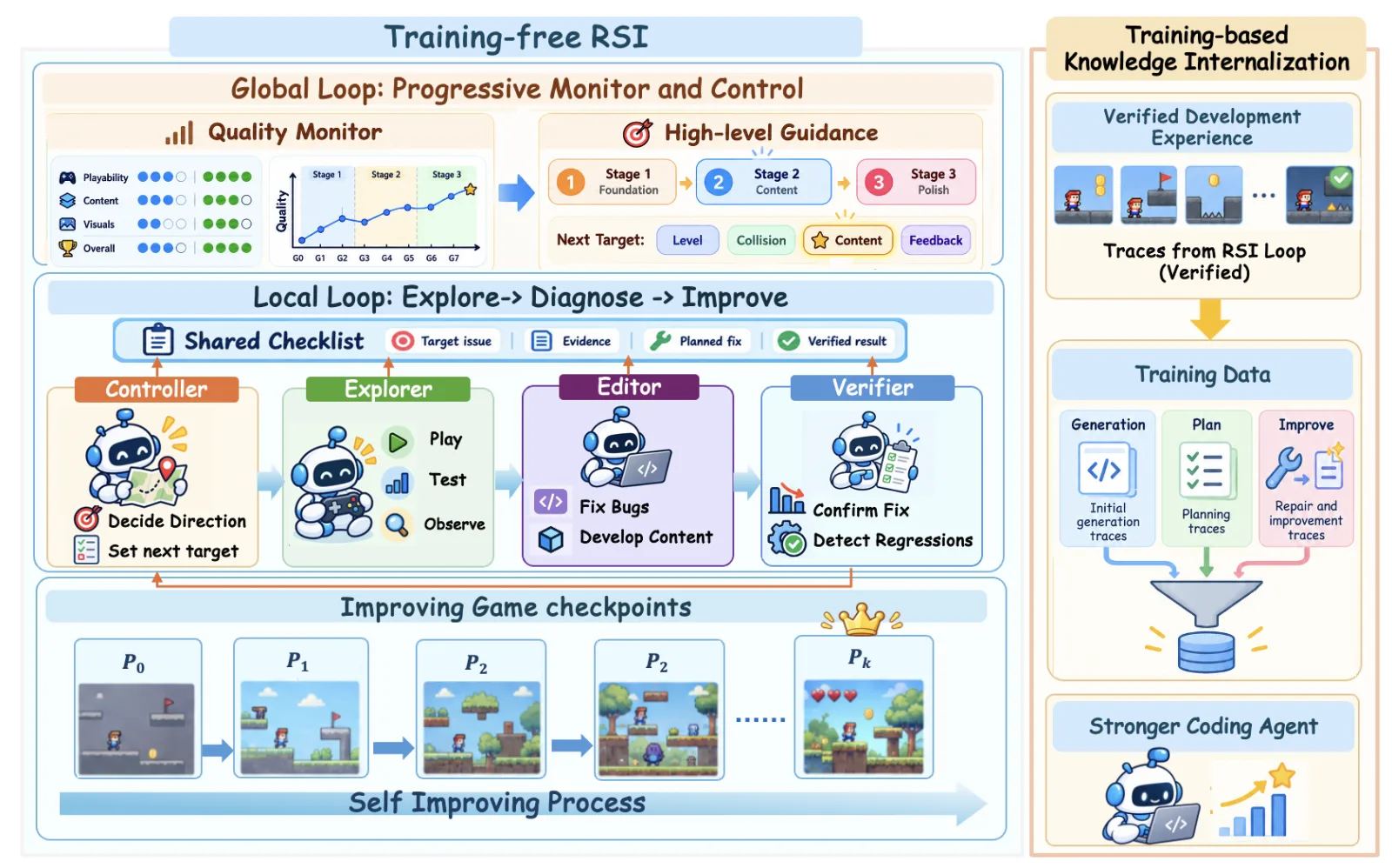
Getting an AI to generate a game in one pass is one problem. Keeping that game playable, fixable and improving over many rounds is another. RSIGame turns game development into a loop. An agent runs the game, records what actually happens, picks the most useful thing to fix, makes the change, and replays the game to check the result. The arXiv paper, 2609.39045, was submitted on September 30, 2026. The code is Apache-2.0, and the paper is under CC BY 4.0.
The paper tests the approach on 140 GameCraft-Bench tasks across two game engines, Godot and Phaser, and five generators. The abstract says RSIGame consistently improves game quality under matched development budgets.
Core features
- An inner loop of explore, diagnose, edit and verify: An explorer agent plays the game and records logs, metrics and screenshots. A diagnosis step turns that evidence into one objective. An edit agent changes code or content for that objective. A verifier replays the game to check that the change works and that earlier working behavior still does.
- An outer loop that tracks quality: A global quality monitor scores each checkpoint and keeps the best build so far. It treats a run as saturated after three checkpoints in a row that fail to beat the held build.
- A published scoring formula: The README gives Overall = BUILD × (0.15·Mechanics + 0.35·Depth + 0.15·Visuals + 0.35·Art). The score comes from replaying scripted demos and judging the recordings.
- Cost accounting for every call: Each model call passes through a loopback proxy.
all_token_calls.jsonllogs the endpoint, model, token counts and cost of each call, andall_token_totals.jsonholds the totals, including for runs that stop early. - Two engines: The paper covers Godot and Phaser. The README links Godot 4.6.2 and credits OpenGame for the Phaser line.
Typical use cases
- A researcher who wants to reproduce the tables: The README says the scoring artifacts behind Tables 1 and 2 are on Hugging Face, with the base game, the scored build and the judge’s records for each row.
- A developer who wants to borrow the role split: Explorer, diagnoser, editor and verifier are separate roles that you can reuse in other agent workflows.
- A team estimating token spend: The cost log counts every model call in a full run.
For a different way to split game-development work across agents, read Claude Code Game Studios, which arranges its roles in a studio-style hierarchy.
Quick start
You need Python 3.11 or later (the README badge says >=3.11), Godot 4.6.2 from the README’s link, and a model API key. Art rounds also need an image-generation key.
cp .env.example .env
rsigame config
rsigame check
Copy .env.example to .env and add your keys, then edit the paths in configs/default.toml. rsigame config shows the configuration a run would use, and rsigame check confirms that the paths, keys and repair agent are ready. A run develops a base game from a corpus directory with one subdirectory per task.
The data story is mixed. The README says the base games behind Table 1 and the scoring artifacts for Tables 1 and 2 are on Hugging Face, in the RSIGame-TableArtifacts dataset. Another section says the base games, run trees, supervised corpus and model weights are still under internal review and will be released after approval.
Summary
RSIGame suits researchers studying agent self-improvement, people who want to reproduce the paper, and anyone running automated game-development experiments. It does not suit a team that wants a finished product. It is research code. It needs model API keys and an image-generation service, a full run can cost real money, and several artifacts are still awaiting release.
A few things to know first. The numbers we cite come from the paper’s abstract. A 27B model reaches 61.38 on Godot and 58.53 on Phaser, exceeds GPT-5.5’s one-shot scores, and generates 11 times fewer tokens. The abstract does not list GPT-5.5’s one-shot scores, so we do not quote any score from press coverage. The README says the two judge prompts stay in Chinese because the paper’s numbers came from that wording. The code is Apache-2.0 and builds on OpenGame and GameCraft-Bench, as the NOTICE file describes. The paper is under CC BY 4.0.
We checked the README, the abstract and the repository metadata only. We did not install or run the code. As of October 21, 2026, the repository had 152 stars, was created on September 28, 2026, and was last pushed on October 11, 2026.