Products#Data analysis#Model training
Action Intelligence launches Chorus, a data engine that turns human video into training data for 16 robot embodiments
Action Intelligence unveils Chorus: 1 hour of egocentric video becomes ~13.6 hours of trajectories for 16 robot embodiments. All numbers self-reported.
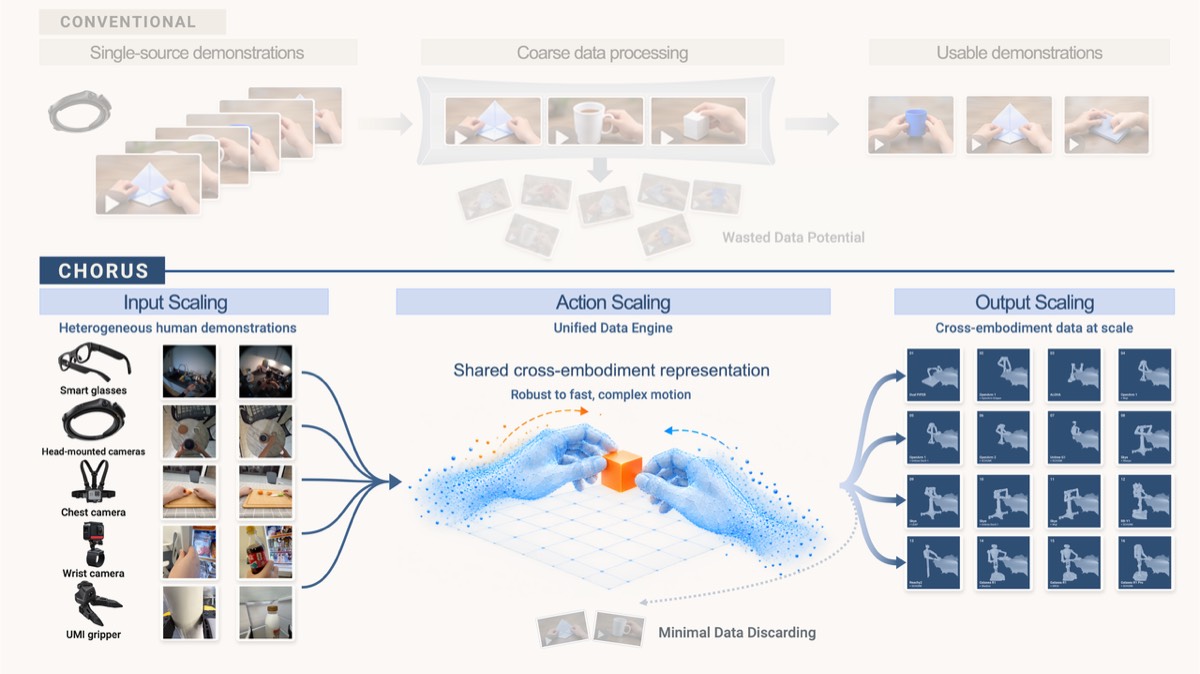
Action Intelligence, a Chinese robotic foundation-model startup, published Chorus (Chinese name 众行) on its research page on October 27: a cross-embodiment data engine that takes egocentric human operation video — from smart glasses, chest cameras, UMI-style rigs — cleans and reconstructs it, and converts it into training trajectories for different robot embodiments. The research page (version v=20261027-5) states the scaling formula plainly: “1 screened source hour × 16 embodiments × 85% ≈ 13.6 trajectory hours.” Add roughly 3× instruction augmentation on top and, per Chinese coverage from TMTPost and Leikeji, one hour of source video stretches to about 40× its weight in effective robot-training data. The buyers are teams pretraining robot policies. One caveat up front: every figure on the page — the 85% conversion rate, the per-hour cost — is the company’s own claim, with no third-party evaluation anywhere.
Key points
- Chorus’s official scaling formula is “1 screened source hour × 16 embodiments × 85% ≈ 13.6 trajectory hours”; with ~3× instruction augmentation, coverage computes to roughly 40× effective training data. Processing cost works out to ~RMB 14.7 per trajectory hour by the company’s own math (Leikeji rounds it to 15 yuan).
- Annotation runs on an in-house 4B atomic-action recognition model at 10 FPS. Action Intelligence says it costs about 1/20 of the Gemini 3.8 Flash baseline — the only comparison on the page, and it measures cost, not capability.
- The company was founded by post-00s researcher Shiqi Yang; TMTPost pins the founding to June of this year (2026). It builds no robots, positioning itself on data plus models — and none of the headline numbers has been independently verified.
Background
Chorus is the second chapter of a three-part product line. On its site, Action Intelligence lays the chapters out as Continuo (随行, “For Human”), a released experience layer that keeps absorbing human experience on wearable devices; Chorus (众行, “From Human”), the data engine released now, with a demo at chorus.a-i.co; and Duet (同行, “With Human”), which plans to route human guidance, corrections and interaction feedback back into training — marked “Classified / UNRELEASED” on the page, with Leikeji reporting a launch within the year. The company’s name carries its thesis: TMTPost explains that tokens are the basic unit of LLMs, and Yang wants to define the equivalent “Action Token” for robots.
The positioning reads differently depending on what you compare it to. OpenAI currently lists 19 robotics job postings running from motor design to manufacturing procurement (see our earlier coverage) — a model company building hardware in-house. Yann LeCun’s camp bets on world models, with the H-JEPA paper using hierarchical planning to predict the physical world (see our earlier coverage). Action Intelligence takes a third path: no embodiment, no hardware lock-in, only the data and models for what it calls a generalist embodied brain. TMTPost quotes the reasoning directly — China already has a mature, massive robot hardware supply chain, and building bodies would burn capital and slow model iteration.
The facts
The pipeline, per the research page: multi-source human video goes through cleaning and 3D reconstruction, then atomic action recognition, semantic annotation and trajectory optimization, and finally cross-embodiment mapping onto the target robot. The checkable numbers, all company-stated:
| Item | Figure | Source |
|---|---|---|
| Embodiments | 16 robot embodiments | Research page |
| Conversion | 85% average usable-data conversion rate | Research page |
| Scaling | 1 hr × 16 × 85% ≈ 13.6 trajectory hrs | Research page |
| Augmentation | ~3× instruction augmentation | Research page |
| Cost | ~RMB 200 per input hour ≈ RMB 14.7 per trajectory hr | Research page |
| Annotator | In-house 4B model at 10 FPS | Research page |
| Annotation cost | ~1/20 of Gemini 3.8 Flash baseline | Research page |
Annotation works over short temporal windows with temporal token compression, labels at three levels (atomic actions, subtasks, complete tasks), then applies instruction augmentation. Data scoring covers semantic completeness, 3D reconstruction quality, motion consistency and visual quality, plus effective duration and action counts. The page also defines an “action surprise” metric: a language model predicts the next action from context, and Chorus measures the gap between prediction and observed action — flagging unexpected choices, strategy changes and corrective moves for human review first. On the input side it accepts smart glasses, chest and wrist cameras, neckbands, head-mounted systems and UMI-style devices, in monocular through six-camera configurations. Leikeji adds an equivalent-cost framing: after augmentation, a unit training sample costs about RMB 5 per hour. Founder background comes from Leikeji: Shiqi Yang graduated from UC San Diego, where he studied under Xiaolong Wang, now a research director at Meta Superintelligence Labs; technical co-founders Chenyang Si and Jingkang Yang both made the 2026 list of the world’s top 2% scientists. TMTPost adds that Yang returned to China in July 2025, spent months surveying the country’s embodied-AI scene, and founded the company this June.
What others say
Public coverage so far is Chinese tech media, and it leans on official material. TMTPost’s angle is business strategy: it calls the at-scale supply and reuse of training data the industry’s real chokepoint, and quotes Yang saying the company “resolutely will not build hardware bodies” or bind to a single vendor. On deployment, it describes logistics sites starting at “one-to-one” — one worker supervising one robot; when the robot gets stuck, a worker with no technical background takes over within two to three seconds, corrects it, hands it back, and the correction flows back into training — with the ratio meant to reach “one-to-three” as success rates climb. Leikeji’s angle is team and cost: the academic lineage, the two co-founders’ scientist-list placements, and the 15-yuan/trajectory-hour and 5-yuan equivalent-sample figures. The takeover-and-correct loop matches the themes (“GUIDANCE · CORRECTION · COLLABORATION”) of the unreleased Duet chapter — it is roadmap, not a shipped feature.
The sourcing picture needs stating. TMTPost’s key numbers (85%, 13.6 hours, 16 embodiments) match the official page; Leikeji transcribes 85%, the 16 embodiments and the cost figures (15 yuan, 5 yuan/hour, 40×). Both rewrite official material rather than test it independently. Jiqizhixin (Machine Heart) ran a piece the same day, but its body text sits behind anti-scraping and we could not read it. The page’s only head-to-head comparison is annotation cost against Gemini 3.8 Flash; there is no task-success or policy-performance benchmark of any kind. Our own search found no fourth independent outlet, no critical coverage, and no community discussion on Hacker News or Reddit yet.
Our take
For teams pretraining robot policies or building data pipelines, Chorus belongs on the comparison list. If the 85% conversion and RMB 14.7 per trajectory hour hold up, amortizing one human demonstration across many embodiments beats the one-dataset-per-robot collection model on cost — and the demo at chorus.a-i.co is public, so checking it is cheap. For anyone tracking embodied-AI strategy, it is a fresh sample of the “data layer” bet: OpenAI builds bodies, LeCun’s camp builds world models, and Action Intelligence asserts the bottleneck is data supply. Three camps, three different bottlenecks in the same market.
The honest catch is that every load-bearing number comes from the company’s own page. The 85% conversion ships without per-embodiment detail; 13.6 hours is formula arithmetic, not a measurement of an actual batch; the 40× figure is two self-reported numbers multiplied together. The research page is silent on founding date and funding — TMTPost’s “founded this June” has no second independent source. Until a third party re-runs this on their own data, treat the numbers as a price quote awaiting verification rather than a benchmark.
What to watch
Three things to track. First, Duet: if it ships within the year as reported, the two-to-three-second human-takeover feedback loop moves from plan to feature, a load-bearing piece of the company’s “system scaling” story. Second, third-party replication: whether any customer or research group publishes task success rates from running Chorus on their own data. Third, the foundation model itself: the site marks it “UNRELEASED / TO BE REVEALED,” and since Action Intelligence refuses to build robots, this model is the endgame product. When it lands, and in what form, will test whether the data-engine-first route actually leads anywhere.