Apple launches HomeView: a $299 family smart display, with HomePod mini 2 and a new Apple TV 4K
Apple announced HomeView, a $299 smart display, on October 13 alongside HomePod mini 2 ($149) and a new Apple TV 4K ($299); only the speaker ships to China.
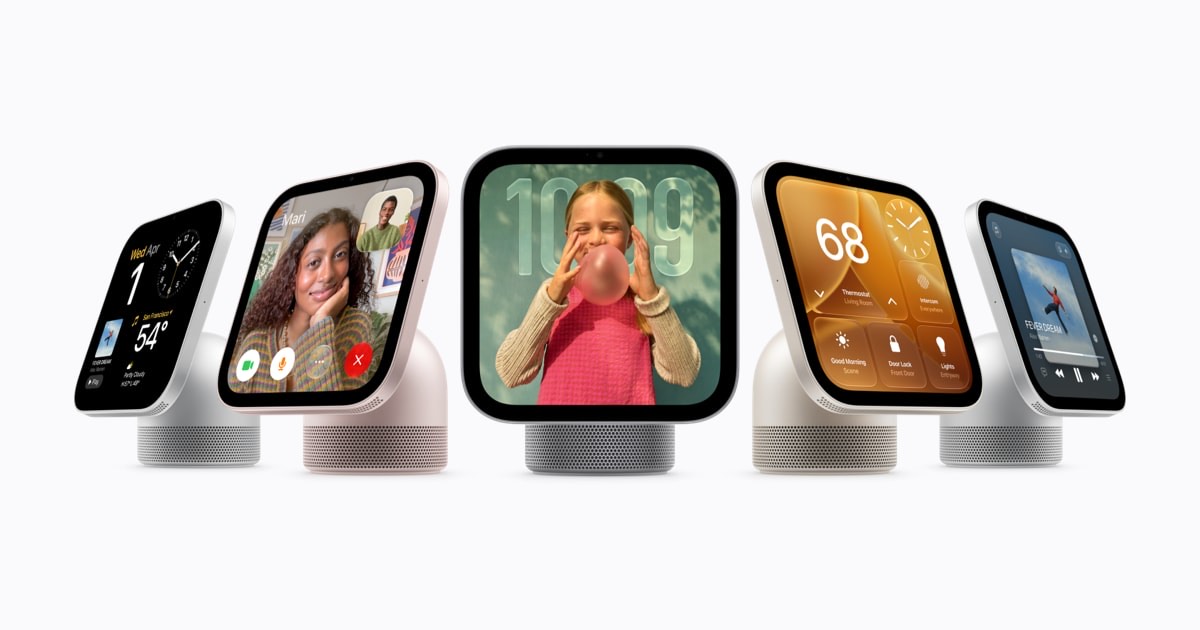
At its “Welcome Home” event on October 13, Apple introduced Apple HomeView, the company’s first purpose-built smart display for the home: a 7-inch Liquid Retina screen on a domed speaker base, an A18 chip inside, priced at $299 and shipping November 13 in seven markets including the US, UK and Canada. It arrived alongside a HomePod mini 2 — the speaker’s first update in six years — a fourth-generation Apple TV 4K, and an Apple Home Collection accessory line built with LG and Schneider Electric. Of the entire batch, only the speaker will be sold in China.
Key points
- HomeView costs $299 in both countertop and wall versions, ships November 13: A18 chip, up to six recognized users, and the seven launch markets exclude the EU — Apple says Siri AI is currently unavailable on iOS there.
- HomePod mini 2 is the only piece of the lineup sold in China: S10 chip, $149 in the US, CN¥1,099 in China (¥100 more than its predecessor), on sale October 30.
- The fourth-generation Apple TV 4K moves to an A19 chip — Apple claims a 50% faster CPU and doubled GPU — adds AV1 hardware decoding and a findable Siri Remote, for $299. No China release.
Background
The lineup was one of Apple’s worst-kept secrets. Bloomberg’s Mark Gurman reported in early October that a roughly 6-inch square home hub — then known by the leak codename HomePad — plus a new HomePod mini and a new Apple TV 4K would land on October 13; we rounded up the full rumor set in our earlier coverage. The shipping products match the leaks on almost every point, with two exceptions: the screen is 7 inches, not 6, and the name is HomeView rather than HomePad.
Siri AI is the other thread. Apple’s assistant has lacked a dedicated home device even as its AI plans stumbled — OpenAI said in court filings that wiring ChatGPT into Siri went badly and Apple turned to Gemini, as we covered last month. October 13 gave the new Siri its first purpose-built hardware. The LG-made accessories that surfaced in FCC filings on October 6 as a rumor arrived as the Apple Home Collection, with Schneider Electric added to the roster.
The facts
The chips, prices and release dates across the announcement, assembled from Apple’s press release and coverage by PCMag and others; details Apple has not published are marked as press reporting.
| Product | Chip | Price | Availability | China release |
|---|---|---|---|---|
| HomeView (countertop / wall) | A18 | $299 | November 13 | No |
| HomePod mini 2 | S10 | $149 / CN¥1,099 | October 30 | Yes |
| Apple TV 4K (4th gen) | A19 | $299 | November 13 | No |
| Apple Home Collection (LG, Schneider) | — | $39.95–$399.95 | From December, some in early 2027 | No |
| HomeView wall mounts (Schneider) | — | $59.95–$129.95 | With HomeView; PoE in early 2027 | No |
HomeView is deliberately not an iPad. It runs no apps and plays no shows; it has no battery and stays plugged in over USB. From across the room it is a large-face clock and a photo frame, dimming to 0.3 nits at night; walk up and your calendar and reminders expand. The front camera recognizes up to six family members, each with their own home screen, apps and widgets — and personal content only appears when two conditions hold at once: the display recognizes your face, and a paired iPhone or iPad is nearby and has been recently unlocked. Apple’s press release adds that the A18’s Secure Exclaves isolate camera and microphone data from the rest of the system. The wall model requires Schneider’s mounting hardware: $59.95 for the USB-C connector, $79.95 for AC power, and $129.95 for PoE (early 2027). Siri AI launches English-only, with Canadian French to follow.
In the HomePod mini 2, the doubled compute goes mostly into bass response and far-field wake accuracy, and the top light — now called Sound Glow — pulses with the music. Stereo pairing carries over, and four units can form a spatial-audio surround set, but each pair must match and the whole setup requires the fourth-generation Apple TV 4K; it can also act as a Mac speaker if the Mac has Wi-Fi 6E or newer. Press reports note the arithmetic for Chinese buyers: four speakers cost CN¥4,396, yet with no China release of Apple TV 4K the surround setup cannot be officially assembled there at all.
The fourth-generation Apple TV 4K pairs its A19 with a claimed 50% faster CPU, doubled GPU performance and a dedicated AV1 decoder. Three far-field microphones handle voice search with echo cancellation, and the new Siri Remote adds a built-in speaker so it can chirp when pinged from Find My; a compatible iPhone shows distance and direction.
The Apple Home Collection spans a smart lock, a video doorbell, indoor, outdoor and floodlight cameras, thermostats and sensors, all managed from the Home app with no per-brand app or account. Per Apple’s materials, LG’s lock unlocks as you approach over UWB, keeps a PIN and a physical key as fallbacks, and runs its unlock logic entirely on-device; the indoor camera physically dips its lens when the first family member comes home; and the thermostat reads temperature and humidity directly from HomeView and HomePod units. The line rolls out from December, with the US and Canada leading.
What others say
The loudest argument landed on Hacker News within hours, where the HomeView thread climbed to 637 points and 758 comments by press time. The flashpoint is the Siri AI requirement: HomeView is not sold in the EU — Apple told MacRumors that Siri AI is unavailable on iOS in the region and that it is “working constructively with the EU in an attempt to find a path forward”, with no timeline given — and readers questioned why a display needs AI at all. “I’ve used a Google Nest Hub for years, and I don’t think it needs AI to be useful,” wrote timpera. maxsilver went further: “The AI is the least interesting and least useful part of this product. Apple basically made a HomePod mini that is also a Skylight… They could turn off all AI and this would be one of the best products on the market.” Another commenter suspected the constraint is margin rather than usability: “They might be perfectly useable but not profitable enough.”
Bloomberg framed the $299 hub as the center of Apple’s broader smart-home push, with the speaker, the TV box and the accessory line all converging on the living room. Chinese media added the subscription angle: the ten-day recording history, AI video summaries and natural-language recording search all sit behind iCloud+, with one camera tying up the 50GB plan and several pushing households to 200GB or 2TB; day-to-day control, music and FaceTime are unaffected.
Our take
For households already living in Apple’s ecosystem, HomeView’s real contribution is not the AI — it is an answer to the problem taping an iPad to the fridge never solved: a shared screen that shows personal data only to the person standing in front of it. Face recognition plus a nearby recently-unlocked device is a thoughtful double lock, and Secure Exclaves gives it a hardware backstop. That mechanism is worth imitating more than any Siri feature. The Hacker News skeptics also have a point about the real competition: strip the assistant away and HomeView’s honest rival is a $200 smart calendar frame, not the Nest Hub.
The business shift deserves as much attention as the specs. Apple spent two decades selling devices to one person at a time; locks, cameras and iCloud+ tiers for recording history turn the household itself into the account — hardware once, services monthly. The catches are real, too: Siri AI ships at three different paces across the three devices (full on HomeView, beta on Apple TV, a later update on HomePod mini), English only at launch, and neither the EU nor mainland China can buy the full lineup.
What to watch
- October 30: HomePod mini 2 goes on sale, including China.
- November 13: HomeView and the fourth-generation Apple TV 4K hit seven markets.
- From December: Apple Home Collection rolls out, with some products in early 2027.
- Around October 27: Apple’s second fall event, expected to headline the first touchscreen MacBook Pro — our earlier report.