AMD's new Ryzen AI Halo developer platform carries up to 192GB unified memory
AMD announced the next-gen Ryzen AI Halo on October 12: up to 192GB unified memory, 300B-parameter models locally per AMD, Linux unit listed at $7,299.99.
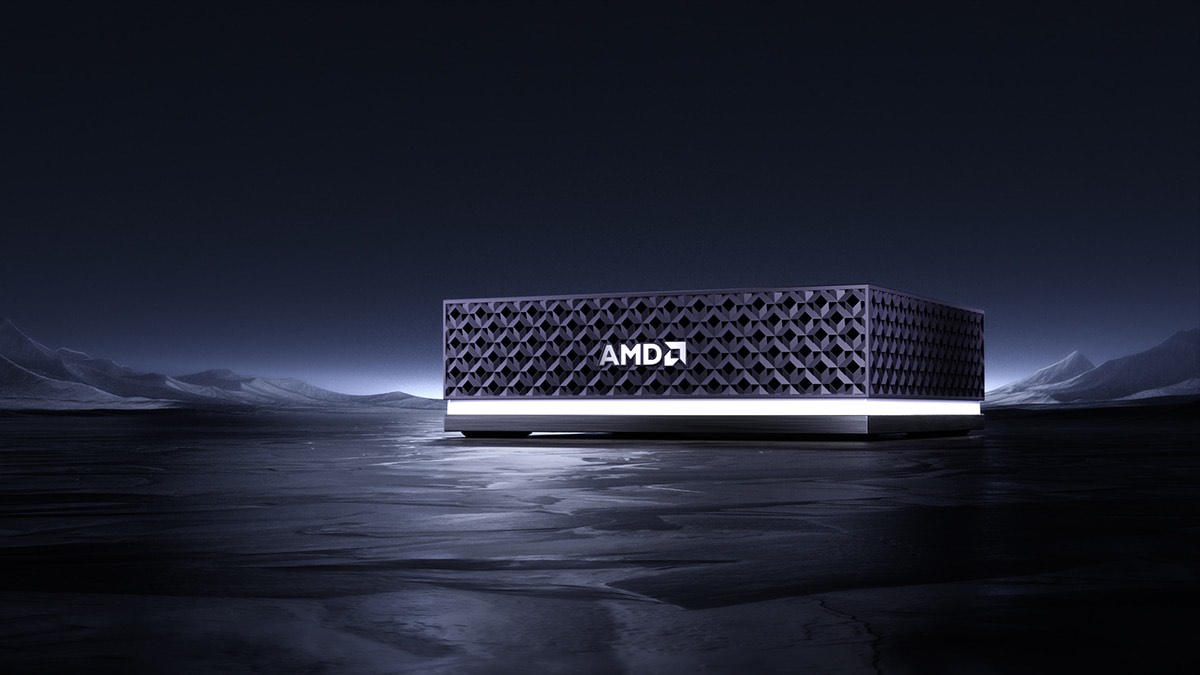
AMD launched the next generation of its Ryzen AI Halo developer platform on October 12 — a desktop box built for running large models on your desk instead of someone else’s GPUs. The top configuration pairs the Ryzen AI Max+ PRO 495 with 192GB of LPDDR5X unified memory, and AMD’s launch blog puts the ceiling at 300 billion parameters at 4-bit quantization. Per Chinese tech outlet IT之家, the Linux version is listed at $7,299.99, with a Windows model to follow.
Key points
- Unified memory tops out at 192GB (LPDDR5X-8533, per IT之家), up from 128GB on the first Halo; IT之家 reports up to 160GB of it can be allocated as shared VRAM.
- The Linux unit is listed at $7,299.99 (IT之家; VideoCardz’s headline rounds to $7,299) — roughly $3,300 more than the original 128GB model’s $3,999.
- AMD’s page confirms two configs side by side: the PRO 495 (55-TOPS NPU, 61 FP16 TFLOPS of GPU compute) rated for up to 300B parameters, and a Ryzen AI Max+ 395 with 128GB rated for 200B.
Background
AMD showed the first Ryzen AI Halo during CES in January and put the original 128GB model on sale mid-year at $3,999. Reviews landed in early July: The Register’s verdict was that local AI “looks easy, but it doesn’t come cheap,” Phoronix focused on the open-source software stack, an LTTLabs piece drew 374 points on Hacker News, and retailer Micro Center published a hands-on on July 10. The category clearly has both attention and an actual buying path.
We have been tracking this personal-AI-workstation price line for a while: NVIDIA’s DGX Spark 128GB climbed to $6,950, Microsoft’s Dev Box landed at $5,999, and the RAM shortage behind those numbers is expected to run through 2028. The 192GB Halo is now the biggest and priciest rung on that ladder. The lineage goes back further, too: when the “Strix Halo” silicon debuted in January 2025, Tom’s Hardware’s headline keyword was “radical new memory tech” — 192GB just pushes that design further.
The facts
The two Halo generations, side by side — specs from AMD’s product page (checked October 13, 2026), price and memory details sourced separately:
| Spec | Original (AI Max+ 395) | New top config (AI Max+ PRO 495) |
|---|---|---|
| CPU | 16-core Zen 5 | 16-core Zen 5 |
| NPU | 50 TOPS | 55 TOPS |
| GPU compute (FP16) | 60 TFLOPS | 61 TFLOPS |
| Unified memory | 128GB | 192GB LPDDR5X-8533 (IT之家) |
| Local model ceiling (AMD claim) | 200B parameters | 300B parameters |
| Price | $3,999 | $7,299.99 (Linux unit, IT之家) |
Details worth unpacking:
- IT之家 reports the new platform can allocate up to 160GB as shared VRAM. The 192GB is one shared pool with no discrete VRAM; after 160GB goes to the GPU, about 32GB is left for the OS and everything else. This box is effectively a dedicated inference machine while a large model is loaded.
- On AMD’s product page (checked October 13, 2026), the 128GB config is on sale while the 192GB top config carries an “Available Soon” badge; the page also claims the system goes “from power-on to tokens in minutes.” The page’s 300B wording carries no quantization qualifier — the “4-bit” framing comes from AMD’s launch blog. There is no official bandwidth figure: IT之家’s LPDDR5X-8533 works out to roughly 273 GB/s on a 256-bit bus, the same league as the 256-bit bus at about 256 GB/s The Register stated for the 128GB original (a speed corresponding to LPDDR5X-8000).
- Software ships preconfigured: ROCm and AMD’s Developer Center, with both Linux and Windows officially supported. A page footnote states the product is available for purchase and use in the United States only.
- AMD frames the pitch as “pay once for cloud-grade intelligence” and claims up to 6x lower three-year cost of ownership versus equivalent cloud API usage in a modeled sustained-use scenario. That is vendor math on a specific usage assumption, not a benchmark.
What others say
VideoCardz framed the launch the same way IT之家 did: Linux first, the Windows model later. IT之家 adds that the Windows unit will come with Microsoft’s Project Zenith preinstalled — consistent with September’s third-party reports that Zenith would debut on the Halo, though neither AMD nor Microsoft has officially confirmed it.
The Reddit r/Amd thread led with the price math in its title: the 192GB model costs $3,300 more than the original 128GB one. Demand was no surprise — a Framework forum thread asking whether the 192GB desktop could run local LLMs dates back to August. The third-party anchor points were already set, too: earlier reports listed Framework Desktop’s 192GB version at $6,799 and MINISFORUM’s equivalent at $7,399, so AMD’s official box lands right in that band. As for whether reviews will be kinder this time, The Register’s July verdict on the original — “it doesn’t come cheap” — is the likely sequel.
Our take
The Ryzen AI Halo 192GB changes one number: the model size a boxed desktop can hold locally, up from DGX Spark’s 128GB to 192GB, which maps to 300B parameters at 4-bit. Why 192GB? Back-of-envelope math: a 300B model at 4-bit needs roughly 150GB for weights alone, and once you add KV cache and runtime overhead you are pressing against the 160GB-allocatable figure IT之家 cites. This config was reverse-engineered from that target. For researchers who need a 100B+ quantized model on their own hardware and are comfortable with Linux, it is among the first boxed desktops with “300B fits” in the official specs — though it can’t be bought until “Available Soon” turns into a live listing, and Framework’s 192GB Desktop opened pre-orders on September 30 per Framework’s announcement.
Two caveats. First, the memory tax: the $3,300 premium over the original buys, in essence, 64GB of LPDDR5X amid memory inflation — the same logic as DGX Spark’s price hike and the Dev Box’s sticker, with no price relief in sight. Second, throughput: at a converted ~273 GB/s, unified memory bandwidth is far below a multi-GPU system’s VRAM bandwidth, and fitting a 300B model is not the same as serving one. Single-stream decode will likely run at single-digit tokens per second by rough math; production throughput still means a GPU cluster. And if you only ever call models through APIs, AMD’s “up to 6x cheaper over three years” projection rests on sustained heavy use — light usage probably never breaks even.
Still unanswered: a date for the Windows model and Project Zenith (IT之家’s reporting only), availability outside the US, and independent throughput benchmarks for the 192GB config.