Baker lab builds proteases from scratch, including enzymes aimed at disease-linked proteins
Two Nature protease-design papers appeared October 14; Huxiu reports 13 of 69 cysteine designs were active and discusses a second metalloprotease study.
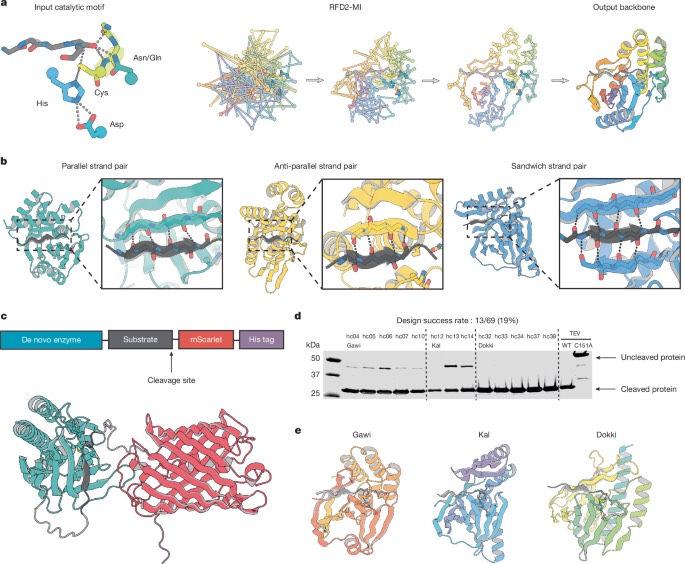
Two protease-design papers associated with David Baker’s group appeared in Nature on October 14, 2026. Huxiu’s account of the cysteine-protease paper reports activity in 13 of 69 designs; its discussion of the companion metalloprotease paper mentions work involving TDP-43. The accessible reporting supports a research milestone, not a treatment claim, and does not resolve every experimental detail in the papers.
Key points
- The cysteine-protease study reports activity in 13 of 69 designs, a 19% hit rate; six crystal structures differed from their design models by less than 1.2 Å.
- Huxiu’s account of the metalloprotease work puts its maximum rate enhancement at about 10⁹ relative to the uncatalyzed background; the accessible material does not specify the assay substrate or conditions.
- Huxiu notes delivery, immunogenicity and off-target toxicity as barriers to drug development; the accessible material does not establish efficacy in animals or clinical safety.
What was designed
The challenge is more demanding than making a protein adopt a chosen shape. A protease must position catalytic chemistry and recognize a substrate well enough to cut a specific peptide bond. The two papers address de novo cysteine-protease and metalloprotease design, as their titles indicate; the accessible reporting does not let us verify the detailed catalytic mechanisms.
Huxiu’s account of the cysteine-protease paper reports activity in 13 of 69 designs, or 19%. It also cites six crystal structures with deviations below 1.2 Å from their models and a TM-score below 0.5 against known natural proteases. The structural agreement supports the models for those six examples; it does not by itself establish catalytic efficiency or a medical use. Nature’s article page could not be read in this review, so this entry does not add mechanism, workflow or cell-assay details that are absent from the accessible account.
The 13-of-69 result is useful context for the design claim: by Huxiu’s reported total, the other 56 designs were not counted as active. Computational design therefore did not remove the experimental screening step. The accessible source does not give the screening protocol or each candidate’s outcome, so it cannot support conclusions about why individual designs failed or claims about mutation tests and optimization.
A second catalytic route
The companion study is titled Computational design of metalloproteases. Huxiu’s accessible account puts the maximum rate enhancement for the metal-protease work at roughly 10⁹ over the uncatalyzed background. That is not a comparison with a natural protease’s efficiency or a drug’s effect. Nature’s page could not be read for this review, so specific design counts, activity rates and optimization figures beyond Huxiu’s summary are not treated here as verified facts. The accessible report also does not identify the substrate, assay conditions or optimization stage behind its approximate figure.
Huxiu specifically mentions cleavage at TDP-43’s disordered C-terminal region. That supports a cautious summary that the research addressed a disease-associated protein target, but does not establish activity on full-length protein in both monomeric and oligomeric states. The accessible material provides no verifiable details for amyloid-β, serum amyloid A, cytokine or receptor-antagonist experiments, or for a selectivity panel and its measured rate range; this article does not present those as confirmed results.
What the numbers mean
Huxiu reports maximum background-relative enhancements of about 3×10⁷ for the cysteine proteases and roughly 10⁹ for the metalloprotease work. There is an unresolved numerical discrepancy in the source record: earlier supplied notes gave a figure above 10¹⁰, but Nature’s article page could not be accessed to verify it or determine whether it reflects another substrate, optimization stage or assay baseline. This account therefore does not state 10¹⁰ as a verified result; the approximate 10⁹ figure is attributed to Huxiu, and its assay scope remains unclear. A background-relative rate ratio is not a direct measure of natural-enzyme efficiency or clinical effect.
The same access limit applies to claims about selectivity. Huxiu’s account mentions a TDP-43 C-terminal target, but the accessible text does not provide enough detail to establish a broad off-target profile. Target choice in a research assay should not be mistaken for demonstrated safety across human tissues or proteins.
From cells to medicines
The accessible reporting does not let us confirm the cell experiments described in earlier drafts, including which protease was tested in which cellular setup. The broader distinction still matters: a result in a research assay, even if confirmed in cells, would not by itself establish that a therapeutic protein can be delivered to the right tissue or compartment. For this reason, this entry does not use cellular activity as a verified claim.
Huxiu highlights delivery, immunogenicity and off-target toxicity as translational hurdles. A therapeutic protease would need to reach relevant cells, remain active where intended and avoid harmful immune responses or cleavage of normal proteins. The materials accessible for this review do not establish whether the papers report clinical delivery, animal efficacy or safety data, so those questions remain open here. Possible therapeutic applications should be read as research directions, not demonstrated clinical uses.
For people working in protein engineering, the independently reported cysteine-protease results offer a bounded research example: 13 of 69 designs were active, and six structures matched their models closely. For patients, there is no treatment to try. The next useful evidence would include accessible primary results, followed by efficiency, delivery and safety data; a larger background-relative number alone would not answer those questions.
Our take
The independently reported cysteine-protease results offer a bounded example of de novo enzyme design: Huxiu reports 13 active designs out of 69 and cites structural agreement in six crystal structures. The metalloprotease paper may extend that research direction, but the primary article was unavailable for this review, so its specific experimental claims remain uncertain. The work is best understood as research, not a therapeutic milestone.
There is a useful comparison with other AI-assisted biology stories. In our earlier report on Anthropic’s Claude-assisted discovery of a CRISPR-like system, the central question was whether sequence discovery had been followed by functional evidence. Here, Huxiu cites structural data for some cysteine-protease designs; the accessible reporting does not let us confirm cellular validation. What should change the assessment next is a review of the complete primary results, followed by evidence that a designed protease can be delivered, controlled and shown to work safely in an organism.