Flipper One raises $15.5M on Kickstarter for a $399 Linux network computer
Flipper One, a $399 pocket Linux network computer, drew $15.5M in pledges from 28,500 backers on Kickstarter against a $300,000 goal. Shipping is due July 2027.
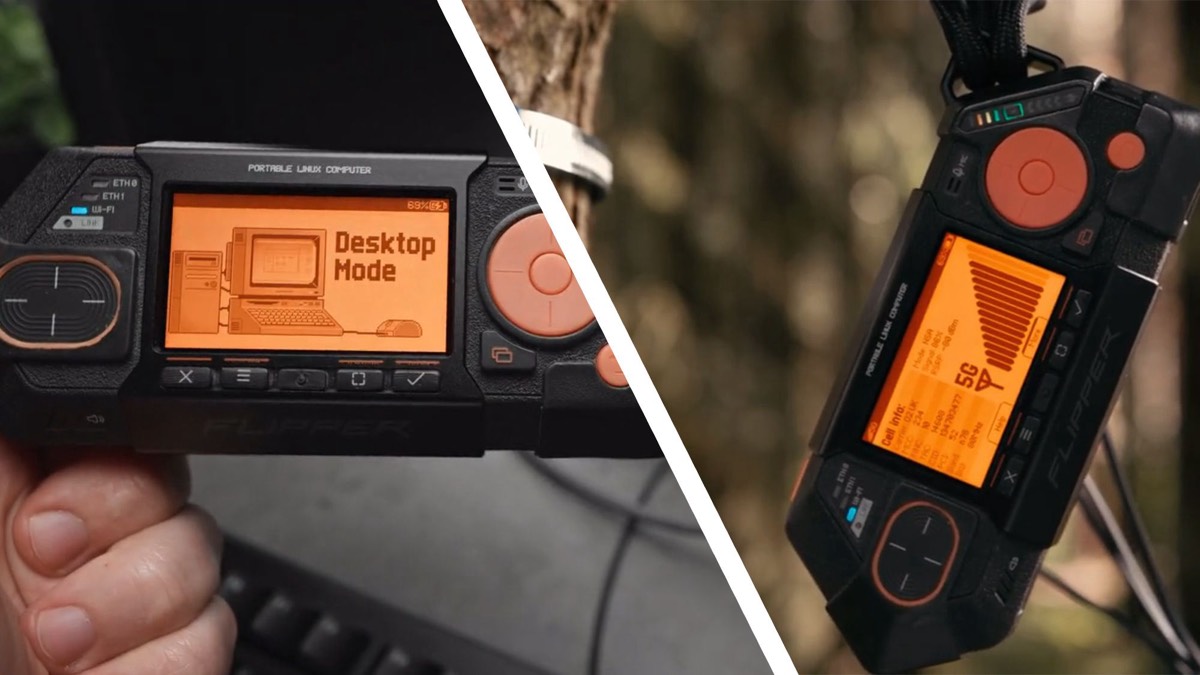
Flipper One is Flipper Devices’ new device after the Flipper Zero, and it is a different kind of machine: a pocket-sized Linux network computer built around an eight-core Rockchip RK3576, 8GB of RAM, two Gigabit Ethernet ports and Wi-Fi 6E, with M.2 and GPIO expansion for a 5G modem, an SDR radio or a desktop setup. It launched on Kickstarter on November 17, 2026; by November 21 the project’s stats endpoint showed $15,481,635 pledged from 28,551 backers against a $300,000 goal. That figure is pledged backing, not collected revenue.
Key points
- The $15,481,635 is pledged, roughly 51 times the $300,000 goal; 28,551 people had backed the campaign by November 21, and it is scheduled to close on December 17.
- The $399 tier is a limited Kickstarter price for 15,000 units, which Flipper describes as 25% off an estimated $550 retail price; the $379 early-bird tier was capped at 1,000 units.
- The hardware is still at the Pre-EVT stage. Flipper aims to start shipping in summer 2027, and the campaign page lists an estimated delivery date of July 2027.
The numbers
The campaign opened on November 17 and runs for 30 days, closing on December 17. Kickstarter’s stats endpoint recorded $15,481,635 from 28,551 backers at 14:06 UTC on November 21. Kicktraq, watching the same campaign, put the average daily pledge at about $3.1 million and the average pledge per backer at $542. With a $300,000 goal, the project passed its threshold on day one; the remaining three weeks only add to the total.
The price ladder matters more than the headline. The $399 tier is a limited Kickstarter price for 15,000 units, set against an estimated $550 retail figure; the $379 early bird was capped at 1,000.
| Tier | Price (USD) | Notes |
|---|---|---|
| Early bird | 379 | 1,000 units |
| Kickstarter special | 399 | 15,000 units; about 25% off the $550 retail estimate |
| LoRa bundle | 439 | Device plus LoRa module |
| SDR bundle | 539 | Device plus SDR module |
| 5G bundle | 599 | Device plus 5G module |
| Ultimate bundle | 759 | Device plus 5G, SDR and LoRa |
| Modules (LoRa/SDR/5G) | 59 / 149 / 219 | Device not included |
A refundable $20 deposit also unlocked a hidden $379 tier; XDA reported the coupons sold out. The $15.5 million is neither revenue nor profit. Kickstarter’s fee and payment processing come off the top, and tooling, certification, components, logistics and support come out of what remains. If the campaign had missed its goal, backers would have been refunded; now that it has passed, Flipper owes them delivery.
What it is
Flipper One is a full ARM computer, not a microcontroller accessory. The RK3576 has four Cortex-A72 cores at 2.2GHz and four Cortex-A53 cores at 1.8GHz, a Mali-G52 MC3 GPU and a 6 TOPS NPU. A separate Raspberry Pi RP2350 handles the display, buttons, LEDs and power, so the device can show status and recover Linux even when the main system is off or broken.
| Spec | Flipper One | Flipper Zero |
|---|---|---|
| Role | Layer 1: IP networking and Linux computing | Layer 0: NFC, RFID, sub-GHz, infrared |
| Processor | Eight-core RK3576 (4 × A72 at 2.2GHz, 4 × A53 at 1.8GHz) plus RP2350 | — |
| Memory | 8GB LPDDR5 (Flipper says it may change) | — |
| Storage | 64GB UFS 2.2 plus microSD | — |
| Radios | Wi-Fi 6E, Bluetooth 5.2, dual Gigabit Ethernet, optional 5G | Bluetooth, sub-GHz, NFC, RFID, infrared |
| Display | 256 × 144 grayscale | Monochrome |
| Ports | 2 × USB-C, 1 × USB-A, HDMI 2.1, M.2 Key-B, 20-pin GPIO | GPIO and expansion headers |
| Battery | 7,000mAh | — |
| Price | From $399 (crowdfunding special) | $169 |
| Availability | Estimated July 2027 | Shipping now |
Flipper’s own page frames the device as several tools in one shell: a multi-WAN router with up to five uplinks, dynamic routing, failover, load balancing and firewall rules; a simultaneous Wi-Fi hotspot and client; a VPN gateway; a wired and wireless network scanner that maps topology, finds hosts and scans ports; a real-time power meter; and, with a monitor attached, a desktop or a 4K media box. The M.2 Key-B slot takes 2230, 2242, 3042 and 3052 modules, including 5G modems, SDRs, NVMe or SATA drives, AI accelerators and adapted Wi-Fi cards. The 20-pin GPIO header uses standard 2.54mm spacing, and the mechanical parts are open source so owners can print their own mounts and antennas.
The relationship to the Flipper Zero needs stating plainly: the One has no built-in NFC, RFID, sub-GHz or infrared. It cannot clone an access card or replay a garage remote out of the box. Flipper calls the Zero a Layer 0 tool for point-to-point radio protocols and the One a Layer 1 device for IP networking, and says they are not generations of the same product. TechRadar’s comparison makes the same point: the One “doesn’t tap into the raw wireless and wired signals that the Flipper Zero does.”
The open-source promise
Flipper’s main software claim is that the One runs fully open-source Linux firmware on a mainline kernel, with no binary blobs and no vendor-locked board support package. The company is working with Collabora to get the RK3576 into the mainline kernel, aiming for an ARM computer that stays supported as kernels move forward. The OS is Debian-based Flipper OS, and Flipper has published the module-mounting 3D models, technical drawings, task trackers and unfinished development docs.
That is still a goal rather than a finished audit. XDA noted on November 17 that DDR memory training still depends on a closed Rockchip binary and that OP-TEE support for the RK3576 is missing; ZDNET doubts that the Wi-Fi and cellular modules can be made completely blob-free. The campaign page itself says the SDR module’s specifications are not final and that the memory capacity may change. Mainline support and open mechanical files have real code and parts behind them; the claim of a machine with no closed components has to wait for drivers, firmware and certification.
What others say
TechRadar’s November 21 headline says the campaign raced to $15 million in three days, while the body reports $13 million on the first day, more than $14.5 million at the time of writing and over 27,000 backers. The headline rounds up; the body is closer to the actual pledge total at that moment. TechRadar also warns that the device is “not suitable for complete beginners” and compares its capabilities to a laptop or a Raspberry Pi.
ZDNET’s comparison, updated on November 21, has the fullest spec sheet and puts the risks first: the One has not shipped, its software is unfinished, and Flipper is asking the community to help finish drivers and core features. Modules and an external display are close to prerequisites for getting the most out of it, and the 8GB of RAM may change. ZDNET’s snapshot of the campaign, about $14 million from 24,900 backers, is lower than Kickstarter’s later stats endpoint simply because it was taken earlier.
XDA adds the cost side. It reports that memory and storage now account for more than half the hardware cost, that the $399 price carries no margin, and that Flipper’s CEO puts sustainable production at “around 500 bucks” per unit, with the campaign possibly cancelled if volume is too low. The article also quotes him saying, “We don’t want to be another scam project that never delivers the product.” XDA gives the goal as $350,000, which conflicts with the archived campaign page from launch day and Kicktraq, both of which show $300,000; the primary page wins.
The broader memory market is part of this story. Raspberry Pi 5’s 16GB model hit $385 after a DRAM shortage, and the shortage has been projected to last through 2028. A $399 Linux computer with 8GB of LPDDR5 and 64GB of UFS is exposed to the same prices, which is why the no-margin claim is plausible and why the retail price is likely to land higher.
Legal boundaries
The Wi-Fi chip supports monitor mode and packet injection, and Flipper lists network scanning, topology mapping and port scanning as features. Those are ordinary tools on your own network, in an authorized penetration test or in a lab. Accessing, scanning or intercepting someone else’s network without permission is illegal in most jurisdictions, including under the US Computer Fraud and Abuse Act, the UK Computer Misuse Act and China’s Cybersecurity Law. The hardware does not change the authorization boundary.
The SDR module’s boundary is transmission. Receiving broadcast, aviation and amateur radio signals is generally legal, but transmitting on regulated bands requires a license, and jamming is illegal; the FCC’s position on jammers is unambiguous. Because the One ships without NFC, RFID or sub-GHz hardware, it cannot do the Flipper Zero’s access-control tricks out of the box. Calling it a universal hacking tool is both inaccurate and a bad reason to buy one.
Our take
Flipper One is for people who solve networking, power and computing problems in the field: network engineers pulling cable, IT staff on site, radio hobbyists running SDR or MeshCore, and anyone who wants a repairable pocket Linux machine with an open firmware path. Its difference from a mini PC plus a travel router is integration, not raw performance: two Ethernet ports, Wi-Fi 6E, a battery, M.2, GPIO and a status screen that works when Linux does not, all in one case. The mainline kernel work is the part that could keep it useful after the hardware generation turns over.
The honest gaps are just as clear. July 2027 is an estimate, not a promise; Pre-EVT means the hardware will still change; the software needs community help; a $399 price with no margin points to a retail price near $550, with modules on top; and there is no NFC, RFID or sub-GHz, so a Zero owner expecting an upgrade will be disappointed. A large pledge total does not prove the product works.
Three things are worth watching: the final total and any refunds when the campaign closes on December 17; the move from Pre-EVT to EVT and DVT, plus whether FCC and CE certification is published by region; and how far Collabora and Flipper get in upstreaming the RK3576. For a reader, the cheapest next step is not to pledge but to read the developer docs on driver status and module specs before putting $399 on a 2027 delivery window.