Models#Video generation#Video editing
Google ships Gemini Omni 1.2 Flash: 15-second clips at $0.07 per second
Google shipped Gemini Omni 1.2 Flash on November 5: clips stretch from 10 to 15 seconds, 720p video costs $0.07 per second, and it is generally available.
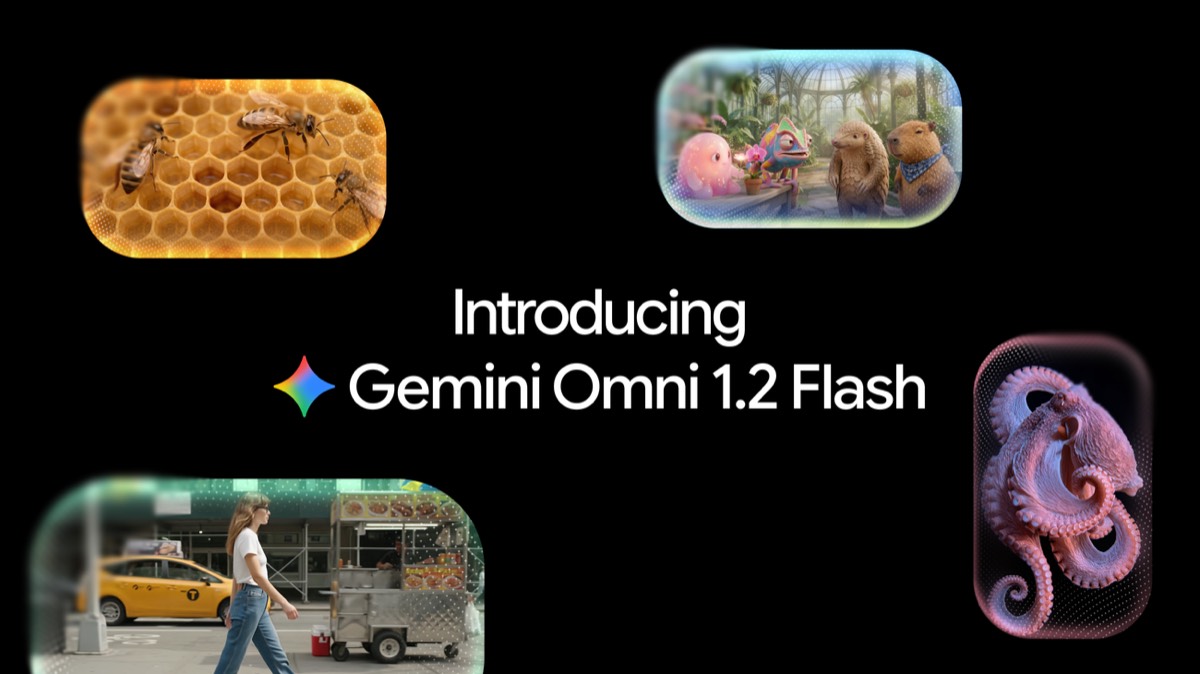
Google shipped Gemini Omni 1.2 Flash on November 5, the second Flash-tier release in its Omni line of natively multimodal models that turn text prompts, reference images and motion clips into video with audio. Native clips now run up to 15 seconds instead of 10, 720p output costs $0.07 per second — a 30% cut from Omni 1.1 Flash, per the official blog — and the model went generally available the same day across the Gemini API, Vertex AI, Vids and Ads.
Key points
- Clip length goes from 10 to 15 seconds, specifiable anywhere from 3 to 15 seconds in one-second steps; drafts render at 360p or 720p and upscale to 1080p or 4K.
- 720p video costs $0.07 per second — about $1.04 for a 15-second clip; on the API, video output drops from $17.50 to $12 per million tokens.
- Conversational editing ships in GA: swap the product or background, change lighting or weather, switch aspect ratio — all on top of the previous turn, without regenerating from scratch. Every output carries a SynthID watermark.
Background
Omni is the line where Google merged its reasoning models with video generation, and developers have been watching it: the original Gemini Omni launch drew 323 points and 146 comments on Hacker News, and the Omni 1.1 Flash thread 297 points and 237. On October 22, Google shut down the three Veo 3.1 preview models (veo-3.1-generate-preview and siblings) and its documentation now sends video users straight to Omni Flash — the video lineup is consolidating under one name. Across the aisle, Kling 4.0 went fully live in October with 30-second native clips; on price, FLUX 3 Max video on fal has been on promotion at $0.0425 per second. Google’s own pricing moves this year have cut both ways: the promotional API price of Gemini 4 Argon doubles after November 30, while the Omni line just got cheaper.
The facts
The official blog post is bylined Anish Nangia, product manager at Google DeepMind (November 5, 2026); billing figures below are from the Gemini pricing page, checked November 6, 2026.
| Item | Value |
|---|---|
| Clip length | 3–15 seconds, in one-second steps |
| Draft resolution | 360p / 720p, upsampling to 1080p and 4K |
| 720p price | $0.07 per second (about $0.70 per 10s clip, $1.04 per 15s clip) |
| Other resolutions | $0.023 per second at 360p; $0.104 at 1080p; $0.209 at 4K |
| API billing | $1.50 input / $9.00 text output / $12.00 video output per million tokens (5,792 tokens per second of 720p) |
| Reference inputs | Up to 6 reference images; motion clips up to 3 seconds; audio cues |
| Audio | Dialogue, lip-sync, multi-speaker conditioning |
| Watermark | SynthID on all outputs |
| Predecessor migration | From December 3, 2026, 1.1 Flash requests route to 1.2 and bill at 1.2 rates |
Multi-turn editing and extension run through the Interactions API in the docs, and the reference inputs mix freely: character, product or style images plus motion clips up to 3 seconds and audio cues. The use cases the blog names are virtual try-on, catalog spins and branded video ads. Availability, all generally available per the official post: Gemini API and AI Studio (paid tier, no free tier), Vertex AI including Provisioned Throughput, Google Vids (15-second clips at no additional cost with a Google account or Workspace subscription), the Gemini app (rolling out to Google AI Ultra subscribers), Asset Studio in Google Ads, and Flow from Google Labs. The mechanics of the cut are worth a second look: per the pricing page, both generations burn tokens at the same rate — 5,792 tokens per second of 720p — so what dropped is the per-token video output price, from $17.50 to $12 per million, while input and text-output rates are unchanged from 1.1. The blog publishes no benchmarks, context window or rate-limit figures, so none are repeated here.
What others say
Independent headlines pair the same two numbers: The Decoder writes “stretches AI video clips to 15 seconds and cuts pricing by 30 percent,” Android Authority calls the clips “50% longer,” and Digital Trends focuses on “longer clips, better editing, and fewer frustrating mistakes.” On Hacker News the contrast is starker: the original Omni launch drew 323 points and 1.1 Flash 297, while the November 5 story for 1.2 Flash sits at 6 points with one comment, and the Google Cloud GA announcement at 1 point with none — the community read this as an incremental update. One aggregator’s August post described 1.1 as ”40s clips, $0.03/sec,” which contradicts the official pricing page (a 10-second cap at about $0.10 per second); this entry follows the official page. Google hedged too: the blog admits fast sports action, rapid script changes and complex physics are still areas under development.
Our take
For teams producing video assets, this update moves ad-creative iteration into a single API: draft at 720p, pick a direction, upscale, then keep editing on top of the same clip — what you save is time first, the three cents per second after that. The reference-adherence pitch, with Google’s own example of packaging typography and brand colors holding across camera angles, aims squarely at catalog and branded-ad pipelines. Keep two facts in view: 15 seconds is still half of Kling 4.0’s 30, and the price has not reached fal’s promotional level; there is no free tier, from December 3 every 1.1 request quietly re-routes to the new pricing, and with the Veo previews already shut down since October 22, integrations still calling the old endpoints have to move too. With no benchmarks published, “30% cheaper” is the only change anyone can measure today.
How to try it
The quickest route is Google Vids: a plain Google account generates 15-second clips at no additional cost, no paid API attached. Developers can pick gemini-omni-1.2-flash in AI Studio on the paid tier and start with 3–5 second tests billed by the second; AI Ultra subscribers can wait for the Gemini app rollout, and Flow is Google’s front door for scene-by-scene multi-turn edits.