Design#Video generation#Video editing
hypit: take a viral video apart and have your agent rebuild it
hypit-ai's open-source video skill: give your agent a reference clip and it rebuilds the captions, B-roll and effects as an editable, re-runnable project.
Skill details
npx skills add hypit-ai/hypit --skill hypit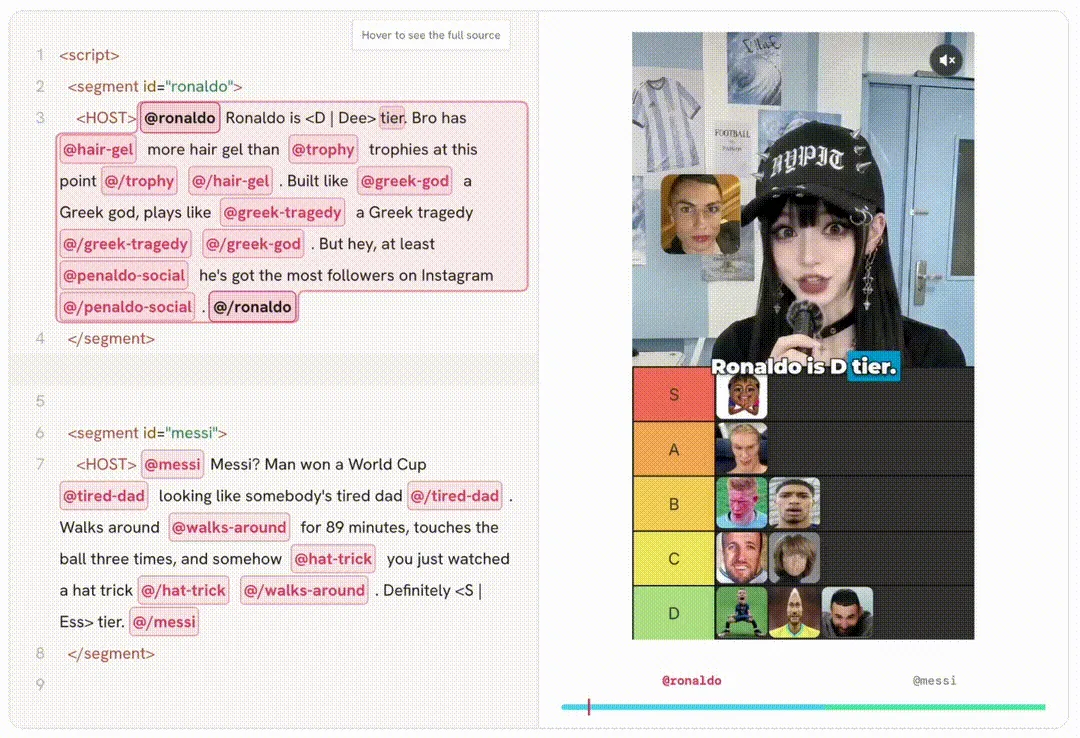
Turning a viral short into your own version usually means one of two things: re-cutting it by hand, or asking a video model to regenerate the whole clip and getting back an MP4 you can’t edit. hypit is the video-making skill from hypit-ai. It is listed on skills.sh, the repo had about 20k stars on October 8, 2026, and the npm package is at 0.2.17. Install it in Claude Code or Codex and the agent takes a reference video apart into speech, captions, B-roll and effects, then writes an editable, re-runnable video project.
The script is on the left, and the video it describes renders on the right. Change a word and the picture event tied to it moves too. That is the main difference from one-prompt video generators: hypit hands you source code for the video, not a file you have to throw away and regenerate.
The order it works in
The SKILL.md casts the agent as director and producer. It should actually watch the reference, pull frames, read the transcript against the picture, and work out why the clip holds attention before swapping the person, the lines or the product. The thinking lives in project files: a Brief for your goal, a Treatment for the agent’s creative answer, Analysis for the reading of the reference, and a Timeline for timed details. A fresh chat picks up from those files, not from scroll-back.
It leans toward generating new material over re-cutting old footage. Image, video and voice models produce the people and places, and components then lay captions, motion graphics and B-roll onto one timeline. Events are anchored to words, not seconds, so rewriting a line re-flows the timing.
What it constrains
- Agree before spending: before paid generation the agent confirms accounts, scope and budget with you and records them in the Brief. Anything beyond that comes back to you.
- Keys stay out of chat: credentials go through
hypit authand the chosen credential store. The agent reports status, not secret values. - Done means watched: the agent has to watch and listen to the result against the Brief, not just see a clean render.
- Reuse is explicit: earlier outputs come back through selected Run Candidates, including media produced by a build that later failed.
- Edit at the source: changes go into the
.svmlscript,.svsrecipes or project components, never into the finished video.
One task, start to finish
Per the README, a task starts with one line: a path to the reference and what to change.
/hypit Clone this video: /path/to/video.mp4, and replace the ranking content with a comparison of Hypit with other AI video products.
The README shows three worked examples with the authors’ own costs: a 20-second football tier list with three clones for $1.15, an 18-second podcast clip for $1.07, and a 26-second street interview for $1.09. They used Seedance 2 Mini and GPT Image 2 for material, WhisperX for word timing, and 64 headless Chromium processes for rendering. Those are the project’s numbers on the models they chose, so expect different bills with other services.
srt-whiteboard-animation does one narrow job, turning subtitles into a whiteboard animation. hypit covers talking heads, podcasts, street interviews and ads, and keeps the result re-runnable. If you only want local cutting of footage you already have, a tool like AutoClip is lighter.
Who it’s for
hypit suits people who ship many variants of one video structure: e-commerce clips, ad creative, multi-language versions, or a creator who wants one hit retold ten ways.
Some limits to know first. The skill and the hypit executable cost nothing, yet image, video and voice models bill to your own accounts, so a run has a real price. The README recommends HypiHub as the hosted option, and you can bring your own keys. The license is not plain Apache 2.0. GitHub reports it as NOASSERTION, and the LICENSE file describes a modified Apache 2.0 with extra conditions. Running it yourself, including for clients, and single-tenant deployments are fine. You may not offer it to third parties as a multi-tenant or hosted service, resell it commercially, or strip the name and logo from the CLI and run reports. Videos you make are yours. The SKILL.md alone is about 28 KB and points into a large references tree, so it is a heavy skill for an agent with a small context window. Finally, installing the skill does not install the executable: on first use the agent sets up hypit, which needs Node 22.15 or newer.