Compute#AI chips#Model training#Model inference
Google adds TPU 8tx and 8i Max for confidential inference and long contexts
Google’s blog dated TPU 8tx and 8i Max to Nov. 10; two media reports are dated Nov. 9. One targets confidential inference; the other pairs two chips.
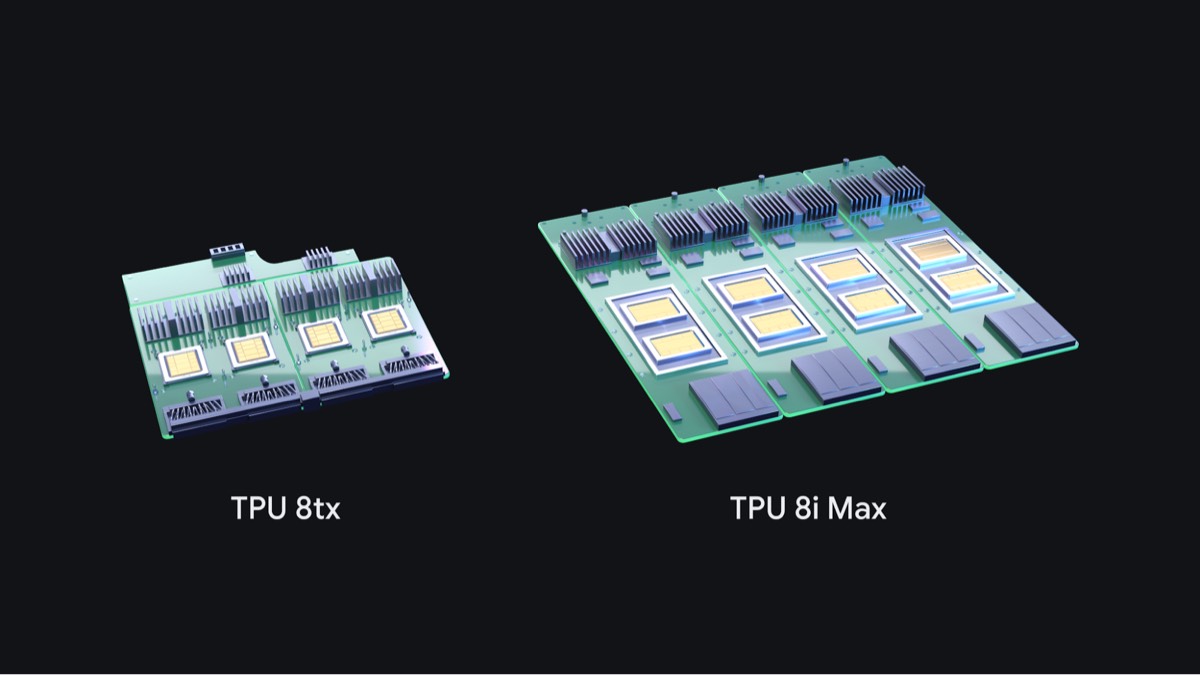
Google’s official blog dated its TPU 8tx and TPU 8i Max announcement November 10, 2026; Data Center Dynamics and Network World published their reports on November 9. TPU 8tx is a configuration for confidential inference and smaller training jobs; TPU 8i Max puts two TPU 8i chips in one package to give large-context workloads more compute and memory bandwidth. Google says 8tx can deliver up to 2x lower latency than TPU 8t, a vendor claim for which I found no independent retest.
Key points
- Google positions TPU 8tx for confidential inference and small-scale training, including fine-tuning, distillation and reinforcement learning on private data.
- TPU 8i Max combines two TPU 8i chips in one package; Google says compute, SRAM and HBM bandwidth each double versus TPU 8i.
- Google gave no pricing or availability date for either system. The available coverage reports product claims and briefing details, not independent performance tests.
Background
Google is dividing its eighth-generation TPU family by workload rather than presenting one accelerator as the answer to every deployment. TPU 8t is aimed at large-scale training, while TPU 8i targets low-latency reasoning. The new 8tx and 8i Max address two narrower constraints: keeping data and model weights isolated while they are being processed, and moving more context data close to compute.
Those are system problems as much as chip problems. A production model service depends on hosts, networking, storage, scheduling and software, so a specification becomes useful only when it changes service latency, throughput or cost under a real workload. Frontier Now previously covered Inferact running Kimi K3 on TPU v7. That deployment provides a useful example of TPU use, but it covers different hardware and a different model; it cannot validate the latency claim for TPU 8tx.
The facts
The key distinction between TPU 8tx and TPU 8i Max is the constraint each is meant to address. One sells a confidential-computing configuration; the other combines more compute and memory resources in one package. The table separates Google’s claims from questions the announcement leaves open.
| System | Design and intended workload | Announced comparison | Still unknown |
|---|---|---|---|
| TPU 8tx | Confidential inference and small-scale training | Google says latency is up to 2x lower than TPU 8t | Independent retest, detailed test conditions, price and availability date |
| TPU 8i Max | Two TPU 8i chips in one package for large-context inference | Google says compute, SRAM and HBM bandwidth each double | Performance on real models, deployment price and availability date |
Data Center Dynamics describes 8tx as a confidential-computing system built on TPU 8t silicon, with paired host processors and Google’s Boardfly network. It attributes the up-to-2x latency improvement to Google. Network World adds figures for 8i Max from Google’s briefing: 384 GB of HBM, 17.2 TB/s of bandwidth and 768 MB of on-chip SRAM. The report says HBM capacity is about one-third higher than on TPU 8i, while bandwidth and SRAM double. These figures describe announced hardware or vendor claims; they are not measurements independently produced by either outlet.
For 8tx, Google says hardware-level protections isolate sensitive inputs and model weights during processing. It presents the system as suitable for workflows such as fine-tuning on private data, model distillation and reinforcement learning. The public announcement does not spell out a threat model, the trusted execution boundary, attestation interfaces or an inventory of the host and device components in scope. “Confidential computing” should therefore be read as a system design goal, not a blanket guarantee against every route to data exposure.
Memory pressure
TPU 8i Max addresses a practical question for long-context serving: how much does moving more memory bandwidth and SRAM into a package help when an application runs out of room or spends time moving context? A model service must hold and retrieve context-related intermediate state as well as model weights. As context length and concurrent requests rise, memory capacity and access speed can constrain how much useful work the accelerator completes.
Pairing two TPU 8i chips and doubling SRAM and HBM bandwidth targets data storage and movement near the compute units, rather than arithmetic throughput alone. But doubled hardware figures do not imply doubled end-to-end throughput. Results depend on whether the workload is memory-bound, the model’s context length, batching, cache behavior, request concurrency and serving software. Google’s announcement does not provide a public, repeatable long-context benchmark that would show 8i Max’s real gains across those conditions.
A team considering the system will need tests on its own model and traffic shape. Useful measures include the number of concurrent sessions at a target context length, time to first token, steady-state generation rate and accelerator utilization. Without those results, the published memory figures help characterize the hardware, but cannot establish a cost or latency advantage for a particular service.
Confidentiality boundary
The security question for TPU 8tx is what “protected during processing” includes in practice. Confidential computing depends on where data is decrypted, what the host operator can inspect, how model weights enter the system, whether device-to-device transfers are protected and how keys behave during failures. Google’s announcement says data and weights are isolated during processing, but does not provide enough detail for an outside team to map the full trust boundary.
That gap matters to engineering and compliance teams. A system can reduce an operator’s ability to access workloads while still relying on components, setup steps and operational controls that need review. Before treating 8tx as a compliance answer, a buyer would need architecture documentation, a way to verify the running environment, and clear procedures for identity, key management, updates and incident response. The product’s intended use is relevant, but it does not replace threat modeling or an audit of the complete deployment.
The same caution applies to performance. Google’s headline comparison is “up to” 2x lower latency versus TPU 8t. The announcement does not publish the workload mix, request sizes or measurement method needed to generalize that number. Until independent testing is available, it should remain a vendor result rather than a promise about any particular model endpoint.
What others say
The three sources contribute different perspectives, but they do not provide independent validation. Google Cloud defines the products and states the performance claims. Data Center Dynamics focuses on the portfolio expansion, 8tx’s confidential-computing role and rack density. Network World frames 8i Max around memory movement and supplies additional specifications from Google’s briefing. Neither independent report describes running its own benchmark or conducting a security audit.
Network World’s 384 GB HBM, 17.2 TB/s and 768 MB SRAM figures give readers concrete hardware baselines for the large-context positioning. Capacity and bandwidth alone, however, do not establish how many tokens a given model can retain or how many users can be served at once. Model architecture, KV-cache precision, sharding and serving software all affect the outcome. Treat the reported numbers as configuration details, not as evidence of a measured service-level result.
Our take
Google TPU 8tx and 8i Max package two specific needs into hardware choices. 8tx is for teams that want to process sensitive data in the cloud while limiting what the cloud operator can see; the central question is whether the trust boundary can be inspected and verified. 8i Max is for long-context or high-concurrency inference where memory capacity or data movement is the bottleneck; its value depends on whether a team’s workload can use the added local resources.
There is not yet enough public evidence to rank either system on real-world performance. The 8tx latency figure is Google’s claim, with no third-party retest found. The 8i Max doubling figures have not been accompanied by independent workload results. Pricing, regions and availability dates are also absent. For now, infrastructure teams can map their constraints: which components touch sensitive data and model weights, and whether long-context serving is limited by memory capacity, bandwidth or scheduling. When the systems become available, tests using the team’s own model, context length and concurrency will show whether the design translates into a practical gain.