Ladybird ships its first alpha with its own engine
Ladybird's first public alpha, out November 23, brings its own engine to macOS and Linux — with no extensions, no DRM and no security promises.
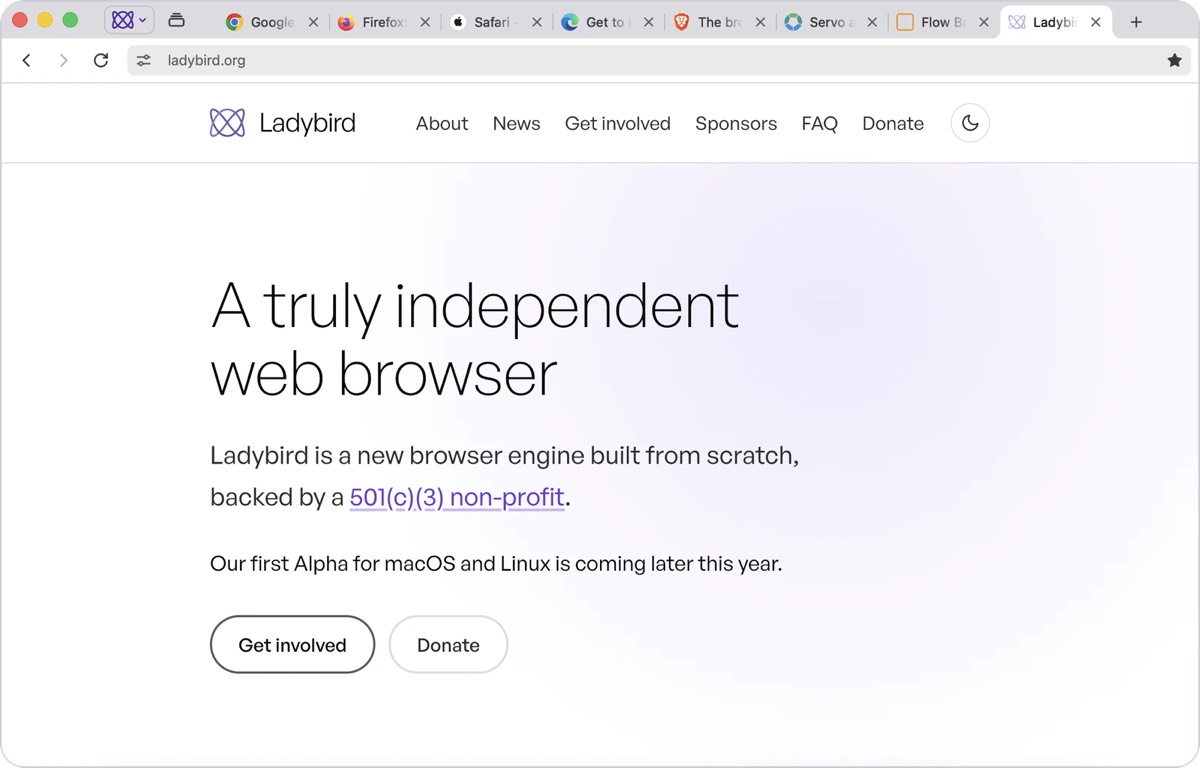
Ladybird, a browser built on an engine written from scratch rather than on Chromium, Gecko or WebKit, shipped its first public alpha on November 23, 2026. The macOS build is a 71.8 MB disk image for Apple silicon that requires macOS 14.4 or later; Linux gets Flatpak, apt and rpm packages. The release is version 2026.47.7.
Key points
- The November 23 alpha is the first time Ladybird ships prebuilt binaries instead of source only, and it updates itself on a rolling channel.
- The project names its own caveats up front: some sites will not work, it will crash, and it makes no security promises today. Extensions have no timeline.
- The roadmap in the repo says beta in 2027 and a stable release in 2028, so this build is for developers and early adopters, not for a main browser.
Background
Ladybird’s code goes back to SerenityOS. A small HTML viewer called LibHTML appeared there in 2019, grew into the LibWeb engine, was named Ladybird in July 2022 and split from SerenityOS that September. In July 2024 the project became a US 501(c)(3) nonprofit, the Ladybird Browser Initiative, seeded with a $1 million pledge from GitHub co-founder defunkt and his family. In February 2026 the team said it would replace C++ with Rust piece by piece, starting with LibJS.
Browser engines remain a tight club. Our own October survey of browser options put Blink-based browsers at roughly 80% of the desktop market, which is why compatibility work defaults to Chromium quirks. Ladybird is not another Chromium shell; it wants to be the engine you can test against when Blink-first habits hide a bug. The same concentration is why Mozilla still cannot get Gecko onto the iPhone.
The facts
The announcement is short and careful. The engine is “our own, built from the ground up, and not a fork,” and “the browser around it is modest, but functional.” The bigger change is delivery: until now you had to compile Ladybird yourself, and the alpha arrives as prebuilt packages with checksums and sigstore attestations, on a rolling channel.
| Item | Detail (checked November 23, 2026) |
|---|---|
| Version | 2026.47.7, built November 23, 2026 |
| macOS | arm64 disk image, 71.8 MB, macOS 14.4 or later |
| Linux | Flatpak (x86_64 / aarch64), apt for Ubuntu 24.04 / 26.04 / 26.10, rpm for Fedora 44 / 45, standalone archive |
| Source | 54.0 MB tar.xz |
| License | BSD-2-Clause; some bundled third-party libraries are LGPL, with source archives published alongside |
| Repository | 67,404 stars, 3,206 forks, 350 open issues (GitHub API) |
| Updates | Rolling channel with automatic updates |
Windows and mobile are out of scope for now. The site’s FAQ says full-time engineers are focused on macOS and Linux, with Windows planned later; CI currently builds and tests only the JavaScript engine on Windows. Extensions are further away: a maintainer answered a January 5 question with “We have no extension support,” adding that nobody is actively working on it. The browser does support user-configured content blocker lists, so basic ad blocking is possible, but uBlock Origin will not run. DRM is unresolved too. An August 27 issue reports that Spotify cannot play songs because there is no Encrypted Media Extensions implementation, and it was still open on November 23; a Rust port of the EME code merged on November 20 does not add the keysystems that protected playback needs.
The money is public. Ladybird is a 501(c)(3) funded entirely by donations and sponsorships, with tiers at $100,000, $50,000, $10,000, $5,000 and $1,000. The FAQ says the project aims to keep 18 months of runway at all times, and that board seats are not for sale and sponsors have no say in the technical roadmap.
What others say
Hacker News is where the first real feedback landed: 556 points and 146 comments about two hours after the post (HN API, November 23, 18:18 UTC). Some of it is enthusiastic and firsthand. One commenter wrote “Posting this from Ladybird”; another said every one of their personal sites rendered correctly; a third measured under 100 MB of RAM with Apple’s homepage open, a single unverified reading. The complaints are equally specific: YouTube and animation-heavy pages feel laggy on an M4 MacBook Air, the interface looks copied from Chrome, and one reader asked why anyone would switch from Firefox or Chrome at all. Another raised certificate trust stores, since a browser vendor has to carry that security work itself.
The argument over “independent” is the most useful thread. The official FAQ defines it as writing the web platform yourself, not wrapping Blink, WebKit or Gecko, while using third-party libraries for common jobs such as images, media, encryption and graphics, some of which Chrome also uses. On HN, that draws the objection that Skia, ANGLE and SQLite make the claim thinner; others answer that those libraries are widely used outside Chromium and that whether it counts as cheating depends on rules you set yourself. This is a disagreement about definitions, not facts, and the official wording is the precise one, so we follow it.
Linuxiac’s June report on the project closing public pull requests adds the part the announcement does not dwell on: AI made it cheap to produce patches that look like serious contributions, and a browser runs untrusted input from the whole internet, so only maintainers who answer for the code should land it. That reporting matches the project’s own post, with no conflict between them.
Our take
The right way to treat this alpha is as an installable compatibility lab, not a daily browser. If you build websites, you can now open your pages in a fourth engine without compiling anything, and the bugs that only appear outside Blink are exactly the ones worth finding. The project points at that use case itself: WebDriver and the Firefox DevTools protocol both work, so automated runs can include Ladybird.
The costs are just as clear. No extensions means no uBlock Origin, only built-in blocking lists. No working DRM means Netflix and Spotify are out. “We make no promises about security today” is honesty rather than modesty: a new attack surface gets probed hard, and the project is asking for it. None of that makes the engine a toy. In the October update, Ladybird passed 2,184,722 Web Platform Tests subtests, ahead of Safari Technology Preview at 2,172,990 but behind Firefox at 2,189,315 and Chrome at 2,244,397. Speedometer 3 went from 5.9 to 8.6 during October.
One variable is easy to miss: a lot of this is AI-assisted work. For the Rust migration, the LibJS lexer, parser, AST and bytecode generator became about 25,000 lines of Rust in roughly two weeks, translated under human direction with Claude Code and Codex, and held to byte-for-byte identical output across 52,898 test262 tests and 12,461 regression tests. That explains the pace, and it is also why “who wrote this and who answers for it” became a question the project had to settle in public when it closed its pull request queue in June.
How to try it
On macOS, download the disk image, drag Ladybird into Applications and open it. On Linux, Flatpak is the recommended route:
flatpak install https://flatpak.ladybird.org/ladybird.flatpakref
When a site breaks, report it from inside the browser. After a crash you can read the report before deciding whether to send it. Security issues go through the repository’s SECURITY.md.
What to watch
The next milestone is the month-end progress post, which the project publishes on the last day of each month. After that, the roadmap says beta in 2027 and stable in 2028. Three signals are worth tracking: whether anyone starts on an extension API, when EME can actually play protected content, and when the Windows port moves from “CI compiles the JavaScript engine” to something you can install.