Products#Open-source alternatives
GrapheneOS built an RCS client prototype with MLS encryption
GrapheneOS demoed a proof-of-concept RCS client on Nov 21, claiming MLS compatibility with Google Messages and iOS, but it needs sandboxed Play services.
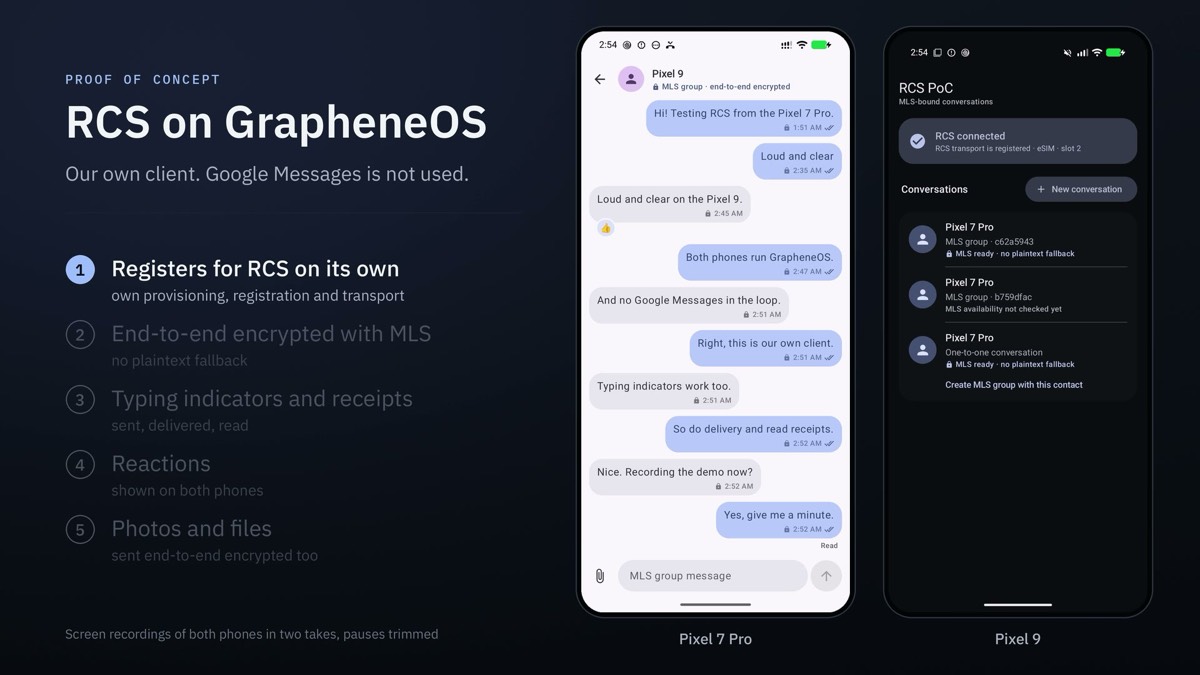
GrapheneOS is a third-party Android system built from open-source AOSP code and sold on privacy and hardening, and using RCS on it has always meant installing Google Messages and turning on sandboxed Play services. At 15:09 UTC on November 21, 2026, the project’s official Mastodon account posted a proof-of-concept RCS client, opening with “We made a proof of concept RCS messaging app.” The post says it already has MLS end-to-end encryption compatible with Google Messages and iOS, plus typing indicators, delivery and read receipts, reactions, and photo and file sharing. In the replies, the team says the prototype drops the requirement to use Google Messages as the default texting app — at the cost of still asking sandboxed Play services for the token carriers demand during sign-up.
Key points
- This is a proof of concept, not installable software: the only release is a 75-second demo video, with no build, launch date or beta plan. The team’s stated goal is to use what it learned to bring RCS into the system’s built-in Messaging app.
- The encryption is MLS. In March 2025 the GSMA based RCS Universal Profile 3.0’s end-to-end encryption on the MLS protocol, so interop with Google Messages and iOS rests on a standard other vendors are implementing, not on a GrapheneOS-only scheme.
- Two limits are explicit: the first version needs sandboxed Play services for phone-number verification, and it handles RCS only, with no SMS/MMS fallback. Both phones in the demo run GrapheneOS, so encrypted cross-platform chat is a claim, not a demonstrated feature.
Background
RCS on GrapheneOS has been a Google-shaped hole. According to Digital Trends on November 23, users had to install Google Messages and enable sandboxed Google Play to get RCS at all, and the GrapheneOS team concedes the same in its replies: “Google Messages already works on GrapheneOS with RCS available by toggling on the access needed by Play services.” For a system whose pitch is removing Google, this was one of the few everyday features still tied to a Google app; calls, camera and the SMS app itself have long been handled by the OS.
This is a separate story from the fight two days earlier. On November 19 the same account accused Google of pressuring OEMs through GMS licensing and discouraging bootloader unlocking, and tagged the US Department of Justice (our report on that). The November 21 RCS post mentions no accusation, no Google, no regulator — it is a technical demo plus answers to users. The two landed close together, but one is about ecosystem rules and the other about closing a product gap.
The other piece of context is what RCS has become. It is no longer just an SMS upgrade: since October 28, OpenAI has offered ChatGPT Dot over iMessage and RCS, letting US Pro users text tasks to the agent (our report). Once RCS starts carrying agents, who supplies the client stops being a matter of interface taste.
What the demo shows
The demo runs 75 seconds and shows side-by-side screen recordings of two phones, labeled Pixel 7 Pro and Pixel 9, both running GrapheneOS. A slide on the left lists five points: it registers for RCS on its own (“own provisioning, registration and transport”), end-to-end encryption with MLS and no plaintext fallback, typing indicators plus delivery and read receipts, reactions, and photos and files sent encrypted too. The conversation on the right walks through “Both phones run GrapheneOS”, “And no Google Messages in the loop”, and “Yes, with MLS. No plaintext fallback”, then a reaction and a file transfer.
The app screens add detail. One phone’s list header reads “RCS connected — RCS transport is registered · eSIM · slot 2”, so registration runs over the eSIM line. Each contact is tagged “MLS ready · no plaintext fallback”, except one that reads “MLS availability not checked yet” — encryption state is checked per conversation, and the app says so instead of implying it. The video’s own footnote is candid about production: “Screen recordings of both phones in two takes, pauses trimmed.”
| Item | The prototype today | After the Messaging integration |
|---|---|---|
| Protocol scope | RCS only, no SMS/MMS | RCS, downgrading when unavailable |
| Number check | Token from sandboxed Play services | Planned to work without Play |
| Encryption | MLS, no plaintext fallback | Same |
| Where it runs | GrapheneOS only, needs OS-level support | The built-in Messaging app |
| Push | FCM, plus a UnifiedPush plan | Not stated |
MLS and interoperability
To weigh “compatible with Google Messages and iOS”, separate two layers. Plain text interop is the easy one: RCS is a carrier-spanning protocol and the iPhone has supported basic RCS since iOS 18, so nothing new is needed there. Encrypted interop is the hard one. The GSMA said on March 14, 2025 that Universal Profile 3.0’s end-to-end encryption is “based on the Messaging Layer Security (MLS) protocol”, and that RCS would be the “first large-scale messaging service to support interoperable E2EE” across client implementations from different providers. That second layer is what GrapheneOS says it has.
The timing makes the claim plausible. Android Central reported on May 5, 2026 that the iOS 26.5 release candidate notes promise “end-to-end encrypted RCS (beta) messaging” for “supported carriers”, rolling out over time. Cross-platform encrypted RCS only started arriving in 2026, so a third-party client built on MLS at this point can in principle talk to both Apple’s and Google’s implementations.
The demo does not prove it. Both phones are GrapheneOS, so every message shown travels client-to-client inside the project. No session with an iPhone or with Google Messages appears. The team’s own framing stops at coverage: it will work “everywhere it does with Google Messages” because the first version uses Google’s RCS service, and as for Apple, “it isn’t entirely clear how Apple does it but they likely just use their own services and federate with Google from those.” That is an inference, not a test result.
The number check
Number verification is where the prototype is least clean. The “registers for RCS on its own” line is easy to misread: it means the client handles registration instead of going through Google Messages, while the token that proves the phone number still comes from sandboxed Play services. The app layer changed; the verification path did not. The team’s replies are blunt about the rest: the app “currently depends on sandboxed Google Play services for phone number verification, etc.”, because “very few carriers will permit using RCS without the Google Play system for phone number verification. They require providing a token from it.” Asked whether Play services could be removed after verification, the answer is no, because there are also “regular check-ins”. The team frames this as a carrier rule rather than its own shortcut: “carriers require Apple or Google to do phone number verification for them.”
There are two ways out, and the team has described both. One is to use RCS directly from carriers that offer it standalone, once they do. The other is to reimplement Google’s services, which it calls “quite impractical in a lot of ways and has very limited benefits”. So it shipped the version that works for most people first, with the niche option to follow. That also explains why the client cannot leave GrapheneOS: it needs OS-level support for the RCS transport, and Android Authority’s report likewise calls the feature effectively exclusive to GrapheneOS.
What others say
Digital Trends led with the cost: the prototype handles RCS only and needs SMS/MMS fallback before any public release, and the piece cautions that the app is not meant to replace a dedicated secure messenger such as Signal. That matches the team’s later reply, which says the OS keeps its “this is not a secure messaging app” warning, reworded to explain that RCS now brings MLS encryption.
Android Authority, publishing at 05:40 UTC the same day, added two details: the feature will effectively be GrapheneOS-exclusive because it needs OS integration, and the app sandboxes incoming media, lets users control automatic downloads, and plans a safeguard so media can be “automatically retrieved without automatically parsing it”. For a channel that takes messages from strangers and stays in the system for years, that design matters more than the chat UI.
Community response has been mostly enthusiasm with boundary questions. Can it run on other ROMs? No, the team says. Can Play services go once the number is verified? No, because of the check-ins. A desktop or web client? No commitment. One reply called it the first free-software RCS client and asked about spam reporting; the answers so far are directional, without dates.
Google has said nothing publicly. As of November 23, neither Digital Trends nor Android Authority records asking Google for comment, and no statement from the company appears in either piece.
Our take
For GrapheneOS users, the prototype trades “you must use Google’s messaging app” for “you must use Google’s verification channel”. The dependency shrinks rather than disappears: interface, conversations and encryption move in-house, while the number and the routing still pass through carriers and Google. That is still real progress, because it shows the client and the infrastructure can be split apart — a year ago they came as one block labeled Google Messages.
Two doubts are worth keeping: encrypted cross-platform interop has no third-party check and no demo, only a claim that is technically coherent; and the distance from prototype to daily driver is measured in unglamorous work — SMS/MMS fallback, push, spam handling — for which the team has given no timeline. None of it touches an ordinary iPhone user either; the value lands on the small group willing to change operating systems.
Google, for its part, has done nothing that would settle the question. That Apple and Google perform number verification on carriers’ behalf is the team’s account, and it fits how the industry works; if that flow really only runs through Play services, a de-Googled RCS client is structurally a half-product, and no amount of client work at GrapheneOS fixes it.
What to watch
Three things are checkable soon. Whether a build appears at all: right now there is a video and no APK, so any “it works today” framing runs ahead of the official line. Whether the Messaging integration ships with SMS fallback, which is the bar for actually replacing Google Messages. And whether anyone posts a real encrypted session with an iPhone or with Google Messages — one screenshot would be worth more than the word “compatible”. Carrier-side standalone RCS, meanwhile, will move at the speed of commercial negotiation, not of code.