Products#Multi-agent#Agent memory
LangChain open-sources the harness behind Content Studio, its Slack design agent
LangChain open-sourced its Content Studio design agent harness on October 27, Apache-2.0; median request cost is down from ~$8 to ~$0.50, it says.
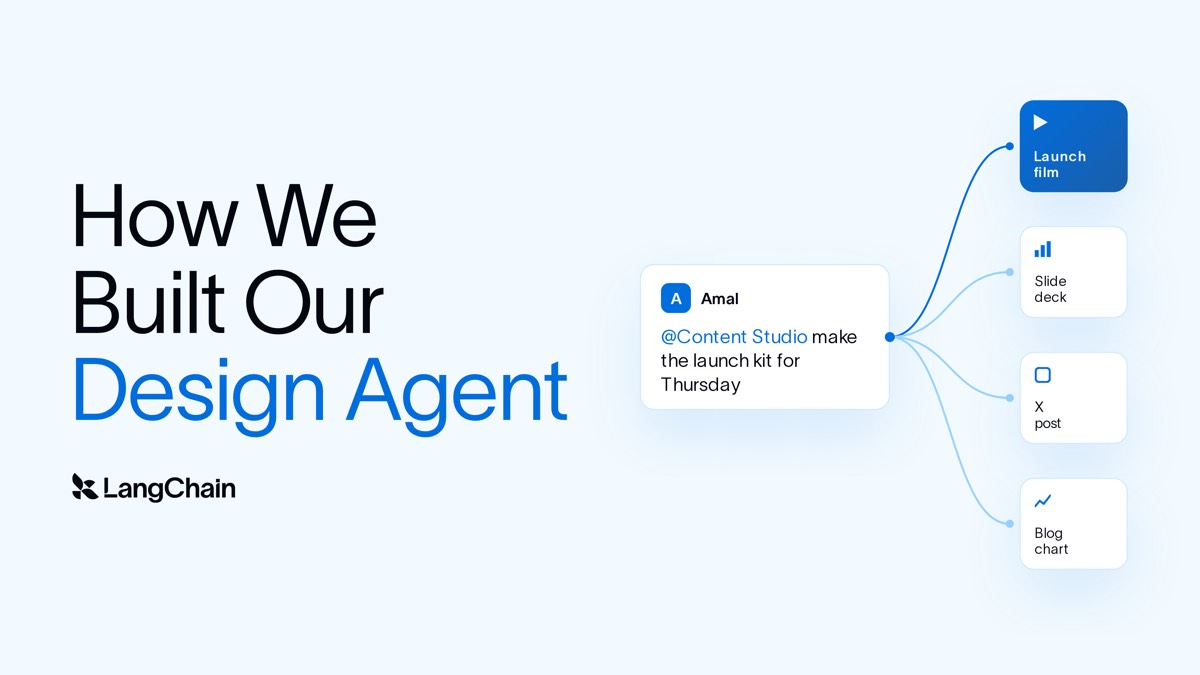
LangChain open-sourced the full harness behind Content Studio — the design agent its own team has run in Slack for the past four months — as the GitHub repository langchain-ai/design-agent under the Apache-2.0 license, the company announced in a blog post on October 27, 2026. Content Studio takes one chat message with an attached brief and returns finished, on-brand files: a resized ad, a slide deck, a social graphic, or an entire launch film. The headline figure from the post: median model spend per request fell from about $8 in mid-September to about $0.50, while the system has shipped 3,000+ assets since August. Per a GitHub API snapshot taken October 28, the repo was created October 18, was still receiving commits on the 27th, and already counted 115 stars, 14 forks and 44 commits.
Key points
- What shipped is the whole harness, not a demo: a Linux sandbox per Slack thread, 48 skills with a design wiki (the README says 35 — see below), a two-layer memory, asynchronous subagents, code-enforced review gates and the Slack interaction layer (official blog, 2026-10-27).
- Every performance number is LangChain’s own: median request cost down from about $8 to about $0.50 in six weeks; the post gives no breakdown of where the drop came from, and no third party has verified any of it yet.
- Three ways in: with a LangSmith account, an installer plus
uv run mda deployputs it in your own Slack; without one, the repo’s own Docker Compose self-hosting runs it on your machine (HTTP API, Postgres, local sandboxes, an optional Socket-Mode Slack app — no LangSmith account required); and a key-free local demo runs the real agent and sandbox against a scripted model.
Background
Content Studio was not built to be open-sourced. LangChain’s design team started using it internally around mid-2026, and the blog reads as an engineering retrospective of roughly four months of iteration, including one major refactor: after the team moved its custom infrastructure onto Managed Deep Agents — the hosted service that entered public beta in August — its own agent code shrank by about 80%. The runtime underneath is Deep Agents, LangChain’s open-source agent framework; we covered its context-engineering mechanics — file offloading, summarization at 85% of the window, progressive skill loading — in an earlier entry. Compared with Anthropic’s Claude Duet, a generalist resident agent in a cloud VM opened for preview on October 21, this is the opposite bet: one vertical craft, taken all the way to finished deliverables.
Inside the harness
The pipeline a request travels is the most instructive part. Each Slack thread gets its own LangSmith sandbox — a Linux machine with a filesystem and shell, preloaded with Chrome, FFmpeg and HyperFrames, HeyGen’s open-source web editor. Everything the agent makes is code: a slide is HTML, a film is an animation timeline, so a revision is an edit and a re-render rather than a regeneration from scratch. A router skill maps each kind of ask to a specialist workflow; the blog counts 48 skills across nearly 1,000 files while the README says 35, a discrepancy nobody can arbitrate from outside (possibly subskills counted one way or the other, possibly drift between the two documents — the README has been updated more recently). Judgment stays in prompts, but measurable checks are hard-coded “gates” that catch things like default capitalization or per-frame animation errors; films pass through storyboard, animatic and production stages in code, and nothing ships until a Slack approval card gets a click.
The numbers
The cost claim, quoted in full: “The median request now costs about 50 cents in model spend, down from about $8 in mid-September.” That is roughly a 94% reduction over six weeks by our arithmetic from the two medians — the post states neither the percentage nor a cause. One deliberate money-saving design is documented: a storyboard frame renders in about 50 milliseconds, against 8 to 40 seconds per second of finished film, so the agent boards before it builds. The output claims: 3,000+ assets including 80+ slide decks; posts featuring its work drew about 4.5M views on X, with about 2x the likes and 3.7x the bookmarks of the account’s other posts; three in four requests came from outside marketing; 75% of users returned weekly. All of it is self-reported by the vendor — the post is bylined Amal Irgashev and Shreya Talegaonkar, and within 24 hours of publication neither Hacker News nor the major tech press had any independent coverage or reproduction (checked via HN Algolia and web search on October 28).
Our take
For engineers building agents, the interesting artifact here is not a design tool — it is a complete, working harness with production mileage, readable layer by layer: how sandboxes isolate work, how skills are organized and routed, how memory is kept from ballooning (indexes are capped at 200 lines after an early version grew to 500K tokens), how subagents are woken asynchronously, how review gates end up in code instead of prompts. Two buckets of cold water before you fork it. First, the production deployment the blog describes runs on Managed Deep Agents, but the code is not locked to that stack: docs/self-hosting.md (in the repo since v0.1) documents a Docker Compose path — HTTP API, Postgres, local sandbox containers, an optional Socket-Mode Slack app, no LangSmith account anywhere. The cost is operational: you run the machine, the agent starts sandboxes through the host’s Docker socket, which the doc itself calls root-equivalent on that host (it recommends a dedicated machine), and there is no mention of LangSmith-style tracing. Second, every effectiveness number is the vendor’s own, and at 115 stars nobody has reproduced any of it yet. To look before you leap, the local demo needs no keys: uv run design-agent sandbox build, then uv run design-agent demo, and Docker hands you a three-size launch card plus a 4-second teaser in workspace/out/demo/.
What to watch
Two things would move the needle on trust. An independent reproduction — the repo ships evals documentation, so a third-party run with someone else’s brand pack would give the cost and output figures a second source. And the small contradictions, like the 48-versus-35 skill count, should converge in later commits; the repo was still being pushed on October 27, one day before this entry was published.