Compute#Cloud#AI chips#Model inference
Microsoft unveils Maia 300, plans multi-gigawatt in-house inference from 2027
Microsoft announced its Maia 300 inference chip on October 12: 40% more tokens per megawatt than leading GPU systems, and multi-gigawatt deployments from 2027.
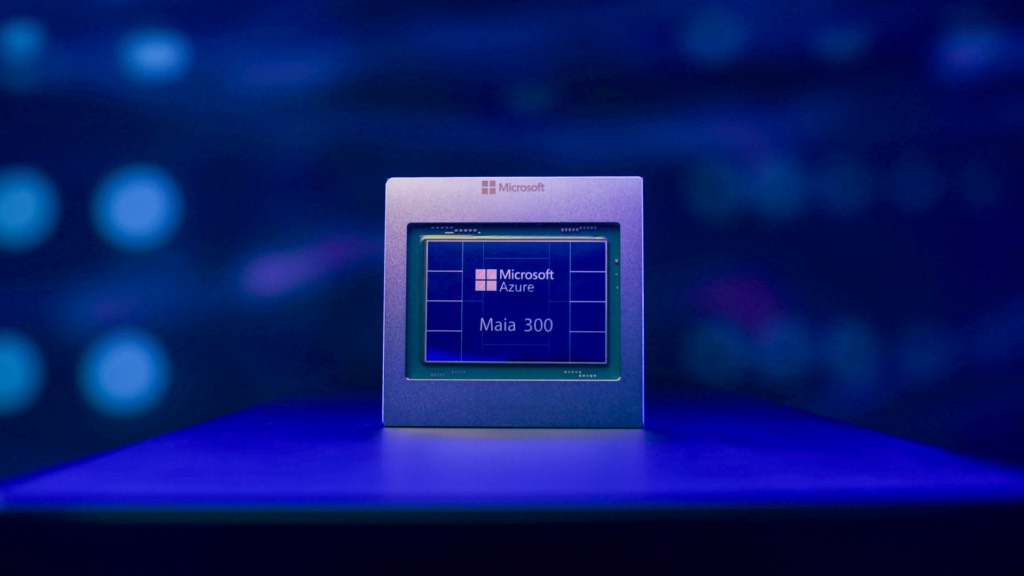
Microsoft announced Maia 300 on October 12, its third-generation in-house AI accelerator, built specifically for inference workloads. The official blog sets the expectation at 40% more tokens per megawatt than leading GPU-based systems, and says Microsoft will scale the Azure Maia family to multi-gigawatt deployments starting in 2027 — making Maia “the primary inference system for Microsoft products and services,” in the words of Scott Guthrie, EVP of Cloud + AI. Its predecessor, Maia 200, already runs in datacenters across the US, Europe and Australia.
Key points
- Microsoft announced Maia 300 on 2026-10-12, with production in 2027. The company claims 40% more tokens per megawatt than leading GPU-based systems, and up to 7x Maia 200’s rack-scale token throughput in the full 96-accelerator configuration.
- Per accelerator: 288 GB of HBM4 across 8 stacks, 18 TB/s peak bandwidth, 950 W TDP. Per rack: 96 accelerators in a 167 kW envelope, aggregating 27.6 TB of HBM and 1.7 PB/s of bandwidth. The largest superpod ties 12,288 accelerators (128 racks) together.
- All performance figures are vendor expectations — the chip ships in 2027 and no independent benchmark exists yet. More detail is promised at Microsoft Ignite 2026 in San Francisco.
Background
Maia 300 is the third generation of Microsoft’s custom silicon program, and the line did not get here in one jump. Maia 200 was announced in January 2026 (per The Verge) and already serves production inference for Microsoft Copilot, with GitHub Copilot and Microsoft Foundry following by the end of the year; Guthrie calls Maia 200 “the best performing AI infrastructure in our fleet.” The schedule has slipped before: Reuters reported in June 2025, citing The Information, that mass production of the then-next-gen Maia chip moved from 2025 to 2026. Microsoft is also not alone in pulling inference onto silicon it controls — DeepSeek recently open-sourced its full operator stack for Huawei’s Ascend chips (our coverage), and the biggest AI operators are now betting their inference costs on chips they can design themselves.
The facts
The primary source for Maia 300’s specifications is the Azure architecture deep dive signed by Rani Borkar, President of Azure Hardware Systems and Infrastructure, and Saurabh Dighe, CVP of Systems Planning and Architecture. One caveat before the numbers: every figure below is vendor-sourced, the chip reaches production in 2027, and no third-party benchmark exists yet.
| Item | Official figure | vs. Maia 200 |
|---|---|---|
| Compute chiplet process | TSMC N2P | — |
| Memory per accelerator | 288 GB (8 HBM4 stacks) | +33% capacity |
| Memory bandwidth | 18 TB/s | ~2.5x |
| TDP per accelerator | 950 W | — |
| Rack configuration | 96 accelerators / 167 kW | 2x accelerators |
| Rack aggregate | 27.6 TB HBM, 1.7 PB/s | — |
| Largest superpod | 12,288 accelerators (128 racks) | — |
| Scale-up bandwidth per peer | up to 750 GB/s | +14% |
| Liquid cooling | over 80% of rack heat | — |
| Compute and efficiency | — | FLOPs +36%, over 2.5x perf/W |
Several design choices stand out. Maia 300 splits the package into three kinds of chiplets — compute, memory controller and I/O — with the compute dies on TSMC’s N2P node, chosen for performance per watt. Memory is now organized as NUMA, placing data next to the compute that will use it. On data formats, Microsoft enhanced MXFP4 and added sub-3-bit storage formats with hardware-accelerated type conversion, which it says fits longer contexts into the same memory. Each rack packs 24 four-accelerator trays on 50 V busbar power, with liquid cooling handling the accelerators, voltage regulators and switch ASICs. The networking is the biggest departure: one Ethernet fabric serves both scale-up and scale-out, cross-rack traffic bypasses the host and needs no discrete scale-out NIC, and a superpod scales to 12,288 accelerators with job packing deciding how much traffic crosses racks.
The deployment plan is concrete too. Microsoft plans to use Maia 300 for MAI team model development, GitHub’s coding and agentic workloads, Foundry model serving, and Dragon Copilot in healthcare. On models, the blog states that across these workloads it is Maia 200, today, that runs OpenAI models, Microsoft’s own MAI models and leading open-source model families.
What others say
The Verge reads the announcement as a move to cut Microsoft’s reliance on Nvidia and AMD, and notes the chip factors into Microsoft AI’s goal of catching up with Google DeepMind, OpenAI and Anthropic. It quotes Microsoft AI CEO Mustafa Suleyman: “we need a platform that we own, and that we co-design with our models.”
The Hacker News thread is small — 4 comments and 24 points when we checked — but representative. One commenter runs the numbers on Microsoft’s behalf: without paying Nvidia’s margins, “they’re probably getting them 2-3x cheaper.” Another points at the OpenAI relationship, asking why Microsoft with its OpenAI IP access has not produced a more impressive chip of its own. The technical comments concentrate on the NUMA shift, and mostly approve: once you scale across machines you already live with non-uniform memory, so pushing it down into the package is the natural next step.
Our take
For teams running inference on Azure, Maia 300’s direct impact lands in 2027. What matters today is the positioning: this is the first time Microsoft has placed its own chip at the center of Azure’s cost structure, and future model pricing and capacity planning will be built around it. About the chip itself, keep the caveats in view — the 40% and 7x figures are expectations, not measurements; the 7x is against Microsoft’s own previous generation, while the 40% is against “leading GPU-based systems,” and neither has a third-party benchmark or a price. This program has also slipped a production deadline before. We have covered the other end of the same efficiency race: Inferact runs Kimi K3 on 16 TPU v7 chips 57% faster than GB200. Chip choice is turning from an ecosystem question into a cost question. The next checkable milestone is Ignite 2026, where Microsoft has promised more detail.
What to watch
- Microsoft Ignite 2026 (San Francisco): more Maia 300 detail promised.
- Before end of 2026: GitHub Copilot and Microsoft Foundry move onto Maia 200.
- 2027: Maia 300 production and multi-gigawatt rollout begin — the first point at which independent numbers become possible.