NASA’s ESCAPADE twins complete powered Earth flybys and head for Mars
NASA confirmed both ESCAPADE spacecraft completed powered Earth flybys on November 7 and 9, 2026. Mars orbit insertion is planned for September 2027.
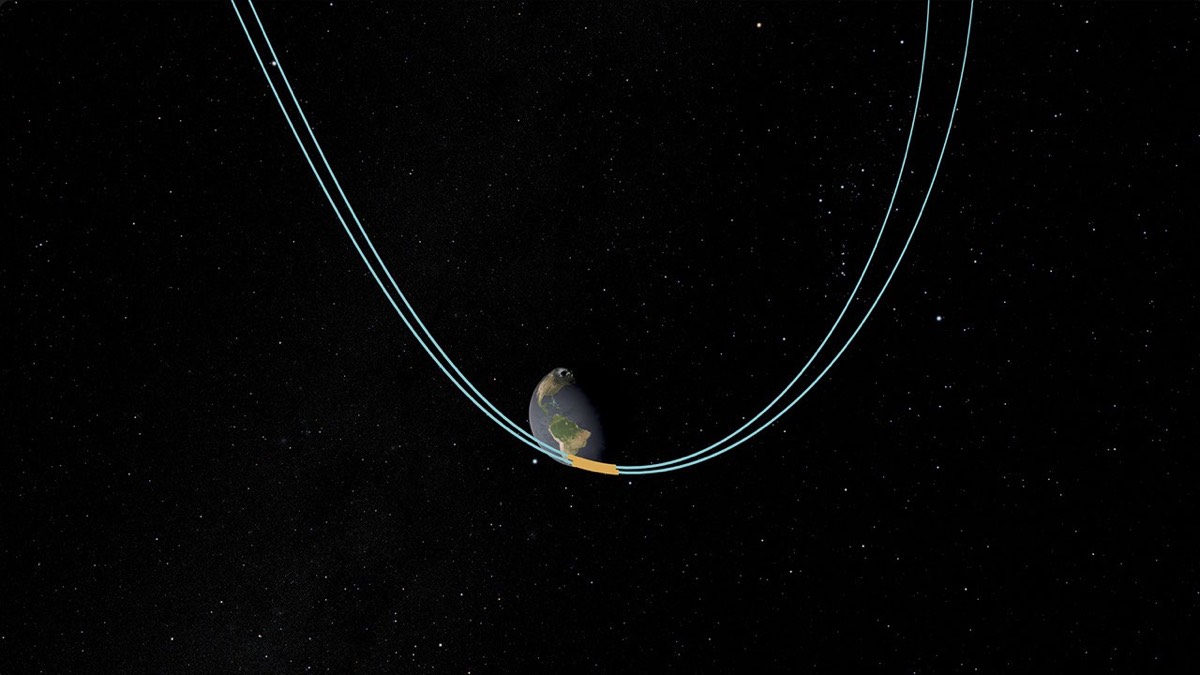
NASA’s ESCAPADE mission — Escape and Plasma Acceleration and Dynamics Explorers — uses two spacecraft to investigate the space environment around Mars. On November 9, 2026, NASA confirmed that both spacecraft had completed powered Earth flybys, on November 7 and November 9; UC Berkeley’s same-day update identifies the first as Blue and the second as Gold. By combining Earth’s gravity with engine burns, the pair has left its near-Earth holding phase and begun the trip to Mars.
Key points
- NASA says the first spacecraft passed about 1,000 miles above Earth at roughly 5 a.m. EST on November 7; the second passed about 650 miles above Earth at roughly 6 a.m. EST on November 9.
- Each spacecraft performed an approximately nine-minute trans-Mars injection burn near its closest approach. The maneuver combined gravitational assistance with propulsion.
- NASA plans Mars orbit insertion burns for September 7 and 9, 2027; Berkeley’s update maps September 7 to Gold and September 9 to Blue. Science operations are expected to begin in June 2028.
Background
ESCAPADE did not take the familiar direct route from Earth to Mars. The mission had originally been slated to launch in 2024, but the New Glenn rocket was not ready for that Mars launch window. The team instead adopted a more flexible route: place the spacecraft in a holding orbit near Earth, let them wait, then return close to Earth in 2026 for a powered flyby onto the Mars trajectory. Space.com’s earlier explainer places the loiter orbit near the Sun–Earth L2 region and describes the trade as flexibility in exchange for a longer journey.
After launching in November 2025, the two spacecraft spent nearly a year in that holding phase instead of heading straight to Mars. NASA’s November 2 preview laid out the planned flyby dates, a predicted closest-approach range of 600 to 1,100 miles, and Mars arrival dates of September 7 and 9, 2027. Those were forecasts issued before the encounter. The November 9 update is the document that confirms the flybys and burns actually took place.
The facts
NASA’s post-maneuver update gives the observed flyby dates and approximate altitudes; it refers to the spacecraft only as the first and second. The mapping of spacecraft to flyby dates and Mars insertion dates comes from Berkeley’s mission update. The reported values fall inside the 600-to-1,100-mile range in the earlier preview; the distances are above Earth’s surface. NASA says each trans-Mars injection burn lasted about nine minutes. The burns, together with Earth’s gravity, changed the spacecraft trajectories so they could leave their holding phase and begin the Mars cruise.
| Spacecraft | Earth flyby | Approx. closest altitude | Planned Mars orbit insertion |
|---|---|---|---|
| Blue | November 7, 2026 | About 1,000 miles above Earth | September 9, 2027 |
| Gold | November 9, 2026 | About 650 miles above Earth | September 7, 2027 |
“On the way to Mars” is not the same as “at Mars.” The milestone confirmed so far is the Earth flyby and trans-Mars injection, not arrival or orbit insertion. NASA lists the September 2027 insertion dates as upcoming mission events. Its November 2 article gave the predicted altitude range; the later NASA update supplies the approximate values for the completed encounters. Keeping the forecast and the result separate matters because the earlier page alone could not establish success.
Mission science
ESCAPADE will examine how the solar wind interacts with Mars’ hybrid magnetosphere and contributes to atmospheric loss. Mars lacks the global, internally generated magnetic shield that dominates Earth’s space environment. The interactions among solar wind, localized magnetic fields, and the upper atmosphere are part of the evidence scientists need to understand how the Martian atmosphere has changed over time. Two spacecraft can make coordinated observations: the plan first has them follow the same orbit at different times, then places them in different orbits so one can sample the incoming solar wind while the other measures Mars’ response.
NASA expects science operations to start in June 2028. The current Earth maneuver is therefore a navigation milestone on the way to the science phase, not a scientific result about atmospheric escape. NASA also says the spacecraft observed Earth’s magnetotail while in their holding orbit, and that the interplanetary cruise offers a chance to study solar wind between Earth and Mars. Those are observations the mission may collect; they should not be mistaken for conclusions about Mars before the spacecraft reach their science orbits.
What others say
NASA is the direct source confirming completion. Its November 9 mission update gives the date, approximate closest altitude and burn duration for each flyby, and lists the planned arrival events; it refers to the two spacecraft by order rather than name. UC Berkeley, whose Space Sciences Laboratory leads the mission, published a same-day update confirming that the spacecraft had left Earth behind and were headed for Mars. Berkeley adds the mission-design perspective: combining a gravity assist with an engine burn gives planners a departure option beyond waiting for a conventional direct-transfer launch window.
IT之家 reported on November 10 that the two maneuvers had succeeded and assigned them to November 7 and 9; that is secondary reporting. Aviation Week’s November 10 story likewise says the probes left their loiter orbits and began separate Mars journeys. Space.com’s earlier account explains why the loiter phase was chosen: it gave the launch and transfer plan more flexibility, at the cost of a longer trip. These reports do not conflict with NASA’s dates. For the success claim, NASA’s after-the-fact update carries more weight than its November 2 preview, which only described what the team expected to happen.
Our take
The interesting part is not gravity assistance as a general concept. It is the mission’s use of a powered flyby after a long wait near Earth to enter a Mars-bound trajectory. Missing a launch window does not always leave a mission with only cancellation or a wait for the next alignment; ESCAPADE shows how a holding orbit and a later powered encounter can be designed as one route. Berkeley’s point about flexibility is an engineering benefit, not evidence that the approach can be repeated without tradeoffs.
There is a cost: the spacecraft spent nearly another year before departure, delaying the science return. They still have a roughly ten-month cruise ahead and must perform their planned Mars orbit insertions in 2027. What is confirmed now is the pair of Earth flybys and burns. The spacecraft have not arrived at Mars, and they have not yet measured how much atmosphere solar wind removes. NASA and the mission team have published a schedule, but arrival dates and later operations remain future events that can change. Readers following spacecraft engineering may also find our report on Starship Flight 15 useful: both are current U.S. spaceflight stories, though one tests an interplanetary transfer and the other focuses on near-Earth flight and recovery.
What to watch
The next major milestone is Mars orbit insertion, currently planned for September 7 and 9, 2027. Berkeley’s update maps September 7 to Gold and September 9 to Blue. NASA expects science operations to begin in June 2028. At that point, the useful questions will be whether both spacecraft reach their intended orbits, whether the planned coordinated observations work as designed, and what their magnetic-field and plasma measurements add to explanations of atmospheric loss. Until those events happen, the accurate status is straightforward: ESCAPADE completed its powered Earth flybys and is now on its way to Mars.